
How Earthwork Subs Bid and Bill Commercial Work
By Wyatt Cooper · Published · 8 min read
Key takeaways
- Bid commercial sitework as a lump sum split by system (earthwork, storm, sanitary, water, paving, site concrete) with unit prices for what no one can measure on bid day: rock, unsuitable soil and import.
- Price haul from loose volume, not bank volume, and put trench protection in the price: boxes or shoring, the competent person's daily inspection, and a ladder or other way out within 25 feet of lateral travel in any trench 4 feet or deeper.
- When the ground isn't what the documents showed, give written notice before you disturb it; the federal model clause bars an adjustment without it unless the contracting officer extends the time.
- Bill monthly by line against measured quantities: the percent complete is the quantity installed divided by the quantity in the line.
An earthwork sub bids commercial sitework as a lump sum split by system (clearing, mass earthwork, storm, sanitary, water, base and paving, site concrete) plus unit prices for rock, unsuitable soil and import. It prices haul from loose volume, carries trench protection under OSHA Subpart P, gives written notice before disturbing a differing condition, and bills monthly against a schedule of values by measured quantity.
Where the scope splits
| Item | Often with sitework | Often with another trade | Write it down |
|---|---|---|---|
| Building pad | Cut, fill and compact to a stated tolerance | Final fine grade by the concrete sub | The tolerance and who proof-rolls |
| Footing excavation and spoil | Spoil hauled or spread on site | Footings dug by the concrete sub | Who digs, who hauls the spoil |
| Under-slab base rock | Supply and place | The concrete sub or the GC | Depth and who compacts |
| Utility connections | Up to 5 feet outside the building | Plumbing inside the building line | The exact point of connection |
| Haul-off and import | Included at bid quantities | Excluded, by unit price | Bid quantities, and the unit price beyond them |
| Dewatering and erosion control | Included as stated | The GC's general conditions | Whether groundwater pumping is in |
Write the split into your bid's qualifications, line by line, so the GC's leveling sees it. A missing line here is one way two sitework numbers end up not comparable.
Unit prices, rock and the ground you can't see
Give unit prices for the quantities no one can measure on bid day: rock excavation per cubic yard, over-excavation and replacement of unsuitable soil per cubic yard, import fill per cubic yard or ton, and trench rock per cubic yard. Then a change in quantity is quantity times rate. A worked case: the engineer finds 320 cubic yards of rock in the storm trench and the subcontract carries $68 per cubic yard, so the change is 320 × $68 = $21,760.
On federal work, the public model for both clauses is in the FAR. The variation-in-quantity clause requires an equitable adjustment, "upon demand of either party", when an estimated unit-priced quantity "varies more than 15 percent above or below the estimated quantity", based on costs "due solely to the variation above 115 percent or below 85 percent" (FAR 52.211-18). The differing site conditions clause has the contractor give written notice "promptly, and before the conditions are disturbed", and allows no adjustment "unless the Contractor has given the written notice required", though the contracting officer may extend the time for that notice (FAR 52.236-2). Private subcontracts vary; read yours for its notice clause and its deadline.
Haul and trench safety in the price
Export haul — 2,400 cubic yards of cut, measured in place (bank)
- Bank volume
- 2,400 CY
- Swell (assumed 25%)
- 2,400 × 1.25 = 3,000 loose CY
- Truck capacity
- 12 loose CY per load
- Loads
- 3,000 ÷ 12 = 250 loads
- Haul at $95 per load (assumed)
- 250 × $95 = $23,750
Trench safety is a cost line, not overhead you forget. In soil, OSHA requires a protective system for any excavation 5 feet or deeper, and under 5 feet unless a competent person's examination shows no sign of a cave-in (1926.652). Trenches 4 feet or deeper need a means of egress within 25 feet of lateral travel, spoil stays 2 feet back, and a competent person inspects before each shift and after rain (1926.651). Price the boxes or shoring for each depth range, the time to move them, the ladders, and the competent person's hours. Slopes by soil type and the rest of the rule are in OSHA's trench safety rules.
A worked example: the schedule of values and pay app 3
A made-up sub, Basin Line Sitework, holds an $800,000 lump-sum subcontract for the site of a retail building, with 10% retainage. Its schedule of values follows its bid breakouts.
| Line | Scheduled value | Complete to date | Billed to date |
|---|---|---|---|
| Mobilization | $18,000 | 100% | $18,000 |
| Erosion control | $22,000 | 60% | $13,200 |
| Clearing and topsoil strip | $35,000 | 100% | $35,000 |
| Mass earthwork | $160,000 | 34,000 ÷ 40,000 = 85% | $136,000 |
| Storm drain | $142,000 | 50%, plus precast manholes stored on site $16,000 | $87,000 |
| Sanitary sewer | $96,000 | 25% | $24,000 |
| Water and fire line | $88,000 | 0% | $0 |
| Base rock and paving | $185,000 | 0% | $0 |
| Curb, gutter and walks | $54,000 | 0% | $0 |
| Total | $800,000 | $313,200 |
Pay app 3 — Basin Line Sitework
- Completed and stored to date
- $18,000 + $13,200 + $35,000 + $136,000 + $87,000 + $24,000 = $313,200
- Less retainage at 10%
- $31,320
- Earned less retainage
- $281,880
- Less previous payments
- $221,000 less 10% = $198,900
- Current payment due
- $281,880 − $198,900 = $82,980
- Check
- This period $313,200 − $221,000 = $92,200, less 10% = $82,980
Bill stored precast and pipe only where your subcontract allows stored materials, and send the supplier invoices with the pay app. Bulk materials such as base rock are usually billed as placed. Load tickets are your proof of quantity for both billing and claims; keep them by line. More on the arithmetic in how to calculate retainage and how a sub fills out a pay app; the neighbor trade's version is how concrete subs bid and bill.
How it works in Conflo
When a GC invites you to a trade bid in Conflo, you submit a base bid, mark each of the package's scope items included or excluded with an optional dollar breakout, price any alternates, write your exclusions and qualifications, attach your proposal file, and acknowledge any trade addenda. There is no unit-price field on a bid today: put your unit prices for rock, unsuitable soil and import in your qualifications or your attached proposal.
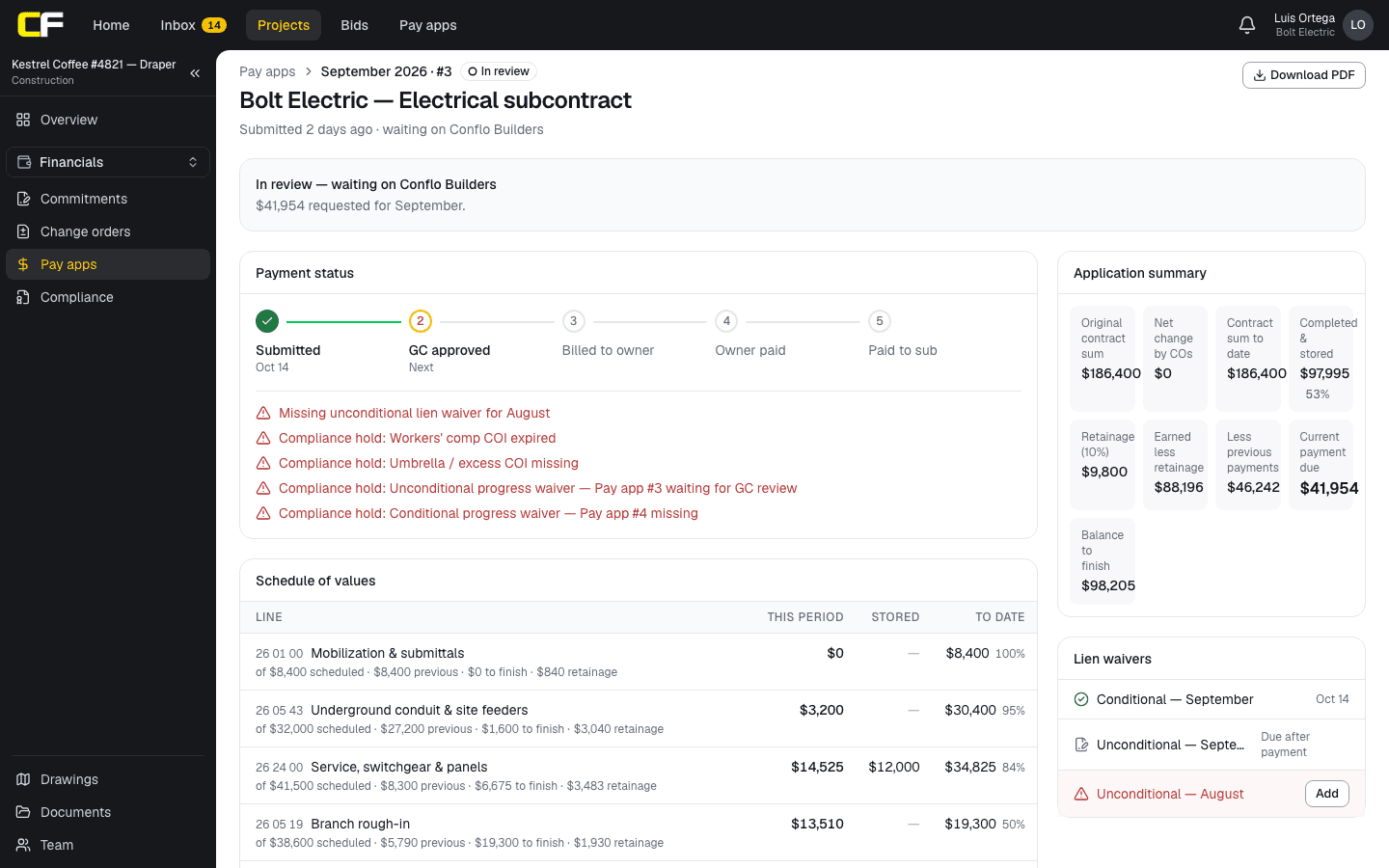
Under contract, you bill monthly in pay apps against your schedule of values: a percent complete this period and a dollar amount of materials stored for each line, with retainage calculated at the contract's rate and no line billed past 100%. The GC approves it or sends back the lines that are wrong with a note. Billing is by percent this period, so convert your measured quantity: if 34,000 of 40,000 cubic yards (85%) are in place and earlier pay apps billed 60% of the line, enter 25%. The form shows the previous and to-date percent beside each line.
The bottom line
Split the bid by system, give unit prices for the ground you can't see, price haul from loose volume and trench protection as real cost, and give written notice before disturbing anything that differs from the documents. Bill each line by measured quantity, with tickets behind it.
Subcontractors invited by a GC use Conflo free. Join the waitlist to bid and bill your next site job in it, and see the subcontractor's guide for the rest.
Sources
- FAR 52.211-18, Variation in Estimated Quantity — Acquisition.gov (General Services Administration). Read October 22, 2026.
- FAR 52.236-2, Differing Site Conditions — Acquisition.gov (General Services Administration). Read October 22, 2026.
- 29 CFR 1926.652, Requirements for protective systems — eCFR (Office of the Federal Register). Read October 22, 2026.
- 29 CFR 1926.651, Specific excavation requirements — eCFR (Office of the Federal Register). Read October 22, 2026.
Questions
Should an earthwork sub bid lump sum or unit price?
On private commercial work for a GC, usually lump sum split by system, with unit prices for rock, unsuitable soil and import. Public work is often bid entirely by unit price on the owner's bid schedule.
What should a rock clause in a sitework bid say?
How rock is defined (for example by the equipment that can't remove it), how it is measured, the price per cubic yard in mass excavation and in trench, and that the GC is notified before the rock is removed so the quantity can be verified.
How do you price haul for earthwork?
Convert the bank volume to loose volume with the swell factor for your soil, divide by the truck's capacity to get loads, and multiply by your trucker's rate per load or per hour, including the haul distance and dump fees.
How does an earthwork sub bill a pay app?
Against a schedule of values by system. Measure the quantity installed on each line, divide by the line's quantity to get percent complete, add stored pipe and precast if the subcontract allows it, and keep load tickets as backup.
Related
Construction
What Does OSHA Require for Trench Safety?
OSHA trench rules from Subpart P: the 5-foot rule and its exceptions, soil types, sloping, shoring and trench boxes, daily inspections, a worked trench.
· 8 min read
Bidding
How Concrete Subs Bid and Bill Commercial Work
How a concrete subcontractor bids and bills commercial work: lump sum vs unit prices, the testing before and after each pour, and a worked pay app.
· 7 min read
Money
How Does a Subcontractor Fill Out a Pay Application?
A subcontractor's pay app bills percent complete and stored materials per schedule-of-values line, less retainage and prior payments, with a lien waiver.
· 9 min read
Role hub
The Subcontractor's Guide: Bidding to Getting Paid
Every step of a commercial job from the subcontractor's seat: bidding, the subcontract, submittals, RFIs, change orders, pay apps, retainage and closeout.
· 9 min read