
What Do You Do After a Failed Building Inspection?
By Wyatt Cooper · Published · 7 min read
Key takeaways
- A failed inspection means the inspector found items that don't meet the code or the approved plans; the work usually can't be covered or move past that point until they are corrected and reinspected.
- Split the correction notice item by item and give each one to the trade responsible, with a date before the reinspection.
- Ask the inspector or the architect at once if an item looks like a design problem rather than an installation problem; that is a different fix and may be a change.
- Reinspect only when every item is done and checked by your own people, because a second failure on the same items often costs a reinspection fee and another lost day.
After a failed building inspection, get the inspector's correction notice and go through it item by item on site. Assign each item to the trade responsible with a due date, stop any work that would cover it, and flag any item that looks like a design issue to the architect. When every item is fixed, check it yourself, photograph it, and only then request the reinspection. Log the failure, the corrections and the new date.
What a failed inspection means
A building inspector checks the work against the code and the permitted plans. The City of Los Angeles Bureau of Engineering's procedure for Building and Safety inspections is clear about the scope: the building inspector "does not inspect for compliance with the plans and specifications" of the contract, but for compliance with the code for the permitted work. When work fails, the inspector issues a correction notice listing what must change.
Results come in three kinds. A pass lets the work proceed. A partial pass lets some of it proceed and lists corrections for the rest. A failure holds the work at that point. Either of the last two leaves a correction list that has to be cleared before the next step: closing the wall, pouring the slab, or the final sign-off.
The owner's own inspectors work the same way. On Los Angeles public works, a Notice of Non-Compliance tells the contractor the work "has not been acceptably completed and payment may not be made for this Work until corrections, acceptable to the Inspector, have been made" (procedure 17.6). On federal jobs, FAR 52.246-12 has the contractor "without charge, replace or correct work found by the Government not to conform to contract requirements".
The steps after the inspector leaves
- Get the correction notice in writing before the inspector leaves, and walk each item with them if you can. Ask what will satisfy each one.
- Stop any work that would cover a failed item: insulation over a failed rough-in, a pour over failed rebar.
- Split the notice by trade. Each item goes to the sub whose work it is, in writing, with a date before the reinspection you plan to book.
- Sort out design items the same day. Los Angeles has the contractor notify the construction manager if it believes corrections "are due to design flaws rather than deficiencies in the installation, material or construction". Send an RFI to the architect, since a design fix may change the work.
- Check each fix yourself and photograph it, item by item, before calling the inspector back.
- Book the reinspection with the notice and the corrections ready to show.
- Update the schedule and tell the owner if the failure moves a milestone. It belongs in the weekly owner update.
- 1InspectorFails the inspection and issues a correction notice
- 2GC superintendentSplits the notice by trade, holds covering work, logs the result
- 3SubcontractorsCorrect their items and report them done
- 4GC superintendentChecks and photographs every correction
- 5InspectorReinspects the corrected items and passes them
A worked example: a failed framing inspection
On a made-up job, the city fails the level 2 framing inspection with four corrections. The superintendent turns the notice into an assignment list the same afternoon.
Framing inspection, level 2 — Failed April 15 — Alder Street Medical Office
- 1. Missing hold-down at shear wall line 4
- Framing sub. Install per detail 7/S-401. Due April 16.
- 2. Fire blocking missing at the corridor soffit
- Framing sub. Due April 16.
- 3. Notched stud at the plumbing wall, room 205, over the limit
- Plumbing sub to reroute; framing sub to replace the stud. Due April 17.
- 4. Header at door 212 smaller than the plan
- Possible design conflict: plan and schedule disagree. RFI 024 to the architect April 15.
- Held
- No insulation or drywall on level 2 until reinspection
- Reinspection
- Request for April 18 once items 1–3 are checked and item 4 is answered
- Schedule
- Drywall start moves from April 17 to April 20 at the earliest; float on level 2 finishes covers it
Item 4 is why the superintendent reads every item instead of passing the notice straight to the framer. If the plans themselves are wrong, the fix is the architect's to give, and any added cost is a change.
Reinspection fees and repeat failures
Many building departments charge for reinspections caused by the builder. The City of San Ramon, California, charges a reinspection fee for "failing your inspection for the same correction item(s) at two or more separate inspections", for not showing up, and for not being ready. On federal work, FAR 52.246-12 lets the government charge the contractor any additional cost of inspection "when prior rejection makes reinspection or retest necessary".
| Cause | Prevention |
|---|---|
| An item wasn't fixed, or was fixed wrong | Check each correction yourself against the notice before booking |
| The inspector wasn't told what changed | Have the notice and photos of each correction ready on site |
| Work wasn't ready or access was blocked | Clear the area, set ladders and lights, and have someone there to walk it |
| New work covered a failed item | Hold covering work in writing until the item passes |
| The design question was never answered | Get the architect's answer before booking |
Keep the item open until it is really closed. Connecticut's construction administration manual has its construction administrator follow up "to be certain the issue isn't simply reported on and the need for resolution overlooked", and work reported as deficient stays open until the corrective work is done or an approved alternate is issued.
Common mistakes
- Forwarding the whole notice to one sub. Split it, so each trade owns its items.
- Calling for reinspection to "see if it's good enough now". Every failed visit costs a day and often a fee.
- Covering work before it passes. Uncovering is slower than waiting.
- Not logging it. The failure, the corrections and the new date belong in the daily log; they explain a slip later.
- Treating a design problem as an installation problem, and paying a sub to rebuild what the plans got wrong.
How it works in Conflo
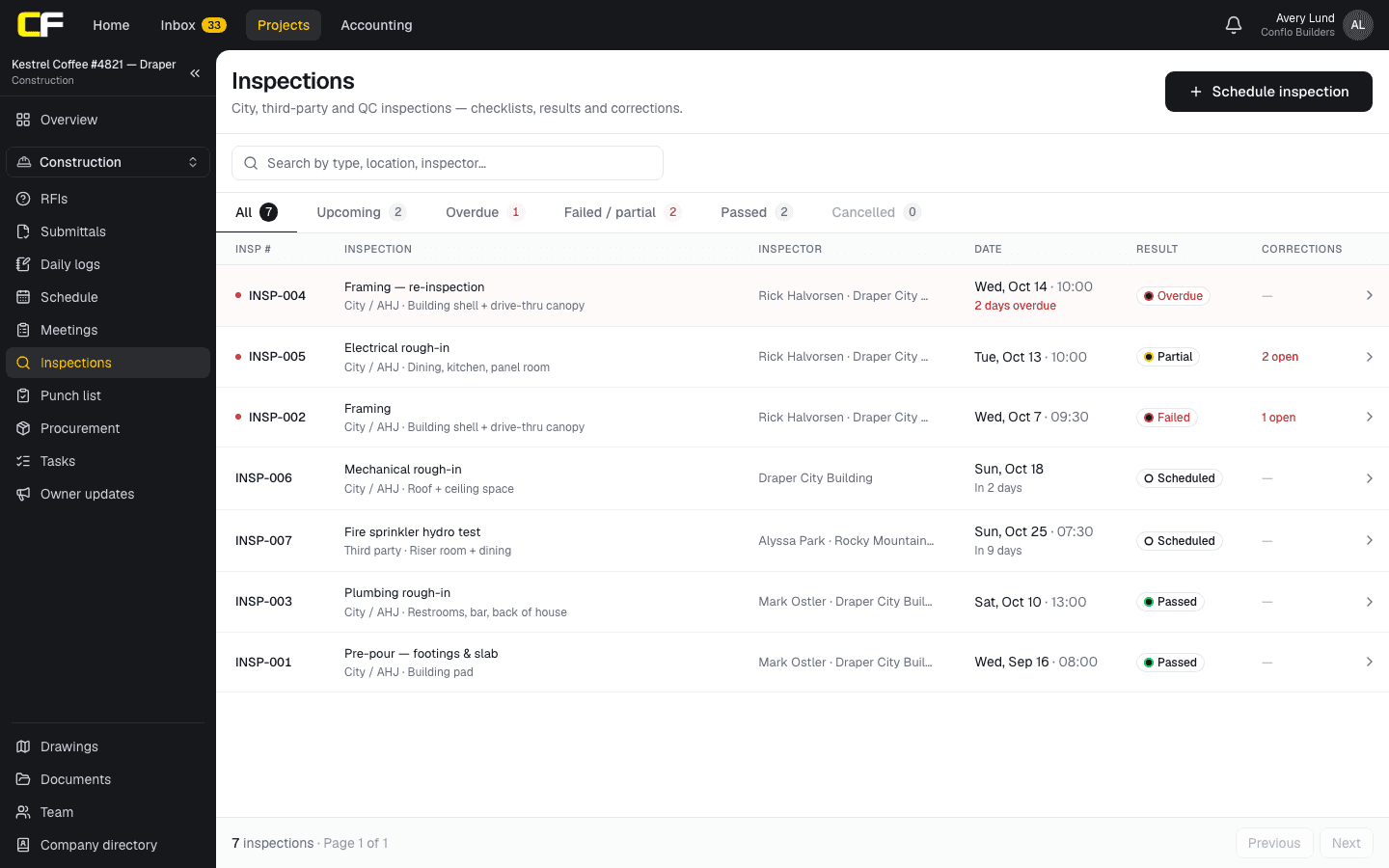
In Conflo's inspections tool, you schedule a city, third-party or internal QC inspection from a checklist template (framing, rough-ins, pre-pour, fire sprinkler and alarm, final building) or a blank one, and mark each item pass, fail or N/A with a note. Conflo suggests passed, partial or failed from the items, and the inspector's call can override it; the record keeps both.
When the inspection is recorded, each failed item becomes a follow-up for the person the superintendent picks to fix it (the checklist shows each item's trade as a guide), and anyone at that person's company can mark it resolved. You then book a re-inspection containing only the failed items, linked to the original both ways.
The bottom line
A failed inspection is a correction list, not a verdict. Split it by trade, hold any work that would cover a failed item, send design questions to the architect the same day, check every fix yourself, and only then book the reinspection.
If correction notices get lost between the superintendent and the subs, let each failed item become a follow-up for the trade that owns it.
Sources
- Project Delivery Manual, 17.11 Inspection by the Department of Building and Safety — City of Los Angeles, Bureau of Engineering. Read October 22, 2026.
- Project Delivery Manual, 17.6 Notices of Non-Compliance and Work Stoppage — City of Los Angeles, Bureau of Engineering. Read October 22, 2026.
- FAR 52.246-12, Inspection of Construction — Acquisition.gov, U.S. General Services Administration. Read October 22, 2026.
- Reinspection Fee — City of San Ramon, California, Building and Safety Services. Read October 22, 2026.
- 0600 Construction Administration Procedures Manual, §2.4 (inspection of the work) — State of Connecticut Department of Administrative Services. Read October 22, 2026.
Questions
What happens when a building inspection fails?
The inspector issues a correction notice listing what doesn't meet the code or the permitted plans. The work usually can't be covered or go past that point until the items are corrected and a reinspection passes.
Is there a fee for a reinspection?
Often, when the failure is the builder's. San Ramon, California, for example, charges one for failing on the same correction items at two or more inspections, for no-shows and for not being ready. Check your building department's fee schedule.
Who pays to fix work that fails inspection?
Usually whoever did the work, under their contract. If the failure comes from the design, the fix is the architect's to give and its cost may be a change to the contract.
What is a partial inspection result?
Some items passed and some failed. The passed work can proceed, while the failed items stay open until they are corrected and reinspected.
How soon can you request a reinspection?
As soon as every correction is done and checked, under your building department's scheduling rules. Booking before the work is ready risks a second failure and a fee.
Related
Construction
How to Write a Construction Daily Log (With Example)
How to write a construction daily log: what to record each day, a filled-in example, and the habits that make a log hold up in a delay claim.
· 6 min read
Construction
How to Write an RFI in Construction (With an Example)
How to write an RFI in construction: the parts of a good request for information, a filled-in example, common mistakes, and how the RFI log works.
· 9 min read
Role hub
The General Contractor's Guide: Bid to Closeout
What a general contractor is responsible for at every phase of a commercial job, from bidding and buyout to RFIs, change orders, pay apps and closeout.
· 8 min read
Closeout
How Do You Build a Punch List?
Build a punch list by walking the job room by room before substantial completion, logging each item with location, trade, photo and due date. With example.
· 9 min read