
How Do You Document a Weather Delay?
By Wyatt Cooper · Published · 8 min read
Key takeaways
- Rain alone doesn't earn a time extension: most contracts grant time only for weather that was abnormal for the place and season and that delayed work on the critical path.
- Document each weather day the same day in the daily log: conditions with times, the work that stopped, the crews sent home and the hours lost.
- Compare the month's actual weather days to what the contract or the climate normals say to expect, and claim only the days beyond that.
- Give written notice within the contract's deadline, even before you know how many days you'll ask for; the record supports the request, the notice preserves it.
To document a weather delay, record on that day's daily log the weather with times, the work stopped and where, the crews and hours lost, and the scheduled activity it hit. Show that activity was on the critical path. Compare the month's weather days with what the contract or NOAA's climate normals say to expect, and claim only the excess. Give written notice within the contract's deadline and attach the logs.
What makes a weather day count
Contracts expect some bad weather. The federal default clause, FAR 52.249-10, lists "unusually severe weather" among the causes that excuse a late finish, and only if the contractor notifies the contracting officer in writing of the causes of delay "within 10 days from the beginning of any delay (unless extended by the Contracting Officer)". The AIA's summary of A201–2017 notes that adverse weather conditions "as set forth in Section 15.1.6.2 may entitle the Contractor to an extension of the Contract Time".
Read together, most contracts ask the same three questions of a weather day:
| Test | The question | The record that answers it |
|---|---|---|
| Abnormal | Was the weather worse than normally expected here, this month? | The contract's expected weather days, or NOAA climate normals, against the month's logged weather days |
| It stopped work | Did it actually stop or slow the work that day? | The daily log: conditions with times, work stopped, crews sent home, hours lost |
| Critical | Did the stopped work hold up the completion date? | The schedule: the activity was on the critical path, or the delay consumed all its float |
The City of Los Angeles Bureau of Engineering's delay procedure makes the last test plain: "inclement weather may not necessarily impact the work if, for example, a project's current critical path is on interior work." A rainy day during drywall is not a delay to the job. More on how the path works is in what is the critical path.
Write it on the daily log the same day
The day's record is what everything later rests on. The daily log post covers the whole log; for a weather day, these lines carry the claim:
- Conditions with times and amounts: "Rain from 6:40 AM to 2:15 PM, 1.1 inches at the site gauge; standing water in the north excavation."
- The scheduled work and what happened to it: "Footings F-12 to F-18 pour canceled; concrete order canceled at 6:50 AM."
- Crews and hours: who was sent home, who worked elsewhere, the hours lost.
- Lingering effects on the next day: "Excavation pumped out 7:00 to 10:30 AM; pour rescheduled." A day the site was too wet to work can count if the log says so; check your contract.
- Photos with the time on them.
Log the days the weather didn't stop work too. A month of clean entries is what shows the bad days were different.
Compare the month with normal weather
Many contracts state how many weather days to expect each month, and the schedule must carry them already. The federal scheduling spec, UFGS 01 32 01.00 10, has the contractor account for anticipated adverse weather in the project schedule, preferably with a weather calendar. Where the contract gives no table, NOAA's U.S. Climate Normals give 1991–2020 averages for thousands of stations, including numbers of days with precipitation. Use the station nearest the job and say which one you used.
Here is the arithmetic on a made-up job whose contract expects six weather days in March. The job logs ten days in March when rain stopped work. Two of those were on interior work and don't count. That leaves eight days that stopped critical-path work. Eight minus the six expected is two days of extension.
Request for time extension — weather, March — Alder Street Medical Office
- Contract
- Expected weather days for March: 6 (specification section 01 32 16, made up)
- Days rain stopped work (daily logs)
- March 3, 4, 9, 10, 16, 17, 18, 24, 25, 30: 10 days
- Not on the critical path
- March 24 and 25: crews were on interior framing, unaffected
- Days that stopped critical work
- 10 − 2 = 8 days (footings and foundation walls)
- Days beyond the expected 6
- 8 − 6 = 2 days
- Notice
- Written notice of weather delay sent March 4, 10, 17 and 30, each within the contract's deadline of that delay's start
- Request
- 2 calendar days added to the contract time; substantial completion moves from September 18 to September 20
- Attached
- Daily logs for the 10 days; the schedule update showing the footings on the critical path; the site rain gauge readings
The request claims two days, not ten. Asking for every rainy day invites a rejection of all of them; asking for the excess, with the logs behind each one, is hard to argue with.
From the weather day to the extension
- 1SuperintendentLogs the weather, the work stopped and the hours lost that day
- 2GC project managerGives written notice within the contract's deadline
- 3GC schedulerShows the stopped work was on the critical path
- 4GC project managerAt month end, compares weather days with what the contract expects and requests the excess
- 5Owner and architectReview and grant the time, usually by change order
Los Angeles documents every time extension "by change order, even if non-compensatory". A weather extension usually adds time but no money: the contractor gets the days and doesn't owe delay damages, but isn't paid for them either. The extension updates the schedule; see how to read a construction schedule.
Common mistakes
- "Rained out" with no times, amounts or crews. A log that doesn't say what stopped can't support a day.
- Claiming every rainy day, including days the critical path was indoors.
- Waiting until month end to give notice. The notice deadline usually runs from the start of the delay.
- Forgetting the days after the rain. If the site was too wet to work, log it as a weather day and say why.
- Not passing it down. A sub's weather days reach the owner only through the GC; see how a subcontractor writes a notice of delay.
How it works in Conflo
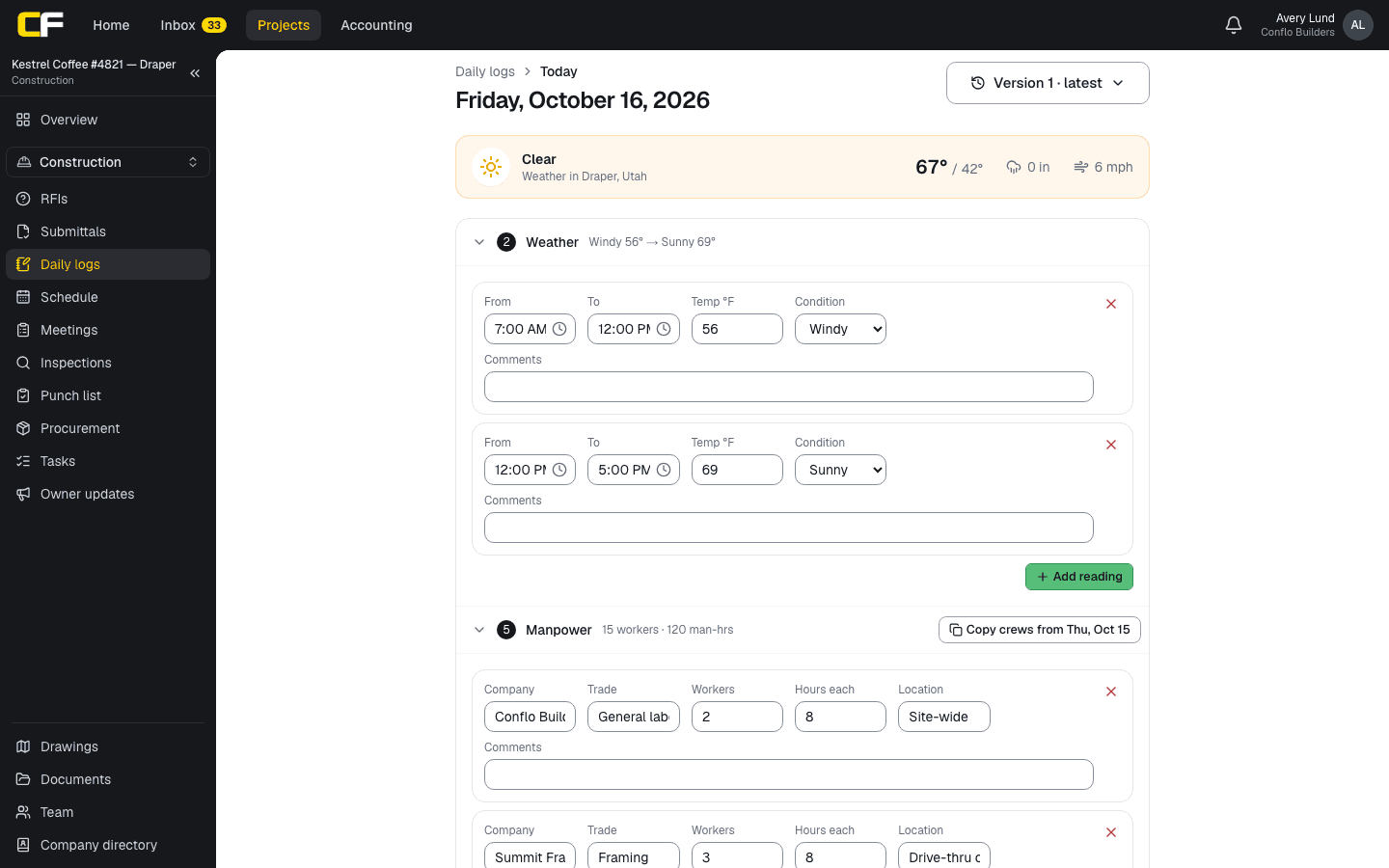
In Conflo's daily logs, each day's log fills in the day's weather from the job's address, and you add readings for what the crew saw through the day: time, temperature and conditions. Each delay is recorded with its cause (Weather is one choice), start and end times, hours lost, location and who is responsible, and delays are counted on each day's row of the calendar.
The log stays editable and keeps every sitting as a numbered version with who edited it and when, so the record of a weather day shows when each part was written. The weekly owner update counts the days that week with a weather delay logged.
The bottom line
A weather delay is documented on the day it happens: conditions with times, the work and crews it stopped, and the hours lost. It earns time when the stopped work was on the critical path and the month's weather days exceed what the contract expects, and only if notice went out on time.
If your weather days live in a superintendent's notebook, put them on a daily log that records the cause and hours lost every time.
Sources
- FAR 52.249-10, Default (Fixed-Price Construction) — Acquisition.gov, U.S. General Services Administration. Read October 22, 2026.
- U.S. Climate Normals — NOAA National Centers for Environmental Information. Read October 22, 2026.
- Project Delivery Manual, 18.4 Analyzing Delays/Granting Time Extensions — City of Los Angeles, Bureau of Engineering. Read October 22, 2026.
- UFGS 01 32 01.00 10, Project Schedule (August 2026), §3.3.9 Adverse Weather — U.S. Army Corps of Engineers (Whole Building Design Guide). Read October 22, 2026.
- Summary: A201–2017, General Conditions of the Contract for Construction — AIA Contract Documents. Read October 22, 2026.
Questions
Do you get a time extension for every rain day?
Usually not. Most contracts expect normal weather and grant time only for weather that was unusually severe or abnormal for the place and season, that actually stopped work, and that delayed the critical path.
What should a daily log say on a weather day?
The conditions with times and amounts, the scheduled work that stopped and where, the crews sent home or moved and the hours lost, any effects carried into the next day, and time-stamped photos.
How do you prove weather was abnormal?
Compare the month's logged weather days with the number the contract says to expect. If the contract has none, use NOAA's climate normals for the nearest station, name the station, and claim only the days beyond normal.
Do weather delays get paid?
Usually not. A weather delay is normally excusable but not compensable: the contractor gets more time and avoids delay damages, but no added money. Check your contract's terms.
When do you have to give notice of a weather delay?
Within your contract's deadline, which often runs from the start of the delay. Under FAR 52.249-10 it is 10 days from the beginning of the delay unless the contracting officer extends it.
Related
Construction
How to Write a Construction Daily Log (With Example)
How to write a construction daily log: what to record each day, a filled-in example, and the habits that make a log hold up in a delay claim.
· 6 min read
Construction
How Does a Subcontractor Write a Notice of Delay?
How a subcontractor writes a notice of delay to the GC: what to include, when to send it, a sample letter, and why the subcontract's deadline comes first.
· 7 min read
Construction
How Does an Owner Read a Construction Schedule?
How an owner reads a contractor's schedule: the Gantt chart, milestones, the critical path, float, the baseline, and what to ask at each update.
· 6 min read
Definition
What Is the Critical Path in Construction?
The critical path is the longest chain of linked activities in a construction schedule. A worked five-activity example, float, and what a delay does.
· 4 min read
Role hub
The General Contractor's Guide: Bid to Closeout
What a general contractor is responsible for at every phase of a commercial job, from bidding and buyout to RFIs, change orders, pay apps and closeout.
· 8 min read