
How Do You Fill Out a Conditional Lien Waiver?
By Wyatt Cooper · Published · 8 min read
Key takeaways
- Use your state's statutory form where there is one: California and Texas make a waiver unenforceable unless it substantially follows the form in the statute.
- The amount and through date come straight from your pay application: the current payment due and the end of the billing period.
- List every exception you keep, such as retention, unpaid extras and earlier progress payments you waived conditionally but were not paid.
- A conditional waiver releases rights only when the stated check is paid by the bank, so it is the one to send with the pay app; the unconditional one waits until the money clears.
To fill out a conditional lien waiver, use your state's form if it has one, then enter your company as claimant, the party that pays you as customer, the job location and owner, and a through date matching the pay app's period end. Enter the check's maker, the amount (the pay app's current payment due) and payee, then list exceptions: retention, unpaid extras and earlier unpaid progress payments. Sign, title and date it. Check your state's law.
Start with the right form for the project's state
A conditional lien waiver says: once I receive this payment, I give up my lien and payment-bond rights for the work it covers. Several states write the form into statute, and a homemade version can fail. Use the form for the state where the project is, not where your office is.
- California. A conditional progress waiver "shall be null, void, and unenforceable unless it is in substantially the following form," and the form is set out in Civil Code § 8132. A waiver releases the owner, lender or surety only if it is in substantially the statutory form, signed, and, for a conditional release, there is evidence of payment (§ 8124). Any other statement purporting to waive a lien is void unless you were actually paid in full (§ 8126).
- Texas. The conditional waiver and release on progress payment must read as set out in Property Code § 53.284(b), and a waiver that does not substantially comply with the applicable form is unenforceable (§ 53.284(a)).
- Florida. The statute gives progress and final forms that a waiver "may be in substantially the following form" (Fla. Stat. § 713.20(4) and (5)), and bars anyone from requiring a lienor to sign a different form: "A person may not require a lienor to furnish a lien waiver or release of lien that is different from the forms in subsection (4) or subsection (5)" (§ 713.20(6)).
- Other states. Many leave the form to the parties. Where there is no statute, use the form your contract requires and read every line.
What each field on a California conditional progress waiver means
| Field | What to enter | Where it comes from |
|---|---|---|
| Name of Claimant | Your company's legal name | Your subcontract |
| Name of Customer | The party that pays you, usually the GC (or the sub above you) | Your subcontract |
| Job Location | The project's street address or legal description | The contract or the GC's notice |
| Owner | The property owner, not the GC | The prime contract, notice of commencement or the GC |
| Through Date | The last day of work covered, usually the pay period's end | The pay application's period |
| Maker of Check | Who signs the check, usually the GC | The GC |
| Amount of Check | The payment you expect for this pay app | The pay app's current payment due |
| Check Payable to | You, or you and another payee on a joint check | The GC |
| Exceptions | Retention; extras not yet paid; earlier progress payments waived conditionally but unpaid (dates and amounts); contract rights | Your pay app history and change order log |
| Signature, title, date | An authorized officer's signature and title, and the date signed | Your company |
The California form keeps four exceptions written into it: retentions, extras you have not been paid for, listed earlier progress payments you waived conditionally but were not paid, and contract rights. It also waives rights for work done under a written change order fully executed before you sign, unless you list it as an exception, so list any signed change order you have not yet billed or been paid for.
Worked example: a September progress waiver
A fictional plumbing subcontractor, "Lakeshore Plumbing Co.", bills its September pay app on a fictional private clinic, the "Harbor Point Clinic", in California. Its subcontract holds 5% retention. To date it has completed $186,400.00 of work; the previous applications covered $138,500.00 of work, and it has been paid for them.
| Line | Amount |
|---|---|
| A. Completed and stored to date | $186,400.00 |
| B. Retention at 5% (A × 5%) | $9,320.00 |
| C. Earned less retention (A − B) | $177,080.00 |
| D. Previous payments ($138,500.00 × 95%) | $131,575.00 |
| E. Current payment due (C − D) | $45,505.00 |
Conditional Waiver and Release on Progress Payment
- Name of Claimant
- Lakeshore Plumbing Co.
- Name of Customer
- Redwood Point Builders
- Job Location
- Harbor Point Clinic site, Harbor Point (fictional)
- Owner
- Harbor Point Medical Properties LLC
- Through Date
- September 30, 2026
- Maker of Check
- Redwood Point Builders
- Amount of Check
- $45,505.00
- Check Payable to
- Lakeshore Plumbing Co.
- Exceptions
- (1) Retentions: $9,320.00 held to date. (2) Extras not paid: change order 3, $6,240.00, signed September 22 and not yet billed. (3) Earlier unpaid progress payments: none. (4) Contract rights.
- Signature
- Signed by an authorized officer, title and date of signature
The figures: 5% of $186,400.00 is $9,320.00; $186,400.00 − $9,320.00 = $177,080.00; previous payments are $138,500.00 less 5% retention, $131,575.00; and $177,080.00 − $131,575.00 = $45,505.00, the amount on the waiver. Once the GC's check for $45,505.00 clears, Lakeshore signs the unconditional progress waiver for the same amount and date, usually with its October pay app.
Compare the two kinds side by side in conditional vs unconditional lien waivers, and see how to fill out the pay application itself.
Mistakes that cost subs money
- Signing an unconditional waiver before payment clears. California's unconditional form warns it is enforceable even if you have not been paid.
- A through date later than the period billed. It can release work you have not billed yet.
- Leaving retention or signed change orders out of the exceptions.
- An amount that does not match the pay app. If the GC pays less, the waiver may not match the payment; send a corrected one.
- Extra release language added by the GC. In California and Texas, a waiver must substantially follow the statute; ask an attorney about anything added.
A waiver is a release of the rights a mechanic's lien protects, and some statutes, such as Texas Property Code § 53.283, bar requiring an unconditional waiver for money not yet received.
How it works in Conflo
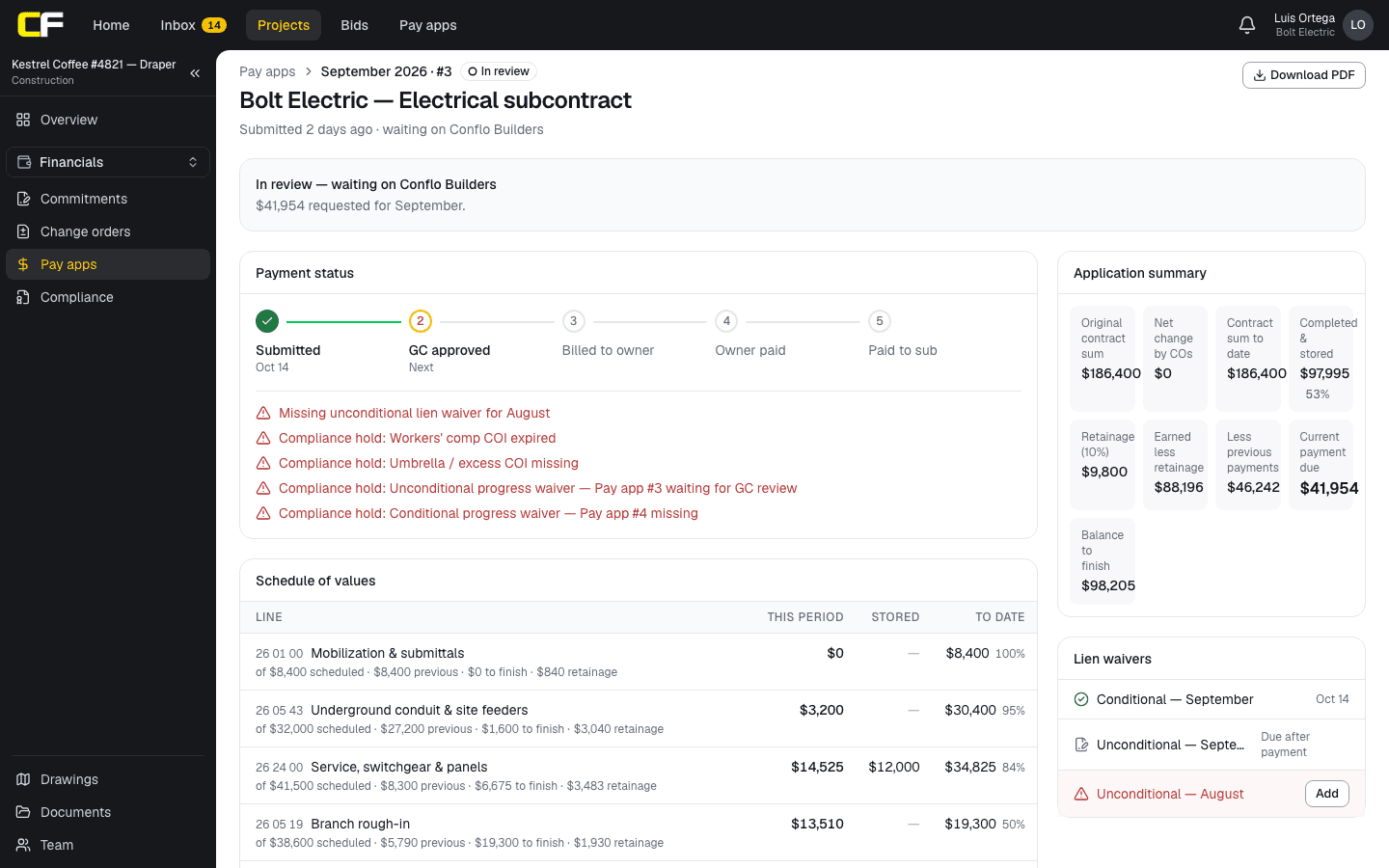
On Conflo's pay applications, a sub submitting a pay app can include its conditional lien waiver for that month with one checkbox, using the waiver on file with its signature. The GC cannot release payment until the conditional waiver for this period and the unconditional waiver for the sub's last payment are recorded, and an unconditional waiver can only be added after that payment is recorded. Missing waivers show by name on the pay app. Compliance tracks lien waivers by type (conditional or unconditional, progress or final) against a commitment and pay app.
Not built: Conflo does not fill out or generate your state's statutory waiver form; it records which waivers are in and when.
The bottom line
A conditional waiver is a pay app in another form: the same amount, the same through date and an honest list of what is still owed. Get those three right on your state's form and the waiver protects you until the money clears.
Before your next pay app, find the statutory form for the project's state, fill it from the pay app's current payment due and period end, and list retention and unpaid change orders as exceptions.
Sources
- California Civil Code § 8132, Conditional waiver and release on progress payment — California Legislative Information. Read October 17, 2026.
- California Civil Code § 8124 — California Legislative Information. Read October 17, 2026.
- California Civil Code § 8126 — California Legislative Information. Read October 17, 2026.
- Texas Property Code Chapter 53, Subchapter L, Waiver and Release of Lien or Payment Bond Claim — Texas Legislature. Read October 16, 2026.
- Florida Statutes Chapter 713 (2026), Liens — The Florida Senate. Read October 16, 2026.
Questions
What amount goes on a conditional lien waiver?
The payment you expect for the period, which is usually the current payment due on your pay application: work completed to date, less retention, less previous payments. If the GC will pay a different amount, the waiver should match the actual check.
What is the through date on a lien waiver?
The last day of work the waiver covers, usually the end of the pay app's billing period. A later date can waive rights for work you have not billed, so match it to the period.
Do I list retention as an exception?
Yes. California's progress forms list retentions as an exception, and the Texas progress forms except unpaid retention. On other forms, write it in.
Can I use my own lien waiver form?
Not in states with statutory forms. California and Texas make a waiver unenforceable unless it substantially follows the statute's form. Elsewhere, the contract usually names the form.
When do I sign the unconditional waiver?
After the payment the conditional waiver named has cleared your bank. Texas bars requiring an unconditional waiver for an amount you have not received.
Related
Definition
Conditional vs Unconditional Lien Waiver
A conditional lien waiver takes effect only when payment clears; an unconditional one takes effect when signed. The difference, side by side, from statute.
· 3 min read
Money
How Does a Subcontractor Fill Out a Pay Application?
A subcontractor's pay app bills percent complete and stored materials per schedule-of-values line, less retainage and prior payments, with a lien waiver.
· 9 min read
Definition
What Is a Mechanic's Lien?
A mechanic's lien is a legal claim against a property by someone who improved it and was not paid. Who can file one, how it works, and what it is not.
· 3 min read
Money
How Can a Subcontractor Get Paid Faster?
Subcontractors get paid faster by billing on the GC's cutoff, sending clean pay apps and waivers, and using the prompt-pay dates that start the clock.
· 6 min read
Role hub
The Subcontractor's Guide: Bidding to Getting Paid
Every step of a commercial job from the subcontractor's seat: bidding, the subcontract, submittals, RFIs, change orders, pay apps, retainage and closeout.
· 9 min read