
The Construction Project Lifecycle: Bid to Closeout
By Wyatt Cooper · Published · 7 min read
Key takeaways
- A construction project runs through planning, design, bidding and award, preconstruction, construction, and closeout, then a warranty period.
- Every phase has a job for each party: the owner decides and pays, the design team designs and administers, the general contractor builds and coordinates, and subcontractors build their trades.
- Each phase produces what the next one runs on: the design becomes the bid documents, the bids become the budget and subcontracts, and the subcontracts set how changes, billing and closeout work.
- Substantial completion and final completion are separate milestones, and money, warranties and risk change hands at each.
A construction project moves through six phases: planning, where the owner sets the need, budget and team; design, from schematic design to construction documents; bidding and award; preconstruction and buyout; construction, with RFIs, submittals, changes and monthly pay applications; and closeout, from the punch list and substantial completion to the closeout package and final payment. A warranty period follows. Each phase has a different job for the owner, the design team, the general contractor and the subcontractors.
The phases at a glance, and who does what
Project delivery methods move these phases around (design-build overlaps design and construction; construction manager at risk brings the builder in during design), but the work in each phase is the same. The table is the map; each section below takes one phase and links the guides for it.
| Phase | Owner | Architect and engineers | General contractor | Subcontractors |
|---|---|---|---|---|
| Planning | Defines the need, budget, site and schedule; hires the team | Helps define the program | On negotiated work, advises on cost and schedule | Rarely involved |
| Design | Approves each design stage and the budget | Schematic design, design development, construction documents | On CM or design-build, prices and reviews constructability | Design-assist trades may advise |
| Bidding and award | Chooses the contractor and signs the contract | Answers bidders' questions, issues addenda | Prices the work, invites and levels sub bids | Bid their trades |
| Preconstruction and buyout | Provides the site, permits and financing | Reviews submittals | Signs subcontracts, plans submittals and the schedule | Sign subcontracts, submit, mobilize |
| Construction | Approves changes and pay applications | Answers RFIs, reviews submittals, observes the work, certifies payment | Runs the field, manages changes, bills the owner, pays subs | Build their scope, ask RFIs, bill monthly |
| Closeout | Accepts the work, makes final payment | Inspects for substantial completion, certifies it | Runs the punch list, delivers the closeout package | Fix punch items, turn in closeout documents |
| Warranty | Reports defects | Advises on disputed defects | Corrects warranty items | Correct their warranty items |
Planning: the owner sets the need, the budget and the team
Every project starts with the owner: what is needed, where, by when, and for how much. The owner chooses the delivery method (design-bid-build, construction manager at risk, design-build), which decides when the builder joins and who holds the design risk, and hires the architect, and on negotiated work, the builder. Owners: see the owner solutions page.
The delivery method decides who carries what. In design-bid-build, the owner holds separate contracts with the designer and the builder, and builders price a finished design. In construction manager at risk, the builder joins during design to advise on cost and schedule, then contracts to build, often for a guaranteed maximum price. In design-build, one contract covers both design and construction. Whatever the method, the owner sets the budget, including a contingency for changes, and secures the site, the financing and the approvals only an owner can get.
Design: from schematic design to construction documents
The design team turns the program into drawings and specifications in stages. The AIA's standard owner–architect agreement divides the architect's basic services into five phases: "Schematic Design, Design Development, Construction Documents, Procurement, and Construction" (AIA B101-2017 summary). Each design stage ends with an owner approval and, ideally, a cost check, because every later change costs more than the one before it.
The construction documents (drawings, specifications and the contract forms) are what everyone else will bid on, build from and argue about. Architects and engineers: see the design team solutions page.
Bidding and award: pricing the documents
In bidding, general contractors price the construction documents, and to do it they break the work into trade packages and get bids from subcontractors. The architect answers questions and issues addenda so every bidder prices the same thing. The GC compares sub bids on the same scope before it carries a number, then the owner awards the contract.
Guides: how to level subcontractor bids and every bidding article. Subcontractors bidding to GCs: start with the subcontractor's guide.
Preconstruction and buyout: contracts, submittals and the schedule
After the award, the GC buys out the job: it awards each trade and signs subcontracts that match the leveled scope, and the budget becomes commitments. It builds the submittal register and the schedule, collects insurance and compliance documents, and subs submit their product data and shop drawings for approval before they buy. This is also when the closeout list should be written into every subcontract. The whole GC side of it is in the general contractor's guide, and every piece on this phase, from the schedule of values to the submittal log and buyout, is in the preconstruction guides.
Construction: the field, the changes and the money
Construction is the longest phase and the one with the most records. Questions go in RFIs, product approvals in submittals, the day's work in daily logs, and every change of scope, price or time in a change order. Each month subs bill the GC, the GC bills the owner, the architect certifies the payment, and the owner pays, less retainage.
- Questions and answers: how to write an RFI, and every construction article.
- Changes: how to price a change order.
- Billing: how a subcontractor fills out a pay application and how to calculate retainage, with every money article.
Closeout: punch list, substantial completion and final payment
Closeout begins before the building is finished. The GC punches each area as it completes; when the work is ready, the architect inspects for substantial completion, which AIA A201-2017 Section 9.8.1 defines as the stage when the work is "sufficiently complete in accordance with the Contract Documents so that the Owner can occupy or utilize the Work for its intended use" (AIA Contract Documents). The certificate records the date, attaches the punch list, and on AIA documents starts the warranties unless it says otherwise (AIA's G704 summary). Public owners run the same steps; Alaska DOT&PF's construction manual moves from a preliminary punch list to a final inspection to a letter of project completion.
Then the punch list closes, the GC delivers the closeout package (record drawings, O&M manuals, warranties, attic stock, training, test reports, final lien waivers), and the owner makes final payment. On federal fixed-price construction, withheld retainage beyond what the contracting officer considers adequate protection is released at substantial completion, and final payment follows "completion and acceptance of all work" and a release of claims (FAR 52.232-5); private contracts set their own terms.
- For GCs: how to build a punch list, the free punch list template and how to assemble a closeout package.
- For architects: how an architect decides substantial completion.
- For owners: what an owner should get at closeout.
- Every closeout article.
After closeout: the warranty period
The job is not over at final payment. The contractor's general warranty runs, commonly for one year: on federal construction, one year from final acceptance (FAR 52.246-21); on AIA documents, usually from substantial completion. Manufacturers' and specialty warranties, such as roofing, run longer. Owners should walk the building before the general warranty ends; GCs and subs should answer warranty calls promptly, because the warranty period is the last part of the job the owner remembers.
Every role guide
Role hub
The Owner's Guide to a Commercial Building Project
The owner's role on a commercial building project, phase by phase: delivery method, choosing the contractor, pay apps, change orders and closeout.
· 7 min read
Role hub
The Residential Builder's Guide: Estimate to Warranty
The residential construction process step by step for builders and remodelers: estimate, contract, selections, draws, walkthrough and warranty.
· 8 min read
Role hub
The Architect's Guide to Construction Administration
The construction administration phase from the architect's seat: site visits, RFIs, ASIs, submittals, pay certification, changes and closeout.
· 8 min read
Role hub
The General Contractor's Guide: Bid to Closeout
What a general contractor is responsible for at every phase of a commercial job, from bidding and buyout to RFIs, change orders, pay apps and closeout.
· 8 min read
Role hub
The Subcontractor's Guide: Bidding to Getting Paid
Every step of a commercial job from the subcontractor's seat: bidding, the subcontract, submittals, RFIs, change orders, pay apps, retainage and closeout.
· 9 min read
How it works in Conflo
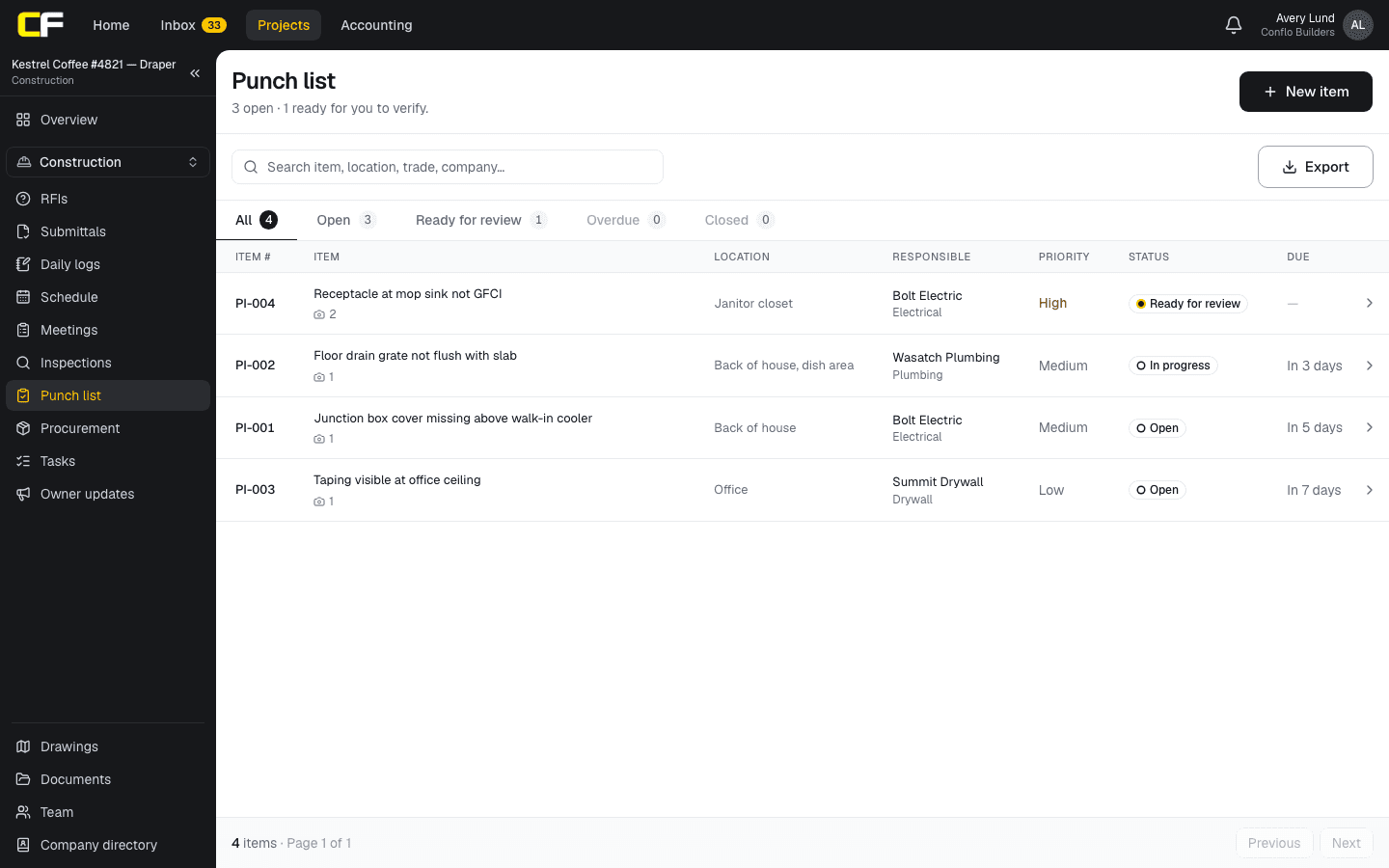
Conflo is one platform for the phases after design: bidding, preconstruction, construction, financials and closeout, with the GC, subs, the owner and the design team on the same project, each seeing what their role allows. It is built for commercial construction today. Subcontractors, owners and architects join free; see pricing.
The bottom line
Every construction project runs the same phases, from the owner's first decision to the last warranty call, and each party has its own job in each one. The handoffs between phases are where time and money are lost.
Find your seat in the role guides below this page and follow the phase you are in.
Sources
- Summary: B101–2017, Standard Form of Agreement Between Owner and Architect — AIA Contract Documents (The American Institute of Architects). Read October 16, 2026.
- The Construction Schedule – Substantial Completion Considerations — AIA Contract Documents (The American Institute of Architects). Read October 16, 2026.
- Summary: G704–2017, Certificate of Substantial Completion — AIA Contract Documents (The American Institute of Architects). Read October 16, 2026.
- Alaska Construction Manual, Chapter 15: Final Field Construction Activities — Alaska Department of Transportation & Public Facilities. Read October 16, 2026.
- FAR 52.232-5, Payments under Fixed-Price Construction Contracts — Acquisition.gov, U.S. General Services Administration. Read October 16, 2026.
- FAR 52.246-21, Warranty of Construction — Acquisition.gov, U.S. General Services Administration. Read October 16, 2026.
Questions
What are the phases of a construction project?
Planning, design (schematic design, design development and construction documents), bidding and award, preconstruction and buyout, construction, and closeout, followed by a warranty period. Delivery methods such as design-build overlap some of them.
What happens in the closeout phase?
The GC runs the punch list, the architect certifies substantial completion, the punch items are finished, the GC delivers the closeout package (record drawings, O&M manuals, warranties and the rest), and the owner makes final payment.
What is the difference between preconstruction and construction?
Preconstruction is the planning between award and mobilization: subcontracts, submittals, the schedule and permits. Construction is the building itself, with its RFIs, changes and monthly billing.
Who manages a construction project?
The owner manages the project overall, the architect administers the construction contract for the owner on most design-bid-build jobs, and the general contractor manages the construction itself and its subcontractors. On some jobs the owner also hires a separate construction manager.
Related
Role hub
The General Contractor's Guide: Bid to Closeout
What a general contractor is responsible for at every phase of a commercial job, from bidding and buyout to RFIs, change orders, pay apps and closeout.
· 8 min read
Role hub
The Subcontractor's Guide: Bidding to Getting Paid
Every step of a commercial job from the subcontractor's seat: bidding, the subcontract, submittals, RFIs, change orders, pay apps, retainage and closeout.
· 9 min read
Role hub
The Owner's Guide to a Commercial Building Project
The owner's role on a commercial building project, phase by phase: delivery method, choosing the contractor, pay apps, change orders and closeout.
· 7 min read
Definition
Design-Bid-Build vs Design-Build vs CM at Risk
Design-bid-build, design-build and CM at risk compared for owners: who holds which contract, when the price is fixed, and when each one fits.
· 4 min read