
What Is an Addendum in Construction?
By Wyatt Cooper · Published · 3 min read
Key takeaways
- An addendum changes or clarifies the bid documents before bids are due, and goes to every bidder at once.
- Addenda are numbered, usually become part of the contract documents, and each bid should acknowledge them by number.
- After the contract is signed, changes come by ASI, change order or change directive, not by addendum.
An addendum is a written change to the bid documents issued before bids are due: it revises drawings, specifications, quantities or the due date, or answers a bidder's question for everyone. Addenda are numbered, sent to every bidder, and usually become part of the contract, and each bid should acknowledge them by number.
How addenda work
Federal sealed bidding sets the model. Changes "in quantity, specifications, delivery schedules, opening dates, etc." or corrections to "a defective or ambiguous invitation" are made by amendment, sent before bid opening "to everyone to whom invitations have been furnished," and information given to one bidder goes to all of them as an amendment if they need it to bid or if lacking it would prejudice them (FAR 14.208). Before issuing one, the contracting officer considers whether to extend the bid date.
Acknowledgment matters. A bid that fails to acknowledge an amendment is excused only if it clearly shows the bidder had it, or if the amendment has "either no effect or merely a negligible effect on price, quantity, quality, or delivery" (FAR 14.405). Otherwise, on federal work, the omission is not a minor informality that can be waived; on private work, the bid may not cover the changed work.
Addendum 2: 26 Electrical
- Issued
- March 6, to all five invited bidders
- Item 1
- Sheet E2.1 revised: four added receptacles in Exam 3
- Item 2
- Answer to bidder question: fire alarm is in this package (Division 28)
- Bid date
- Unchanged: March 10, 2:00 p.m.
- Acknowledge
- List Addendum 2 on the bid form
Addendum vs. ASI vs. change order
| Document | When | Changes price or time? |
|---|---|---|
| Addendum | Before bids are due | The bids include it |
| ASI (architect's supplemental instructions) | After award | No; a minor change or clarification |
| Change order | After award | Yes, signed by both sides |
See how to write an ASI and change order vs. change directive for the after-award side. The step-by-step for a GC issuing addenda to its trade bidders sits with how to send an invitation to bid.
How it works in Conflo
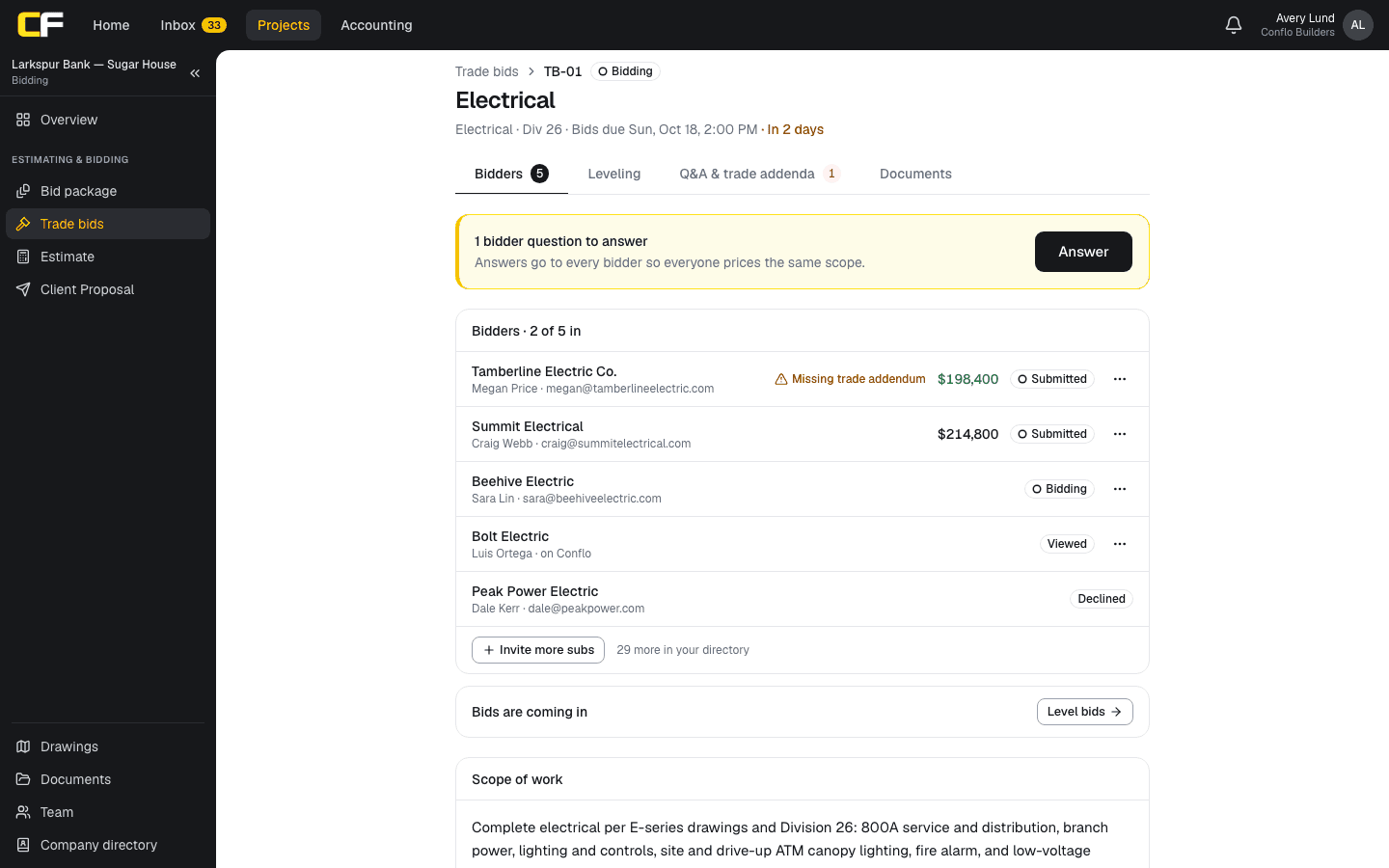
In Conflo's trade bids, you issue numbered addenda to a package. The bidder sees the trade addendum to acknowledge before bidding, and the Bidders tab warns when a bid is missing one.
The bottom line
An addendum is the only clean way to change bid documents before bids are due: numbered, in writing, to every bidder.
Check every bid's acknowledgments before you level, because a bid that missed an addendum may not price the changed work.
Sources
- FAR 14.208, Amendment of invitation for bids — Acquisition.gov, U.S. General Services Administration. Read October 22, 2026.
- FAR 14.405, Minor informalities or irregularities in bids — Acquisition.gov, U.S. General Services Administration. Read October 22, 2026.
Questions
Is an addendum part of the contract?
Yes. Addenda issued before the bid are part of the bid documents, and the agreement normally lists them among the contract documents.
Should an answer to one bidder's question be an addendum?
If it changes or clarifies what everyone prices, yes. Send it to every bidder in writing, without naming who asked.
What if an addendum comes out the day before bids are due?
Consider moving the bid date. Federal rules tell the contracting officer to weigh the time left and the need to extend it before issuing the amendment.
Related
Bidding
How Do You Send an Invitation to Bid to Subs?
What an invitation to bid to subs includes, how to send it, and how to run questions and addenda so every bid prices the same scope, with an example.
· 7 min read
Construction
How Does an Architect Write an ASI?
How an architect writes an ASI: what it may change, the parts of a good one, a filled-in example, and when it must become a change order.
· 8 min read
Definition
What Are the Contract Documents in Construction?
The contract documents are the agreement, conditions, drawings, specifications, addenda and modifications that together make up a construction contract.
· 3 min read
Bidding
How Do You Write a Bid Addendum?
How a GC writes a bid addendum to trade bidders: what goes in it, how to word each change, when to send it, and how to collect acknowledgments.
· 8 min read
Role hub
The General Contractor's Guide: Bid to Closeout
What a general contractor is responsible for at every phase of a commercial job, from bidding and buyout to RFIs, change orders, pay apps and closeout.
· 8 min read