
What Is a Long-Lead Item in Construction?
By Wyatt Cooper · Published · 3 min read
Key takeaways
- A long-lead item is equipment or material whose approval, fabrication and delivery take long enough to threaten the schedule unless it is ordered early.
- Lead time is the span from order to delivery; the latest order date is the need-on-site date minus the lead time, and the submittal has to be approved before that.
- Federal schedule specifications call procurement long lead when its sequence is expected to run over 90 calendar days.
A long-lead item is equipment or material that takes so long to approve, fabricate and deliver that it must be ordered early to avoid delaying the job: switchgear, generators, elevators, rooftop units, curtain wall, structural steel. Its lead time, counted back from the date it is needed on site, sets the latest day to order it.
What makes an item long lead
There is no single number, but federal schedule specifications give one: they want the schedule to carry the submittals, approvals, procurement, fabrication and delivery of long lead materials, and define "Long lead procurement activities" as "those with an anticipated procurement sequence of over 90 calendar days" (UFGS 01 32 01.00 10, 3.3.4). Long-lead equipment is also the kind owners will pay for before it is installed: the federal payment specification lists "major high cost, long lead, special order, or specialty items" as eligible for payment as stored materials (UFGS 01 20 00, 1.7.2); see stored materials.
A long-lead item's clock starts before the order. The submittal must be prepared and approved first, so the order-by date pushes the submittal due date earlier too. That is why long-lead items are set up in the submittal log first.
Example: working back from the need date
Main switchgear
- Needed on site
- March 15, 2027
- Lead time
- 112 days (16 weeks) from order to delivery
- Latest order date
- November 23, 2026
- Submittal review allowed
- 21 days
- Latest submittal date
- November 2, 2026
The count: from November 23 to November 30 is 7 days; December adds 31 (38), January 31 (69), February 28 (97), and March 15 makes 112. Then November 23 less 21 days is November 2. If the switchgear will not make the date, the team looks at a substitution request for a product with a shorter lead time.
How it works in Conflo
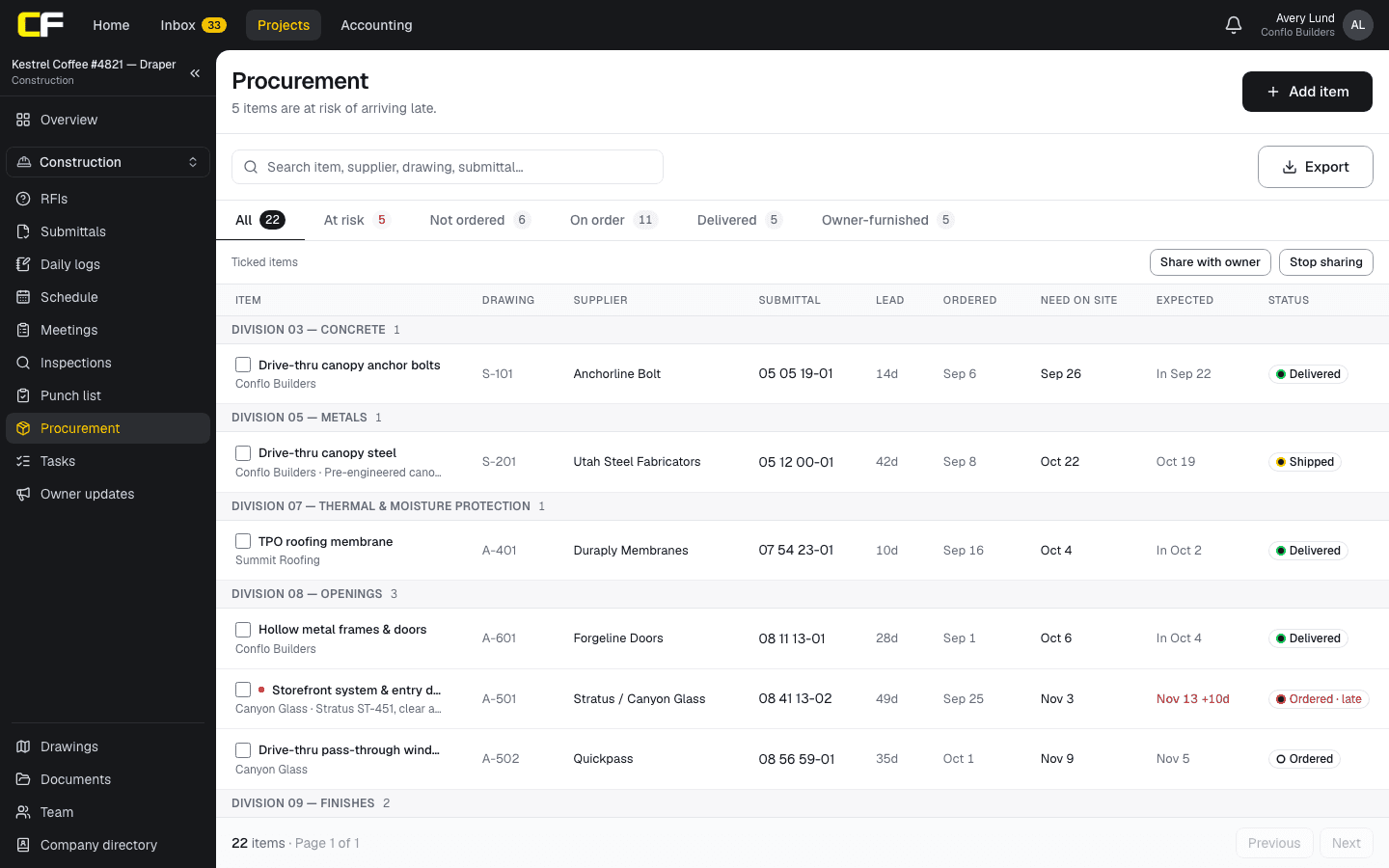
In Conflo's procurement log, you enter each item's lead time and required-on-site date, and Conflo works out the latest day to order it. An item is flagged when it has not been ordered and that date has passed, or when its expected delivery lands after the date it is needed, with how many days it would slip.
The bottom line
A long-lead item is anything whose lead time can move your finish date.
List them at buyout, work back from the need date to an order date and a submittal date, and track both every week.
Sources
- UFGS 01 32 01.00 10, Project Schedule (August 2026) — Whole Building Design Guide (USACE / NAVFAC / AFCEC). Read October 22, 2026.
- UFGS 01 20 00, Price and Payment Procedures (November 2020) — Whole Building Design Guide (USACE / NAVFAC / AFCEC). Read October 22, 2026.
Questions
What is lead time in construction?
The time from placing an order to the item arriving on site, including fabrication and shipping. Approval of the submittal comes before it.
What are typical long-lead items?
Electrical switchgear and transformers, generators, elevators, rooftop and air-handling units, curtain wall, structural steel and specialty doors and hardware.
Who tracks long-lead items?
The general contractor, usually the project manager or project engineer, with each subcontractor confirming lead times from its suppliers.
Related
Preconstruction
How Do You Set Up a Submittal Log From the Specs?
Build a submittal log from the specs: one row per required item, section by section, with approve-by and submit-by dates worked back from the schedule.
· 10 min read
Definition
What Is a Submittal in Construction?
A submittal is what the contractor sends the design team to show how it will meet the specs: shop drawings, product data, samples. Types and an example.
· 4 min read
Preconstruction
How Do You Buy Out a Construction Job?
Construction buyout step by step: scope review, leveling, award, the subcontract and its exhibits, compliance documents, and savings against budget.
· 7 min read
Preconstruction
How Do You Track Long-Lead Items on a Job?
How a GC tracks long-lead items: work back from the need-on-site date through lead time and submittal review to an order-by date, and review it weekly.
· 6 min read
Role hub
The General Contractor's Guide: Bid to Closeout
What a general contractor is responsible for at every phase of a commercial job, from bidding and buyout to RFIs, change orders, pay apps and closeout.
· 8 min read