
How Do You Keep an RFI Log?
By Wyatt Cooper · Published · 7 min read
Key takeaways
- The RFI log is one numbered list of every RFI on the job, showing who each one is waiting on, when it was sent, when the answer is due and how long it has been open.
- Ball in court is the most useful column: it says whose move it is, so the weekly meeting can chase the right person.
- Count days open in calendar days from the day the RFI was sent to the day it closed, or to today if it is still open; overdue means today is past the due date with no answer.
- Mark cost and schedule impact on every line, so the log shows at a glance which open questions could become change orders or delays.
To keep an RFI log, list every RFI in one numbered sequence with its subject, who sent it, who it is waiting on, the date sent, the date the answer is due, the date answered and closed, its status, days open, and any cost or schedule impact. Update it the day anything changes, sort the open ones oldest first, flag the overdue ones, and review it at every weekly meeting.
What the log is for
An RFI form asks one question. The log answers a different one: across every question on the job, what is waiting on whom, and for how long? The form is covered in how to write an RFI, with a free RFI template. This post is the list that tracks them.
Public owners build the log into their procedures. The City of Los Angeles Bureau of Engineering's RFI procedure has RFIs "sequentially numbered starting with the number one" and tracked in the city's document control system. Its meetings procedure has the construction manager "establish the time limit for all unanswered RFIs" at the weekly meeting, and its minutes procedure attaches the updated RFI log to each week's minutes. Connecticut's construction administration manual tells its construction administrator to emphasize the RFI contract provisions at the preconstruction conference.
The columns of an RFI log
| Column | What goes in it | What it tells you |
|---|---|---|
| RFI number | One project-wide sequence, never reused | That nothing is missing from the sequence |
| Subject | The element and the problem in a few words | What it is, without opening it |
| From | The company that raised it (a sub's RFI comes through the GC) | Which trade is waiting |
| Ball in court | The person or company who must act next | Who to chase |
| Sent | The date it went to the person who answers | Where days open starts |
| Due | The date the answer is needed, per the contract or the RFI | When it becomes overdue |
| Answered and closed | The date the answer came back, and the date the GC closed it | Whether the answer has reached the field |
| Status | Draft, open, answered, closed | Where it is in its life |
| Days open | Calendar days from sent to closed, or to today | How long the question has cost |
| Cost and schedule impact | No, possible or yes, for each | Which ones could become a change order or a delay |
A filled-in RFI log, with days open counted
Here are the five most recent RFIs on a made-up job, as of Tuesday, April 7, the morning of the OAC meeting. Days open count calendar days from the sent date: RFI 019 was sent March 27, so March 28 to 31 is 4 days and April 1 to 7 is 7 more, 11 in all. Its answer was due April 3, so on April 7 it is 4 days overdue.
| RFI | Subject | Ball in court | Sent | Due | Answered | Status | Days open | Cost / schedule |
|---|---|---|---|---|---|---|---|---|
| 019 | Roof drain sizing at the east roof | MEP engineer | Mar 27 | Apr 3 | — | Open, overdue | 11 | Possible / yes |
| 020 | Stair 2 handrail extension at the landing | Architect | Mar 30 | Apr 9 | — | Open | 8 | No / no |
| 021 | Conduit routing through shear wall line 4 | — | Apr 1 | Apr 8 | Apr 3 | Closed Apr 4 | 3 | No / no |
| 022 | Storefront sill height at the finish floor | GC (to close) | Apr 2 | Apr 9 | Apr 6 | Answered | 5 | No / possible |
| 023 | IT room conduit sizes | Owner | Apr 3 | Apr 10 | — | Open | 4 | Possible / no |
Check the arithmetic the same way for each line. RFI 020: March 31 is 1 day, plus April 1 to 7 is 8. RFI 021 closed on April 4, so it stopped counting there: April 2, 3 and 4 make 3. RFI 022 is answered but not closed, so it is still counting: April 3 to 7 is 5. RFI 023: April 4 to 7 is 4.
Read the log the way the meeting will. One RFI is overdue, and it is the one marked yes for schedule: it goes first. RFI 022 has an answer sitting with the GC; until it is closed and sent to the storefront sub, the answer hasn't reached the field. And two open RFIs say "possible" for cost, so the PM knows where change orders may come from.
Keeping it current
- 1GC project managerNumbers the RFI, logs it as sent, sets the due date
- 2Architect or engineerBall in court until the answer goes back
- 3GC project managerLogs the answer, sends it to the field and the trades
- 4GC project managerCloses it, and starts a change order if the answer adds cost or time
- Update the log the day anything happens, not before the meeting.
- Sort open RFIs oldest first, overdue at the top.
- Move the ball when it moves. An RFI sent back to you for clarification is in your court again.
- Don't close an RFI until the answer is in the field. The trades build from the answer, not from the log.
- Send the log with the OAC meeting agenda, and attach it to the minutes.
- Keep the log after the job. If a delay is disputed later, its dates show who was waiting on whom.
The design team's side of the log, turning answers around on time, is in how to respond to an RFI.
How it works in Conflo
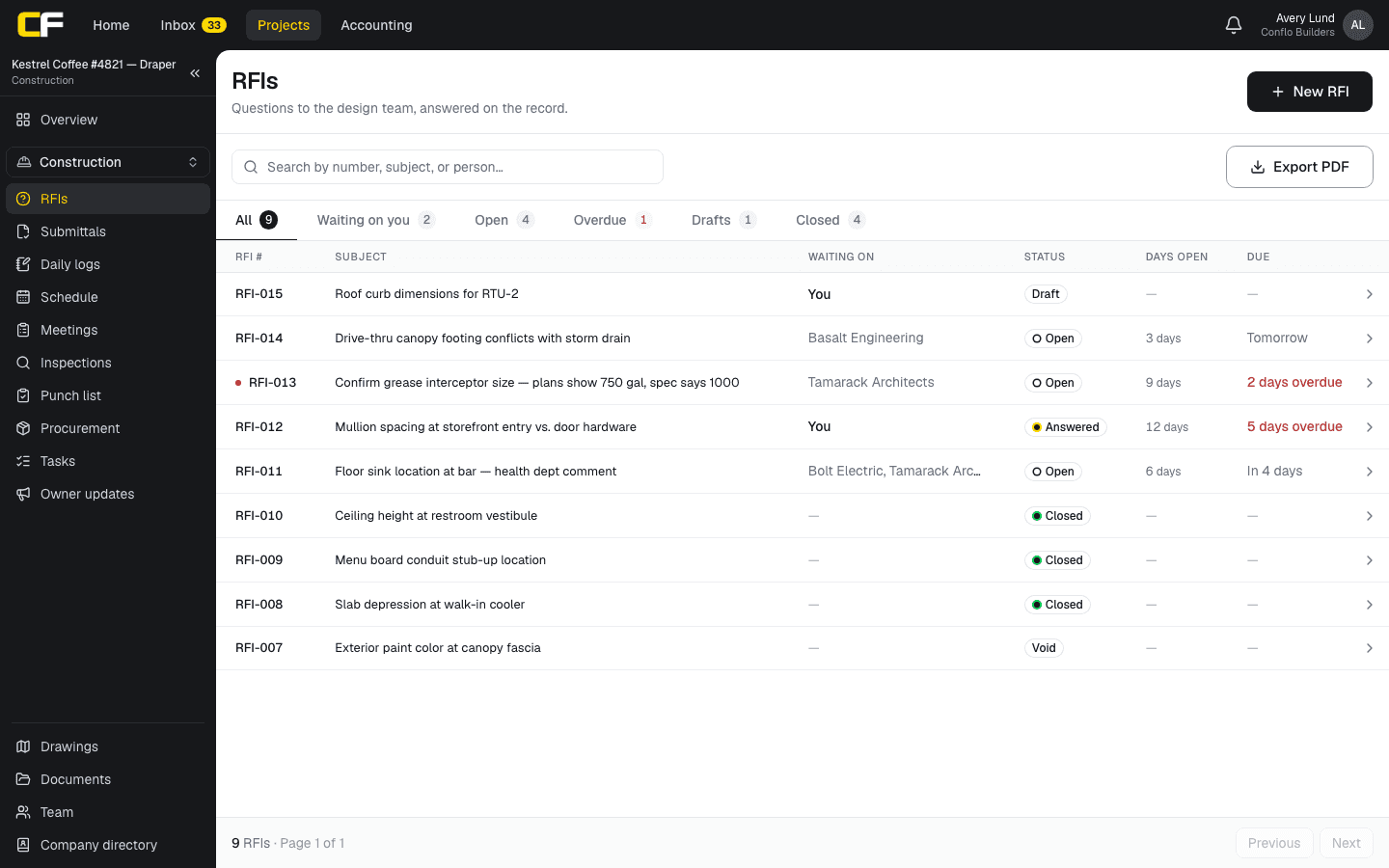
In Conflo's RFI tool, the log is built from the RFIs themselves, so there is nothing to retype. Each row shows the RFI's number, subject, who it is waiting on, status, days open and due date, and an overdue RFI is marked as overdue. Tabs split the log into all, waiting on you, open, overdue, drafts and closed, and you can search it.
The log exports as a PDF of every RFI matching the tab and search: number, subject, who it is from, status, who it is waiting on, the sent, due, answered and closed dates, days open, and cost and schedule impact, with counts of open, overdue and closed RFIs.
The bottom line
An RFI log is one numbered list with the columns that drive action: ball in court, sent, due, answered, days open and impact. Update it the day anything changes, put the overdue ones first, and review it at every weekly meeting.
If your log is a spreadsheet someone retypes before each meeting, build it from the RFIs instead.
Sources
- Project Delivery Manual, 16.2 Request for Information — City of Los Angeles, Bureau of Engineering. Read October 22, 2026.
- Project Delivery Manual, 16.6 Meetings — City of Los Angeles, Bureau of Engineering. Read October 22, 2026.
- Project Delivery Manual, 16.7 Meeting Minutes — City of Los Angeles, Bureau of Engineering. Read October 22, 2026.
- 0600 Construction Administration Procedures Manual, §2.4.1 Pre-Construction Conference — State of Connecticut Department of Administrative Services. Read October 22, 2026.
Questions
What should an RFI log include?
For each RFI: its number, subject, who sent it, who it is waiting on, the dates sent, due, answered and closed, its status, days open, and cost and schedule impact. Keep one project-wide sequence, and sort the open ones oldest first.
What does ball in court mean on an RFI log?
The person or company who must act next: the architect or engineer while they are answering, the GC once the answer is back and needs closing, the owner if the question is theirs to decide.
How do you count days open on an RFI?
Count calendar days from the day it was sent to the day it was closed, or to today if it is still open. An RFI sent March 27 and still open on April 7 has been open 11 days.
Who keeps the RFI log?
Usually the general contractor's project manager, since RFIs go through the GC. On some public jobs the owner's construction manager tracks them in its own system as well.
What is the difference between an RFI template and an RFI log?
The template is the form for one RFI: the question, references, proposed answer and impact. The log is the list of every RFI on the job and where each one stands.
Related
Construction
How to Write an RFI in Construction (With an Example)
How to write an RFI in construction: the parts of a good request for information, a filled-in example, common mistakes, and how the RFI log works.
· 9 min read
Template
Free RFI Template With a Filled-In Example
A free RFI template in Word, no email needed: every field a good request for information needs, a response section, and a filled-in example on page two.
· 4 min read
Construction
How Should an Architect Respond to an RFI?
How the design team answers an RFI: check it against the documents, answer the question asked, cite the sheet and spec, and say if it changes the work.
· 8 min read
Construction
How Do You Run an OAC Meeting?
How a GC runs an owner-architect-contractor meeting: who attends, what each party brings, a worked agenda, and how open items carry to the next one.
· 8 min read
Role hub
The General Contractor's Guide: Bid to Closeout
What a general contractor is responsible for at every phase of a commercial job, from bidding and buyout to RFIs, change orders, pay apps and closeout.
· 8 min read