
How Door and Hardware Subs Bid Commercial Work
By Wyatt Cooper · Published · 10 min read
Key takeaways
- Doors, frames and hardware are bid by the opening: count every door on the door schedule, then price its frame, its door and its hardware set.
- The bid must say who installs: furnish only, or furnish and install, and who sets the frames that are built into the walls.
- The hardware schedule is the submittal that drives the job; frames are released first, and keying needs a meeting with the owner before the keying submittal.
- Fire-rated doors and frames carry factory labels and are installed to NFPA 80, so a painted-over label or a field-modified door is a closeout problem.
Door, frame and hardware subcontractors bid commercial work by the opening: they count each door on the door schedule, then price its frame, door and hardware set, and state whether they only furnish the material or also install it. After award they submit door and frame shop drawings, a hardware schedule and a keying plan, release frames first because the walls are built around them, and bill by delivery and installation against a schedule of values split into frames, doors, hardware and keying.
Furnish only, or furnish and install
The first line of a door and hardware bid is what you are selling. Many door and hardware companies are distributors who detail, order and deliver; the doors are hung by the GC's carpenters or an install-only sub. Others furnish and install. Both are common, so say which one your number is.
| Item | Common question | Write in your clarifications |
|---|---|---|
| Installation | Is hanging doors and hardware in your price? | Furnish only, or furnish and install, by door type |
| Setting hollow metal frames | Who sets and anchors the frames in the walls? | By the framer or mason, unless you list it as included |
| Grouting frames in masonry | Who fills frames set in block walls? | By the mason, unless listed |
| Electrified hardware | Who supplies, wires and programs electric strikes, power transfers and card readers? | What you supply; wiring by the electrician; access control by others unless listed |
| Storefront and glass doors | Whose doors and hardware are they? | Aluminum entrances and their hardware by the glazier unless listed |
| Receiving and storage | Who unloads, sorts and protects hundreds of labeled cartons? | Delivered to site; storage and protection by the GC |
| Keying | Construction cores, permanent cores and the key cabinet: whose? | What you furnish, and when permanent cores go in |
Frames are built into the walls, so the framing or masonry sub usually sets them. The federal guide spec for steel doors and frames says to "build in or secure wall anchors to adjoining construction" and to set frames to the Steel Door Institute's erection standard, SDI A250.11 (UFGS 08 11 13). The framer's side of that line is in how drywall and framing subs bid.
Count the openings, then price each one
A door bid is a count, not a measurement. Start from the door schedule and the hardware sets in the specification, and build one row per opening: door number, size and swing, frame type, door type and material, fire rating, and hardware set. Then check the two against each other. A door scheduled with a 90-minute rating and a hardware set with no closer, or a pair of doors with a set written for a single leaf, is a question to ask the GC before bid day, through the bid's questions so every bidder prices the same thing.
The hardware schedule the spec asks you to submit later is a good checklist for the takeoff now. The federal guide spec lists, for each hardware set, the "Hardware Set Number", "Opening Number(s)", the opening description, "Fire Rating", "Sound Rating", and each item's quantity, size and finish (UFGS 08 71 00). If your takeoff carries the same fields, the submittal is half written when you win.
Set HW-07: doors 112, 114 and 116, single leaf, 3'-0" x 7'-0", 20-minute rated corridor doors
- Hinges
- 3 each, ball bearing, per leaf
- Lockset
- 1 classroom-function lever lockset, keyed to the corridor master
- Closer
- 1 surface closer, sized for the door
- Protection
- 1 kick plate, push side
- Stop
- 1 wall stop
- Seals
- 1 set smoke gasketing at head and jambs
- Remarks
- Fire-rated assembly: labeled door and frame, no field modification
The submittals that run the job
This trade's submittals come in a set, and they gate every order. In the federal guide spec, the hardware section asks for manufacturer's detail drawings, the hardware schedule and the keying system as shop drawings, product data for each item, installation instructions, operation and maintenance data, and key bitting at closeout (UFGS 08 71 00). The steel door section asks for a schedule of doors inside the shop drawings, "identifying door number, door and frame types and construction, dimensions, thickness" and, where the spec includes them, fire ratings and hardware sets (UFGS 08 11 13). How to package them is in how to prepare a submittal.
- 1Door and hardware subSubmits door and frame shop drawings, the hardware schedule and product data
- 2ArchitectReturns them; frames are released to order first
- 3Owner, GC and hardware subMeet on keying before the keying submittal
- 4Door and hardware subSends hardware templates to the door and frame makers, then orders doors and hardware
- 5Framer or masonSets frames as the walls go up
- 6InstallerHangs doors, installs hardware with construction cores
- 7Door and hardware subInstalls permanent cores, hands over keys and the bitting chart
Three spec details to plan for. Hardware is made to templates, and the spec says to "provide templates to door and frame manufacturers", so a late hardware schedule delays doors you have not ordered yet. Before the key shop drawing is submitted, the contracting officer, contractor, hardware sub, user and base locksmith "must meet to discuss and coordinate key requirements". And the key bitting chart asks for a "listing of 20 percent more key cuts than are presently required in each master system" (UFGS 08 71 00). Your project's spec may differ; read its keying article before you bid the keying line.
Fire-rated openings and NFPA 80
NFPA 80, the Standard for Fire Doors and Other Opening Protectives, covers "installing, inspecting, testing, and maintaining fire doors and other opening protectives" (NFPA), and the federal guide spec says to "install fire doors and frames, including hardware, in accordance with NFPA 80". It also says fire door and frame labels are "permanently affixed at the factory to frames and to the hinge edge of the door. Do not paint door and labels." (UFGS 08 11 13).
- Price labeled doors and frames prepared for their hardware before they ship; the guide spec has doors and frames drilled and tapped to receive finish hardware, so a late hardware schedule means a late door.
- Tell the painter, through the GC, to mask labels.
- List electrified hardware on rated doors in the hardware schedule so the rating covers it.
- NFPA 80 covers inspecting and testing as well as installing, so ask whether the owner wants an inspection report for the rated openings at turnover. The Door and Hardware Institute runs a Certified Fire & Egress Door Assembly Inspector credential for that work (DHI).
A schedule of values that follows the deliveries
Door and hardware work arrives in waves: frames first, then doors, then hardware, then permanent cores. Give each wave its own line in the schedule of values so each can be billed when it lands. A fictional $243,000 furnish-and-install subcontract:
| Line | Description | Scheduled value |
|---|---|---|
| 1 | Submittals: door and frame schedules, hardware schedule, keying | $4,500 |
| 2 | Hollow metal frames, material | $38,200 |
| 3 | Hollow metal doors, material | $29,600 |
| 4 | Wood doors, material | $41,800 |
| 5 | Finish hardware, material | $64,300 |
| 6 | Electrified hardware, material | $18,900 |
| 7 | Install doors and hardware | $36,400 |
| 8 | Permanent cores, keying and key cabinet | $5,800 |
| 9 | Closeout: O&M data, key bitting chart, warranties | $3,500 |
| Total | $243,000 |
In the fictional period 2, the submittal line goes from 50% to 100% ($2,250) and the frames are delivered and stored on site ($38,200 stored). That bills $40,450; at 10% retainage $4,045.00 is held and $36,405.00 is added to the payment due. Checks: $2,250 + $38,200 = $40,450; $40,450 − $4,045 = $36,405. When the frames are set, line 2 moves from stored to complete with no new billing. Stored material and retainage on the form itself are covered in how to fill out a pay application as a subcontractor and how to calculate retainage.
Two quirks of this trade. On a supply-only purchase order, settle before you sign whether retainage applies at all and when it is released; your last dollars should not wait on someone else hanging the doors. And when the door schedule changes after frames are ordered (a swing, a size, a rating), price it right away as a change order request with the opening numbers listed.
Closeout for doors and hardware
- Keys: the spec may ask you to tag file and duplicate keys and give "complete instructions for setup and use of key control system", and to "demonstrate that permanent keys operate respective locks" (UFGS 08 71 00).
- The key bitting chart, delivered to whoever the spec names (the federal guide spec has it submitted to the contracting officer before the work is complete).
- Operation and maintenance data for the hardware schedule items.
- Manufacturer warranties; the federal guide spec, for example, asks for a 10-year manufacturer's warranty on door closers.
- Attic stock, if the spec calls for spare hardware.
- Final lien waiver and the retainage request.
Doors are among the last items finished, so walk every opening with the GC's punch list before you ask for retainage. Where this trade sits in the sub's whole job is in the subcontractor's guide, and the job's phases in the construction project lifecycle.
How it works in Conflo
When a GC sends a door, frame and hardware package through Trade bids in Conflo, you read the scope, ask questions that are answered to every bidder without your name, acknowledge each addendum, and submit a base bid with each of the GC's scope items marked included or excluded, such as installation or electrified hardware, plus alternates, exclusions and qualifications. Attach your proposal and opening list as a PDF; there is no field for a per-opening or unit price.
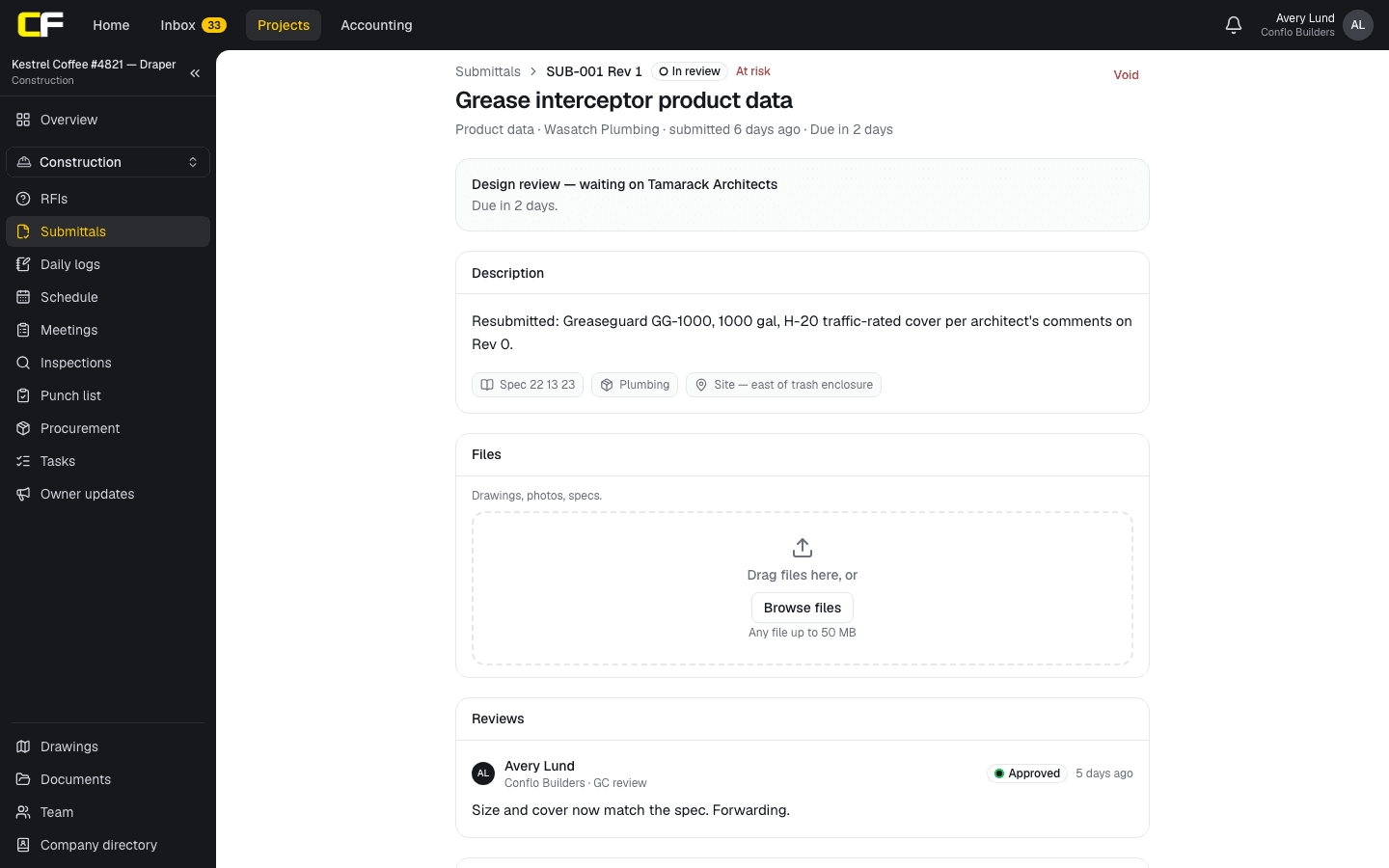
After award, the hardware schedule and the door and frame shop drawings go through Submittals. You see only your own company's submittals; you can start one or fill in one the GC set up, with its spec section, type (shop drawings, product data, samples and others), package and the files attached. The GC reviews it, then the design team, and each returns approved, approved as noted, revise and resubmit, or rejected, with a note on anything but approved. A resubmittal opens as the next revision under the same number. Conflo keeps your hardware schedule as the attached file; it does not read it into hardware sets.
The bottom line
A door and hardware bid is a count of openings and a clear line on who installs and who sets frames. The job is won or lost on the hardware schedule: get it in early, keyed and matched to the door schedule.
Before your next bid, add the seven clarifications in the first table to your proposal template.
Sources
- UFGS 08 71 00, Door Hardware (February 2016, change 4) — Whole Building Design Guide (USACE, NAVFAC, AFCEC). Read October 22, 2026.
- UFGS 08 11 13, Steel Doors and Frames (August 2020, change 1) — Whole Building Design Guide (USACE, NAVFAC, AFCEC). Read October 22, 2026.
- NFPA 80, Standard for Fire Doors and Other Opening Protectives — National Fire Protection Association. Read October 22, 2026.
- Door and Hardware Institute (home page and credential list) — Door and Hardware Institute. Read October 22, 2026.
Questions
How do you bid doors, frames and hardware?
Count every opening on the door schedule, match each to its frame type, door type, fire rating and hardware set, price material for each, and add installation only if you are furnishing and installing. State who sets frames, who wires electrified hardware and what keying you include.
What is a hardware schedule?
The submittal that lists every hardware set, the openings each set goes on, and every item in it with quantity, size, finish and fire rating. It is checked against the door schedule and drives the hardware order.
Who installs hollow metal frames?
Usually the trade building the wall: the framing sub in stud walls and the mason in block walls, with the door supplier furnishing the frames. Your bid and the GC's scope should say so plainly.
What is a keying meeting?
A meeting with the owner, the GC and the hardware supplier, before the keying submittal, to agree the master key system: who opens which doors and how many keys. The keying schedule follows from it.
Can you paint over a fire door label?
No. The federal guide spec says labels are permanently affixed at the factory and not to paint the door labels, and fire doors are installed to NFPA 80. Ask the GC to have the painter mask them.
Related
Bidding
How Drywall and Framing Subs Bid Commercial Work
How drywall and metal framing subs bid commercial work: the scope gaps at blocking, firestopping and finish levels, priced in a worked example.
· 6 min read
Role hub
The Subcontractor's Guide: Bidding to Getting Paid
Every step of a commercial job from the subcontractor's seat: bidding, the subcontract, submittals, RFIs, change orders, pay apps, retainage and closeout.
· 9 min read
Construction
How Does a Subcontractor Prepare a Submittal?
How a subcontractor prepares a submittal the GC and architect can approve the first time: what to include, how to mark it up, deviations, and resubmittals.
· 9 min read
Bidding
How Glazing Subs Bid and Bill Commercial Work
How glazing subs bid curtain wall and storefront: takeoff units, the clarifications that protect you, the engineering and mockup submittals, and billing.
· 10 min read