
How Do You Write a Recovery Schedule?
By Wyatt Cooper · Published · 8 min read
Key takeaways
- A recovery schedule shows how a late job gets back to its completion date: which activities speed up, by how many days, with what resources, at what cost.
- Start from an honest update: the slip in working days on the critical path, and its cause.
- Recover time with real resources and real sequence changes; shortening durations on paper is not recovery, and federal guide specifications prohibit it.
- Whether the owner pays for acceleration depends on why the job is late, so settle the cause before you settle the cost.
To write a recovery schedule, start from a current update that shows how many working days the critical path is behind and why. List the ways to win days back (more crews, longer hours, extra workdays, overlapping trades, faster deliveries), price each, and estimate the days it recovers. Pick the cheapest set that closes the gap, show the changed activities and links in the schedule, explain every change in a narrative, and make the added crews visible in the daily reports.
When you need one
A schedule update tells you the job is late. A recovery schedule says how it will catch up. Owners ask for one when the forecast completion passes the contract date, and contracts often give them the right to. Where the federal schedules clause applies, FAR 52.236-15(b) says that if the contractor "falls behind the approved schedule, the Contractor shall take steps necessary to improve its progress, including those that may be required by the Contracting Officer, without additional cost to the Government."
The Corps of Engineers' guide specification UFGS 01 32 01.00 10 spells out the plan: when progress falls behind "for reasons other than those that are excusable", the Contracting Officer "may require provision of a written recovery plan" that details "which activities will be accelerated by adding additional crews, longer work hours, extra workdays, etc." (§3.9). Private contracts usually have a similar clause; read yours before you price anything. (The general contractor's guide and the project lifecycle cover the rest of the construction phase.)
Write it in six steps
- Measure the gap. From the latest update: the forecast completion, the contract completion, and the difference in working days on the critical path.
- Name the cause. Weather, a late owner decision, a design change, a slow subcontractor or your own sequence. Excusable delay is a time extension request, not a recovery plan.
- List the options activity by activity on the critical and near-critical path: a second crew, a Saturday shift, an earlier start for the next trade, a faster delivery, prefabrication.
- Price each option and estimate the working days it recovers. Ask the subs for crew availability before you count on it.
- Choose the set that closes the gap at the lowest cost, and put it in the schedule as real changes: new resources in the notes, changed links with their lags, extra workdays on the calendar.
- Write the narrative: the gap, the cause, each change and its days, the cost and who carries it, and what the daily reports will show.
A worked example: eight days back
A fictional two-story office, Larchmont Commons. The April update forecasts substantial completion 8 working days after the contract date, all of it from a slow start on interior framing. The GC prices three options on the critical path.
| Option | What changes | Working days recovered | Added cost |
|---|---|---|---|
| Saturday drywall shift | Crew of 6, 8 hours, 4 Saturdays: 192 hours at a $30 overtime premium | 4 | $5,760 |
| Overlap ceiling grid with taping | Grid in area A starts 5 days after taping starts (start-to-start, lag 5) instead of after taping finishes | 3 | $0 |
| Expedite rooftop units | Air-ride freight brings delivery forward 2 days; only 1 day is on the critical path | 1 | $2,400 |
| Total | 8 | $8,160 |
Check the arithmetic: 6 workers × 8 hours × 4 Saturdays = 192 hours, and 192 × $30 = $5,760. Adding the freight, $5,760 + $2,400 = $8,160 for 4 + 3 + 1 = 8 days. The overlap is free in money but not in risk: the ceiling crew works behind the tapers in the same rooms, so the superintendent writes down the area handoffs before it starts.
Larchmont Commons: recovery schedule narrative, data date April 17
- Gap
- Forecast substantial completion 8 working days after the contract date.
- Cause
- Interior framing fell 8 days behind: Crestline Interiors was short-crewed in March (daily reports, March 2–27). Not excusable under the contract.
- Change 1
- Saturday drywall shifts on the next four Saturdays, crew of 6 (Crestline Interiors). Recovers 4 days. Workdays added to the project calendar.
- Change 2
- Ceiling grid area A linked start-to-start to taping area A, lag 5 days. Recovers 3 days. Area handoff plan attached.
- Change 3
- Rooftop units by air-ride freight. Recovers 1 day.
- Cost
- $8,160. Crestline Interiors carries its own $5,760 Saturday premium; the GC pays the $2,400 freight and back-charges it to Crestline under the subcontract's schedule article (notice sent April 17).
- Verification
- Added crews and Saturday hours recorded in the daily reports and the next update.
- 1Project managerMeasures the slip on the critical path and names the cause
- 2Superintendent and subsOffer crews, shifts and sequence changes, with what each costs
- 3Project managerPicks the cheapest set that closes the gap and puts it in the schedule
- 4Owner or architectReviews the recovery schedule and narrative
- 5SuperintendentRuns it, and the daily reports show the added crews
Who pays for acceleration
It follows the cause. If the delay is the contractor's, the recovery is at its own cost: that is what "without additional cost to the Government" means in FAR 52.236-15. If the delay is excusable (owner changes, unusual weather, differing site conditions, depending on the contract), the remedy is usually a time extension, and an owner who wants the original date anyway is asking for acceleration it may have to pay for. When a subcontractor caused the slip, the GC passes the cost down under the subcontract, as in the example; see what a GC should do when a sub falls behind.
Failing to keep up has consequences on federal work: the guide spec says failure to follow the recovery plan "may result in an interim and final unsatisfactory performance rating" and corrective action under FAR 52.236-15 and the default clause, FAR 52.249-10 (§3.9.2).
How it works in Conflo
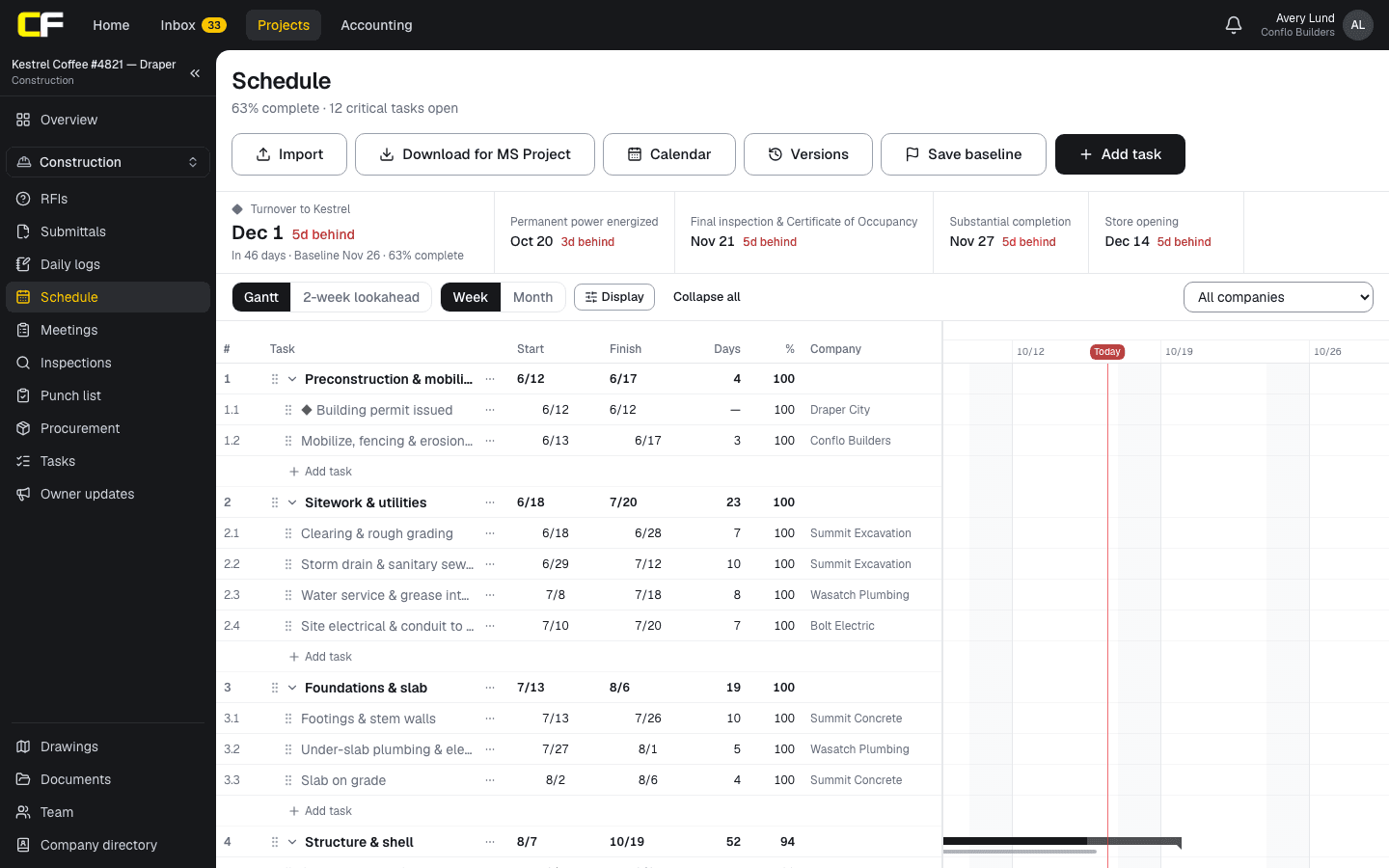
In Conflo's schedule, save a named version of the late schedule before you change anything, with a note, so the pre-recovery plan stays on record and can be restored. Then make the changes as real edits: a start-to-start link with a 5-day lag, Saturday set as a working day in the project calendar while the shifts run (the calendar is project-wide, so every task counts Saturdays while it's set), the added crew in the task's notes. The baseline doesn't move, so each task's days late against it and the key dates strip show whether the recovery is working at the next update.
Conflo doesn't price the options or write the narrative; do that in the update you send the owner.
The bottom line
A recovery schedule is the plan for getting a late job back to its date: the gap, the cause, and the crews, hours and sequence changes that close it, each with its days and its cost.
Make every recovered day visible on site and in the daily reports. Days that only exist in the software come back as a later, bigger slip.
Sources
- UFGS 01 32 01.00 10, Project Schedule (August 2026), §3.9 Failure to Achieve Progress, §3.9.1, §3.9.2 and §3.9.3 — U.S. Army Corps of Engineers (Whole Building Design Guide). Read October 22, 2026.
- FAR 52.236-15, Schedules for Construction Contracts — Acquisition.gov (General Services Administration). Read October 22, 2026.
- FAR 52.249-10, Default (Fixed-Price Construction) — Acquisition.gov (General Services Administration). Read October 22, 2026.
Questions
What is a recovery schedule in construction?
A revised schedule that shows how a late project gets back to its completion date: which activities are accelerated, with what added crews, hours or sequence changes, how many days each recovers and what it costs, with a narrative explaining each change.
When can an owner ask for a recovery schedule?
When the contract gives the right, usually once the forecast completion passes the contract date for reasons that aren't excusable. Federal contracts with FAR 52.236-15 let the Contracting Officer require steps to improve progress.
Can I shorten durations to recover time?
Only if something real makes the work faster: a second crew, longer hours, prefabrication. Shortening a duration with the same crew is artificial progress, which federal guide specifications prohibit, and it slips again at the next update.
Who pays for a recovery schedule?
Whoever caused the delay, under the contract. If the contractor is responsible, recovery is at its own cost. If the delay is excusable, the usual remedy is a time extension, and acceleration the owner asks for may be a change.
How is a recovery schedule different from a schedule update?
An update records progress and shows the slip. A recovery schedule changes the plan to close the slip, and says what changed and why, so the owner can approve it.
Related
Construction
How Do You Update a Construction Schedule?
How to update a construction schedule each month: the data date, actual dates, remaining durations, the baseline comparison and a slip narrative.
· 7 min read
Construction
What Should a GC Do When a Sub Falls Behind?
What a GC does when a sub falls behind: measure it, talk, send written notice with a cure period, ask for a recovery plan, supplement, terminate.
· 7 min read
Definition
What Is the Critical Path in Construction?
The critical path is the longest chain of linked activities in a construction schedule. A worked five-activity example, float, and what a delay does.
· 4 min read
Construction
How Do You Build a Three-Week Look-Ahead Schedule?
How to build a three-week look-ahead from the master schedule: crew-sized pieces of work, what must be ready, and how to run it at the weekly meeting.
· 7 min read
Role hub
The General Contractor's Guide: Bid to Closeout
What a general contractor is responsible for at every phase of a commercial job, from bidding and buyout to RFIs, change orders, pay apps and closeout.
· 8 min read