
How Do You Level Subcontractor Bids?
By Wyatt Cooper · Published · 9 min read
Key takeaways
- Leveling means pricing every gap so all bids for one trade cover identical scope; the leveled total is the base bid plus your plugs and deducts.
- Read each proposal against one scope sheet: inclusions, exclusions, alternates, allowances, qualifications, bonds and insurance, schedule, and which addenda it acknowledges.
- In the worked example below, the low base bid stays low after leveling, but the runner-up changes: the highest base bid moves to second once its extra scope is deducted.
- The lowest leveled number is where the decision starts, not where it ends: confirm the low bidder's scope in writing and weigh schedule, capacity and record.
To level subcontractor bids, list every scope item the trade must cover, then read each bid against that list. Where a bidder excluded something, add a plug (your estimate of its cost); where a bidder included work that is not theirs, deduct it. Add plugs for missing bonds and unacknowledged addenda too. Each bid's leveled total is its base bid plus those adjustments. Compare leveled totals, keep alternates separate, and confirm the apparent low bidder's scope before you choose.
Leveling makes every bid price the same work
A base bid is only comparable with another base bid when both cover the same work, and they rarely do. One drywall bidder excludes firestopping, another bids a lower finish than the drawings call for, a third includes access panels the owner is furnishing. Picking the lowest base bid then means picking the bidder who left out the most.
Leveling (also called bid normalization) turns each proposal into a number for the same scope. It does not change what the bidder offered; it records what filling each gap would cost you. Do it per trade package, after bids are due and before you carry a number into your estimate.
- 1EstimatorWrites one scope sheet from the drawings, specs and bid package
- 2EstimatorReads each proposal against it: included, excluded or unclear
- 3EstimatorPlugs every gap and deducts every extra, the same way for every bidder
- 4Project teamCompares leveled totals, with alternates on their own rows
- 5BiddersConfirm scope and price the gaps in writing
- 6Project managerAwards on the leveled number and the bidder's record
Build one scope sheet before you open a single bid
Write the scope sheet from the drawings, specifications and your bid package, not from the first proposal you open, or that bidder's scope becomes yours. For each trade package, list:
- Inclusions: every scope item the trade must cover, in plain words ("Level 4 finish at lobby walls", not "finishes").
- Exclusions you expect: items commonly left out of this trade (firestopping, blocking, temporary protection), so you look for them on purpose.
- Alternates: the priced options in your bid form. These stay out of the base comparison.
- Allowances: fixed amounts every bidder carries for undefined work. Check every bidder carried the same figure.
- Qualifications: conditions the bidder attached ("price valid 30 days", "based on 2 mobilizations").
- Bonds and insurance: whether a performance and payment bond is required and included; the insurance limits the subcontract requires.
- Schedule: the duration and start the bidder commits to, and any long-lead items.
- Addenda: the highest addendum number each bidder acknowledged.
Each line becomes a row of the leveling sheet; each bidder, a column.
Read every proposal line by line and mark what is in and out
Go through each proposal with the scope sheet beside it. For each row, mark the bidder as included, excluded or unclear. Unclear is common: "drywall per plans" does not tell you whether firestopping is in. Treat unclear as excluded until the bidder confirms in writing.
Read the fine print as closely as the number: exclusions hide in a qualifications paragraph on page two, and a bidder who did not acknowledge the latest addendum has priced older drawings. Write each question down as you go; the bidders' answers will replace your plugs.
Plug the gaps and deduct the extras
A plug is the amount you add to a bid to cover scope the bidder left out. Use the best number you have, in this order: a breakout another bidder gave for the same item, your own takeoff and unit costs, or a quote for the item on its own. Write down where each plug came from; you will be asked.
A deduct is the opposite: a bidder included work that is not in this package (owner-furnished items, another trade's work), and you remove it, ideally at the bidder's own breakout price. Some rules that keep the sheet honest:
- Plug the same item at the same amount for every bidder who excluded it.
- Never plug an alternate into the base; show alternates on their own rows.
- Price a missing bond at the bidder's own quoted bond add if they gave one; otherwise ask.
- Keep your plugs private. Bidders see their own proposal, not your adjustments.
A worked example: three drywall bids on a fictional clinic
The job is fictional: a two-story medical clinic, "Harlow Street Clinic", built by a fictional general contractor. The package is metal framing and drywall, and three fictional bidders submitted.
- Northline Interiors bid $412,000. It excludes firestopping at rated partitions and excludes the performance and payment bond, which it quoted as an add of $4,100. It acknowledged Addenda 1 and 2.
- Cardinal Wall Systems bid $398,500. It bids Level 3 finish throughout, where the drawings call for Level 4 at the lobby, and acknowledged Addendum 1 only, so it has not priced the soffit framing added by Addendum 2. The bond is included.
- Ridgeback Drywall bid $431,750. It includes everything, plus $6,000 for access panels the owner is furnishing (Ridgeback's own breakout). The bond is included.
The GC's plugs come from its own takeoff: firestopping $11,200; Level 4 finish at the lobby $7,800; Addendum 2 soffit framing $5,400.
| Row | Northline Interiors | Cardinal Wall Systems | Ridgeback Drywall |
|---|---|---|---|
| Base bid | $412,000 | $398,500 | $431,750 |
| Firestopping at rated partitions | + $11,200 (excluded; plug) | Included | Included |
| Level 4 finish at lobby | Included | + $7,800 (bid Level 3; plug) | Included |
| Addendum 2 soffit framing | Included | + $5,400 (not acknowledged; plug) | Included |
| Performance and payment bond | + $4,100 (bidder's quoted add) | Included | Included |
| Access panels (owner-furnished) | Not included | Not included | − $6,000 (deduct at bidder's breakout) |
| Leveled total | $427,300 | $411,700 | $425,750 |
| Alternate 1: impact-resistant board at corridors (not in total) | + $14,500 | + $16,200 | + $12,900 |
- Northline: $412,000 + $11,200 + $4,100 = $427,300.
- Cardinal: $398,500 + $7,800 + $5,400 = $411,700.
- Ridgeback: $431,750 − $6,000 = $425,750.
Cardinal had the lowest base bid: $13,500 under Northline ($412,000 − $398,500) and $33,250 under Ridgeback ($431,750 − $398,500). After leveling, Cardinal is still lowest, by $14,050 against Ridgeback ($425,750 − $411,700) and $15,600 against Northline ($427,300 − $411,700). The runner-up changed: Ridgeback, the highest base bid, is second once its extra scope is removed. The median leveled total is Ridgeback's $425,750; Cardinal is 3.3% below it ($14,050 ÷ $425,750), so nothing about its number looks like a mistake.
If the owner takes Alternate 1: Cardinal $427,900 ($411,700 + $16,200), Ridgeback $438,650 ($425,750 + $12,900), Northline $441,800 ($427,300 + $14,500). Cardinal stays lowest, by $10,750. Alternates sit on their own rows because they answer a separate question.
Choose on the leveled number and on what it cannot show
The leveled total tells you who is cheapest for the same scope, on your plugs. Before you award:
- Replace plugs with the bidder's own price. Ask Cardinal, in writing, to price Level 4 at the lobby and the Addendum 2 soffits. If its numbers come back more than $14,050 above your plugs combined, Ridgeback becomes low.
- Look at the spread, not only the low number. The Federal Highway Administration's bid review guidelines list factors such as the number of bids, the distribution or range of bids received, and which prices differ significantly from the estimate and from other bids.
- Check a bid far below the others. It may hold a mistake. Federal contracting officers must examine bids for mistakes and ask the bidder to verify a suspected one before award (FAR 14.407-1); the same habit protects a private GC.
- Weigh what the number leaves out: workload against your schedule, crew, bonding capacity and record on similar work. Federal agencies call this responsibility, with standards that include financial resources, the ability to meet the schedule, the performance record and integrity (FAR 9.104-1).
Usually the lowest leveled bid wins. When it does not, write down why. Once the work is awarded, the same scope discipline carries into pricing change orders and into the sub's schedule of values.
Common mistakes when leveling bids
- Leveling to the first proposal you opened instead of the documents.
- Plugging one item at different amounts for different bidders.
- Folding alternates into the base.
- Ignoring addenda, or treating "unclear" as included.
- Showing bidders your plugs.
- Leaving a scope question open when it belongs to the designer: send an RFI before bids close.
How it works in Conflo
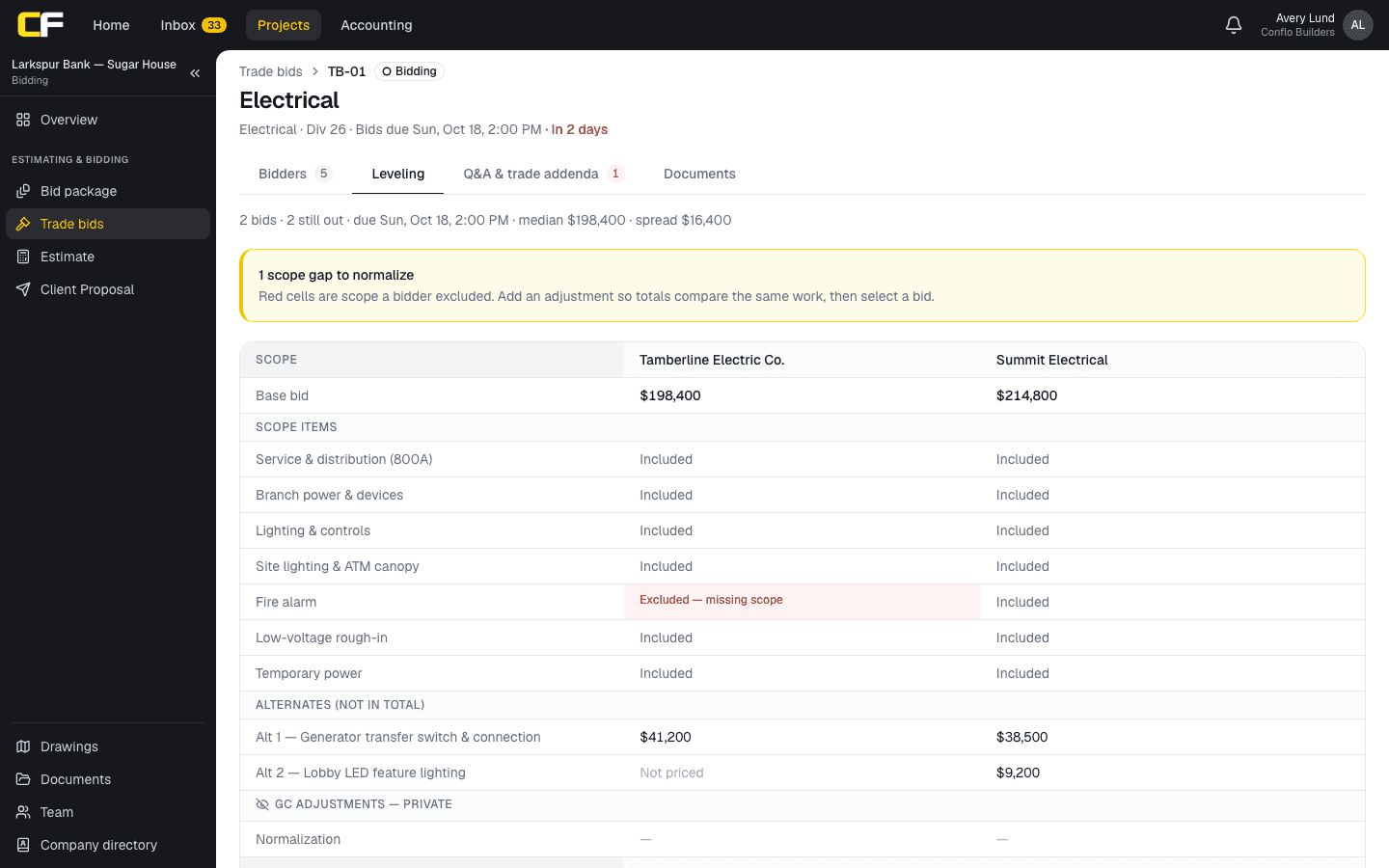
Conflo's bid leveling is a tab of each trade bid package, visible only to the general contractor. Each bidder is a column and each of the package's scope items a row; a scope item a bidder did not include is flagged as missing. You add private plus or minus adjustments to a bid, optionally tied to a scope item, and each bid's leveled total is its base bid plus your adjustments.
The grid shows the median and spread, highlights the lowest leveled total, and with three or more bids flags any bid more than 15% from the median. Alternates are shown apart from the total, exclusions and qualifications sit beside each bid, and a bid that has not acknowledged every addendum is flagged. You select a bid, then award it; the award opens a draft subcontract for the winner at the leveled amount. One limit: bonds and insurance are not separate fields, so they are read from the bidder's exclusions and qualifications and priced with an adjustment.
The bottom line
Leveling is a discipline more than a calculation: one scope sheet, every proposal read against it, every gap priced the same way for everyone, and alternates kept apart. The arithmetic is addition; the judgment is in the plugs and in the questions you send before award.
When the leveled number and the bidder's record both point the same way, award with confidence. When they do not, write down why.
Sources
- FAR 14.407-1, General (Mistakes in bids) — Acquisition.gov, U.S. General Services Administration. Read October 16, 2026.
- FAR 9.104-1, General standards (Contractor qualifications) — Acquisition.gov, U.S. General Services Administration. Read October 16, 2026.
- Guidelines on Preparing Engineer's Estimate, Bid Reviews and Evaluation (January 20, 2004), Bid Review Factors — Federal Highway Administration. Read October 17, 2026.
Questions
How do you level subcontractor bids?
List every scope item the trade must cover, read each bid against that list, add a plug for each excluded item and deduct anything included that is not theirs. The leveled total is the base bid plus those adjustments. Compare leveled totals, keep alternates separate, and confirm the low bidder's scope in writing.
What is a plug number in bid leveling?
A plug is the amount you add to a bid to cover scope the bidder left out, so it can be compared with bids that included it. Take it from another bidder's breakout, your own takeoff, or a separate quote, and use the same plug for every bidder who excluded that item.
Should alternates be included in the leveled total?
No. Keep alternates on their own rows. The base comparison answers who is cheapest for the base scope; each alternate answers a separate question the owner decides. Adding them in changes the order of bidders without anyone deciding to accept the alternate.
Do you always award to the lowest leveled bid?
Usually, but not always. The leveled total rests on your plugs, so replace them with the bidder's own prices first. Then weigh schedule, workload, bonding capacity and past performance. If you award to someone else, write down why.
What do you do with a bid that is much lower than the others?
Ask the bidder to confirm the price and its scope in writing before award. A bid far below the rest often has a missing item or an arithmetic error, and finding it after award costs everyone.
Related
Template
Free Bid Leveling Spreadsheet (Excel Template)
A free bid leveling spreadsheet for Excel: five bidders, fifteen scope rows, plugs and deducts, leveled totals, median and alternates. No email needed.
· 4 min read
Definition
Bid Tabulation vs Bid Leveling: What's the Difference?
A bid tabulation records each bid as received; bid leveling adjusts each bid for scope gaps so all cover the same work. How they differ, with an example.
· 4 min read
Bidding
How Do You Build an Estimate From Sub Bids?
Build a GC estimate from sub bids: plug each division, carry the leveled bid in place of the plug, add your own work and general conditions, then markups.
· 7 min read
Preconstruction
How Do You Buy Out a Construction Job?
Construction buyout step by step: scope review, leveling, award, the subcontract and its exhibits, compliance documents, and savings against budget.
· 7 min read
Role hub
The General Contractor's Guide: Bid to Closeout
What a general contractor is responsible for at every phase of a commercial job, from bidding and buyout to RFIs, change orders, pay apps and closeout.
· 8 min read