
How Do You Price a Change Order?
By Wyatt Cooper · Published · Updated · 9 min read
Key takeaways
- A change order price is direct cost plus the markups the contract allows: burdened labor, materials with tax, equipment, and subcontractor quotes, then overhead, profit, insurance and bond.
- Markup percentages are not standard: Caltrans force-account work, for example, adds 35% to labor, 15% to materials and equipment and 10% to subcontracted work.
- In the worked example below, $11,293.53 of direct cost becomes a $12,265.60 change order after a split overhead-and-profit markup, then insurance and bond.
- Ask for time in the same change order as the money, with schedule logic, because a change order signed with zero days usually settles the time question.
To price a change order, total the direct cost first: labor hours at the burdened rate, materials with tax and delivery, equipment, and each subcontractor's quote. Then add the markups your contract allows, usually overhead and profit on your own work, a smaller markup on subcontracted work, and insurance and bond where permitted. Add the schedule impact in days. Attach the backup an owner expects: quotes, timesheets, invoices and the reason for the change. Markup rules vary by contract.
Start from the contract's change clause, not from the estimate
Before pricing anything, read three parts of the contract: the changes article, the definition of cost (what counts as reimbursable), and any stated markup percentages. These decide what you can charge, how you must present it and how long you have.
Notice deadlines matter as much as the price. The federal changes clause, for example, allows no adjustment for costs incurred more than 20 days before the contractor gives written notice of a constructive change, except for an adjustment based on defective specifications, and requires the contractor to assert its right to an adjustment within 30 days of a written change order unless the government extends that period (FAR 52.243-4). Private contracts set their own periods. Missing one can cost the whole change.
Write down the cause too: an RFI answer, an owner request, a field condition or a design error. The cause decides who pays and is the first question an owner asks.
Price the direct cost line by line
Direct cost is what the change costs you before any markup. Price it in four groups.
- Labor: hours by trade, times the burdened hourly rate. The burden is the cost on top of the base wage: payroll taxes, workers' compensation insurance, benefits and any union fringe. It varies by trade, state and company; use your own payroll figures, not a rule of thumb.
- Materials: quantity times unit cost, plus delivery and sales tax where it applies. Use the supplier quote or invoice.
- Equipment: rental invoices or your company's equipment rates, including delivery. Some public agencies publish rental rates contractors must use.
- Subcontractor quotes: each sub's priced quote for its part of the change. A sub's quote already includes the sub's own overhead and profit.
Keep each group separate. Owners and architects review them separately, and many contracts allow a different markup on each.
Apply only the markups your contract allows
Markups cover the cost of running the business (overhead), the return on doing the work (profit), and the insurance and bond premiums that rise with the contract sum. There is no standard set of percentages. Contracts state them, cap them or leave them to negotiation.
Public specifications show how specific this gets. Caltrans' force-account rules, taught in its local-assistance payment module, add 35% to labor (after a labor surcharge), 15% to equipment, 15% to materials and 10% to subcontracted work. A private contract might instead allow 15% overhead and profit on self-performed work and 5% on subcontracted work. Neither is a norm for your job.
Two rules prevent most arguments:
- Mark up each layer once. If the contract allows markup on a sub's quote, the sub's own markup is already inside it; do not add your full overhead-and-profit rate on top of theirs unless the contract says you may.
- Apply insurance and bond where the contract says, usually as a percentage on the subtotal after overhead and profit, at your actual premium rates.
A worked example: floor boxes added to a fictional office fit-out
The job is fictional: "Cedar Row Office Fit-Out", built by a fictional GC. The owner asks for 12 additional floor boxes in an open-office area after the slab is poured. The GC self-performs coring and patching; a fictional electrical sub, "Halvorsen Electric", quotes the electrical work. The fictional contract allows 15% overhead and profit on the GC's own work, 5% on subcontracted work, then 1.0% insurance and 1.2% bond on the subtotal.
- Labor: two workers, 6 hours each, 12 hours. Base wage $48.50 an hour; the GC's labor burden on this crew is 38%. Burdened rate: $48.50 × 1.38 = $66.93. Labor: $66.93 × 12 = $803.16.
- Materials: grout and sleeves, $412.38, plus 8% sales tax (this example's local rate): $412.38 × 0.08 = $32.99. Materials: $445.37.
- Equipment: core drill, one day: $185.00.
- Subcontractor: Halvorsen Electric's quote, $9,860.00.
| Line | Basis | Amount |
|---|---|---|
| Labor, GC forces | 12 h × $66.93 burdened rate | $803.16 |
| Materials | $412.38 + $32.99 tax | $445.37 |
| Equipment | Core drill, 1 day | $185.00 |
| GC's own work, subtotal | $803.16 + $445.37 + $185.00 | $1,433.53 |
| Subcontractor: Halvorsen Electric | Quote | $9,860.00 |
| Direct cost | $1,433.53 + $9,860.00 | $11,293.53 |
| Overhead and profit on own work | 15% × $1,433.53 = $215.0295 | $215.03 |
| Markup on subcontracted work | 5% × $9,860.00 | $493.00 |
| Subtotal | $11,293.53 + $215.03 + $493.00 | $12,001.56 |
| Insurance | 1.0% × $12,001.56 = $120.0156 | $120.02 |
| Bond | 1.2% × $12,001.56 = $144.01872 | $144.02 |
| Change order total | $12,001.56 + $120.02 + $144.02 | $12,265.60 |
| Time | Flooring start moves 2 working days on the critical path | 2 days |
Each line is rounded to the cent at the line shown. The total markup is $12,265.60 − $11,293.53 = $972.07, about 8.6% of direct cost, because most of the cost is subcontracted work at the lower rate.
Change order 004 — Add 12 floor boxes, open office
- Project
- Cedar Row Office Fit-Out (fictional)
- Reason
- Owner request, written on November 2
- Scope
- Core, sleeve and patch 12 new floor box locations; furnish, install and wire 12 floor boxes per the owner's marked-up furniture plan
- Direct cost
- $11,293.53 (GC labor $803.16, materials $445.37, equipment $185.00, Halvorsen Electric $9,860.00)
- Markups
- 15% on own work $215.03; 5% on sub work $493.00; insurance 1.0% $120.02; bond 1.2% $144.02
- Change order total
- $12,265.60
- Time
- 2 working days added; the floor boxes must be installed and inspected before flooring, which is on the critical path
- Backup attached
- Halvorsen Electric quote; crew hours and rates; grout and sleeve invoice; core drill rental; schedule fragment
Show the schedule impact and ask for time with the money
A change that touches the critical path needs days as well as dollars. State the days in the change order, and show why: the activities affected, the logic, and the new dates. In the example, the floor boxes must be installed and inspected before flooring starts, and flooring is on the critical path, so the GC asks for 2 working days.
Ask for time in the same document as the money. A change order signed with a price and no days usually ends the time question for that change, and a later delay claim for the same work starts from behind. If you cannot yet price the delay, say so in the change order and reserve the right in writing, as the contract allows.
Send the backup an owner expects
Owners, architects and lenders review change orders the same way. Expect to provide:
- The reason and the document that caused it (the RFI, the owner's request, the bulletin).
- A scope description an outsider can follow.
- Each subcontractor's quote on its letterhead, with its own breakdown.
- Labor hours by trade and the rates, with the burden explained.
- Material quotes or invoices; equipment rates or rental invoices.
- The markup calculation, matching the contract's percentages.
- Days requested, with the schedule fragment.
Once executed, the change raises the contract sum that retainage is held on, and the sub bills it on its pay application.
Common change order disputes
- Markup on markup: full overhead and profit added on a sub's quote that already carries the sub's.
- Labor burden: a burden percentage with no payroll backing.
- Unit prices: the contract has unit prices for the work and the change was priced as a lump sum instead.
- Late notice: the change was priced after the contract's notice period ran out.
- Time left off: the change was signed with no days, and a delay claim followed.
- Scope already in the contract: the owner says the work was shown or specified; the RFI and the drawings settle it.
How it works in Conflo
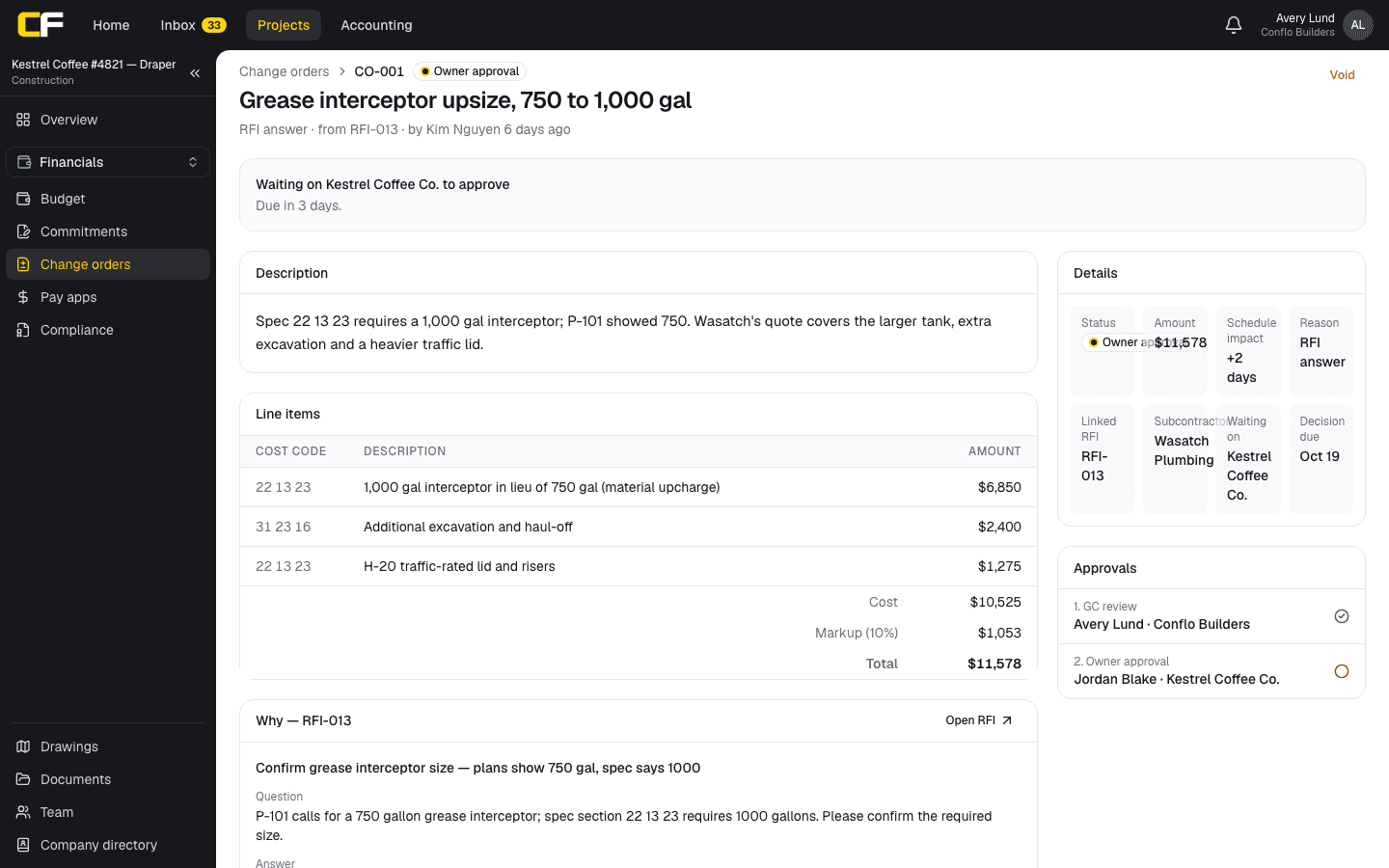
In Conflo a change order records its reason (RFI, owner request, field condition or design error) and can link to the RFI that caused it. You price it in lines, each with a cost code, a description and an amount, and set one markup percentage, from 0 to 50%, applied to the total cost; the owner price is cost plus markup, calculated to the cent. Days added or saved are recorded on every change order. Each one has a Files section everyone on it sees, and a Cost backup section for quotes, takeoffs and receipts that only the GC and that change order's sub see. It goes through GC review, then owner approval.
A subcontractor can quote a change order for its scope and sees its own cost, never the GC's markup or the owner price. Once executed, the change raises the contract sum on pay apps, and a sub's quoted cost is added to its commitment. Limits today: lines are amounts, without separate labor-hours, material or equipment fields, and there is one markup rate rather than separate rates for own work, sub work, insurance and bond.
The bottom line
A change order price that gets approved quickly is built in the same order every time: direct cost by group, the contract's markups applied once each, days with schedule logic, and backup a stranger could follow. The percentages differ from contract to contract; the method does not.
Read your changes article before the first change arrives, and price every change the same way.
Sources
- FAR 52.243-4, Changes — Acquisition.gov, U.S. General Services Administration. Read October 16, 2026.
- Local Assistance Module 8: Payment (January 2026), force account under Standard Specifications 9-1.04 — California Department of Transportation (Caltrans). Read October 16, 2026.
Questions
How do you price a change order?
Total the direct cost first: burdened labor, materials with tax, equipment, and subcontractor quotes. Add the markups the contract allows, typically overhead and profit on your own work, a lower markup on sub work, then insurance and bond. Add the days of schedule impact and attach quotes, timesheets and invoices.
What markup is allowed on a change order?
Whatever your contract says. There is no standard rate. Some contracts state percentages for own work and for subcontracted work; public agencies often publish them, such as Caltrans' 35% on labor and 10% on subcontracted force-account work. If the contract is silent, the markup is negotiated. Check your contract.
Can a general contractor mark up a subcontractor's change order?
Usually, yes, at the rate the contract allows for subcontracted work, which is often lower than the rate on self-performed work. The sub's own overhead and profit are already inside its quote, so the GC's markup covers managing the sub, not the sub's costs again.
What is labor burden on a change order?
Labor burden is the cost of an hour of labor above the base wage: payroll taxes, workers' compensation insurance, benefits and fringes. It is added to the wage to get the burdened rate. It varies by trade, state and company, so back it with payroll records.
Should a change order include schedule time?
Yes. State the days added or saved in the same change order as the price, with the schedule logic. A change order signed with no days usually ends the time question for that change. If the delay cannot be priced yet, reserve the right in writing.
Related
Template
Change Order Pricing Calculator
A free change order pricing calculator (Excel): direct cost, markup on your own and subcontracted work, insurance and bond, to the cent. No email needed.
· 4 min read
Money
How Does a Subcontractor Write a Change Order Request?
A sub's change order request: notice first, then scope, priced direct cost, your markup, days and backup the GC can pass to the owner. Worked example.
· 9 min read
Bidding
Markup vs Margin: How Should a Contractor Price Work?
Markup is a percentage of cost; margin is a percentage of price. A 20% markup is a 16.7% margin. Conversion table and a worked remodel example.
· 5 min read
Definition
Change Order vs Construction Change Directive
A change order is an agreed change in scope, price and time; a construction change directive orders the work before price or time is agreed.
· 4 min read
Role hub
The General Contractor's Guide: Bid to Closeout
What a general contractor is responsible for at every phase of a commercial job, from bidding and buyout to RFIs, change orders, pay apps and closeout.
· 8 min read