
How Do You Bill for Stored Materials on a Pay App?
By Wyatt Cooper · Published · 7 min read
Key takeaways
- Stored materials are materials delivered and paid for but not yet installed; where the contract allows it, you bill them before installation, with backup.
- Send the invoice, proof of where the material is stored, insurance and, where asked, evidence that title passes to the owner; off-site storage usually needs the contract's explicit permission.
- Bill stored materials at invoice cost with no overhead or profit where the specification says so, and move them to work completed as they are installed.
- In the worked example, $58,400.00 of switchgear is billed as stored in one period; when half is installed, $29,200.00 moves to work completed and only $11,000.00 of new labor is billed.
To bill stored materials on a pay app, enter the value of materials delivered but not yet installed in the stored-materials column of the line they belong to, at invoice cost, and attach the backup the contract asks for: the paid invoice, where they are stored, insurance and evidence of title. As material is installed, move it out of stored and into work completed, so it is never billed twice. Off-site storage usually needs the contract's permission.
What counts as stored materials
Stored materials are materials or equipment bought or fabricated for the job and delivered, but not yet built in: switchgear in a locked container on site, fixtures in a bonded warehouse, fabricated steel in the fabricator's yard. A standard continuation sheet has a column for materials presently stored, not in work completed (AIA's G703 summary describes the sheet). The basics are in how a subcontractor fills out a pay application; this post is the backup and the period-to-period method.
On federal work the rule is in the payments clause. In preparing estimates, the Contracting Officer may authorize material delivered on the site to be taken into consideration. Material delivered to locations other than the site may also be taken into consideration only if the contract specifically authorizes it and the contractor furnishes satisfactory evidence that it has acquired title to the material and that it will be used to perform the contract (FAR 52.232-5, paragraph (b)(2)). Material and work covered by progress payments become the Government's property at the time of payment, without relieving the contractor of responsibility for it (paragraph (f)).
The backup owners ask for
Owner specifications spell out the package. The University of Houston's payment procedures section is a clear public example: it asks for a separate schedule-of-values line for each part of the work that may include stored materials, with on-site and off-site storage told apart, and for a certificate of insurance, evidence of transfer of title to the owner and consent of surety, paid invoices that match the amount requested, and no overhead and profit on stored materials (Section 01 29 00).
| Backup | What it proves | Usually needed for |
|---|---|---|
| Paid supplier invoice | What the material cost, and that you paid for it | On site and off site |
| Delivery ticket or photos with location | It arrived, and where it is | On site and off site |
| Certificate of insurance | Loss or theft in storage is covered | Often both; always off site |
| Bill of sale or title transfer | The owner gets title when it pays | Off site; some owners on site too |
| Consent of surety | Your bond's surety agrees to the payment | Bonded jobs where the specification asks |
| Storage agreement or warehouse receipt | The material is set aside and labeled for this job | Off site |
The same section asks for a summary each month: the value of materials stored as of the previous application, the value of those materials put in place since then, and the value newly stored since then and still stored. That three-part summary is the easiest way to show nothing is billed twice.
A worked example: switchgear over two pay apps
The job and companies are fictional. "Brightline Electric" has a schedule-of-values line "Switchgear and panelboards" worth $84,000.00: $62,000.00 of equipment and $22,000.00 of installation. Retainage is 10%. In period 5 the switchgear arrives and is locked in a container on site; the paid invoice is $58,400.00. In period 6 half of it is set and terminated, and half of the installation labor is done.
| Pay app | Previous (work) | Work this period | Presently stored | Completed and stored to date | % | Balance to finish |
|---|---|---|---|---|---|---|
| 5 | $0.00 | $0.00 | $58,400.00 | $58,400.00 | 69.52% | $25,600.00 |
| 6 | $0.00 | $40,200.00 | $29,200.00 | $69,400.00 | 82.62% | $14,600.00 |
Period 6's work this period is the installed half of the equipment, $29,200.00, moved out of stored, plus half of the installation, $11,000.00: $40,200.00. The other $29,200.00 is still stored. Completed and stored to date is $40,200.00 + $29,200.00 = $69,400.00. The new money in period 6 is only $69,400.00 − $58,400.00 = $11,000.00; the installed switchgear was already paid as stored. Stored material is billed at the paid invoice, so the $3,600.00 between the invoice and the equipment's $62,000.00 scheduled value is billed as work with the last of the line, when all the gear is installed.
| Pay app | New billing on the line | Retainage at 10% | Due on the line |
|---|---|---|---|
| 5 | $58,400.00 | $5,840.00 | $52,560.00 |
| 6 | $11,000.00 | $1,100.00 | $9,900.00 |
Stored materials summary — pay app 6, line 9 Switchgear and panelboards
- Stored as of pay app 5
- $58,400.00 (container 2, on site)
- Previously stored, put in place this period
- $29,200.00 (main switchboard and two panelboards)
- Newly stored this period
- $0.00
- Presently stored
- $29,200.00
- Backup
- Paid invoice 44719, delivery ticket, container photos, certificate of insurance
Percentages are rounded to two decimals: $58,400.00 ÷ $84,000.00 = 69.52% and $69,400.00 ÷ $84,000.00 = 82.62%. To run your own numbers, the pay application workbook has a stored-materials column on every line, and how to calculate retainage covers the 10%.
Mistakes that get stored materials cut
- Billing material that has not been delivered, or that is ordered but not paid for.
- Billing off-site material when the contract does not allow it, or without the insurance and title evidence it asks for.
- Adding overhead and profit to stored materials when the specification says invoice cost.
- Billing installed material a second time as work completed, instead of moving it out of stored.
- No separate line for the stored item, so the GC cannot see what is stored and what is installed.
The GC checks all of this before it signs its own application; how it does is in how a GC reviews a subcontractor's pay app. More on a sub's billing is in the subcontractor's guide and the project lifecycle.
How it works in Conflo
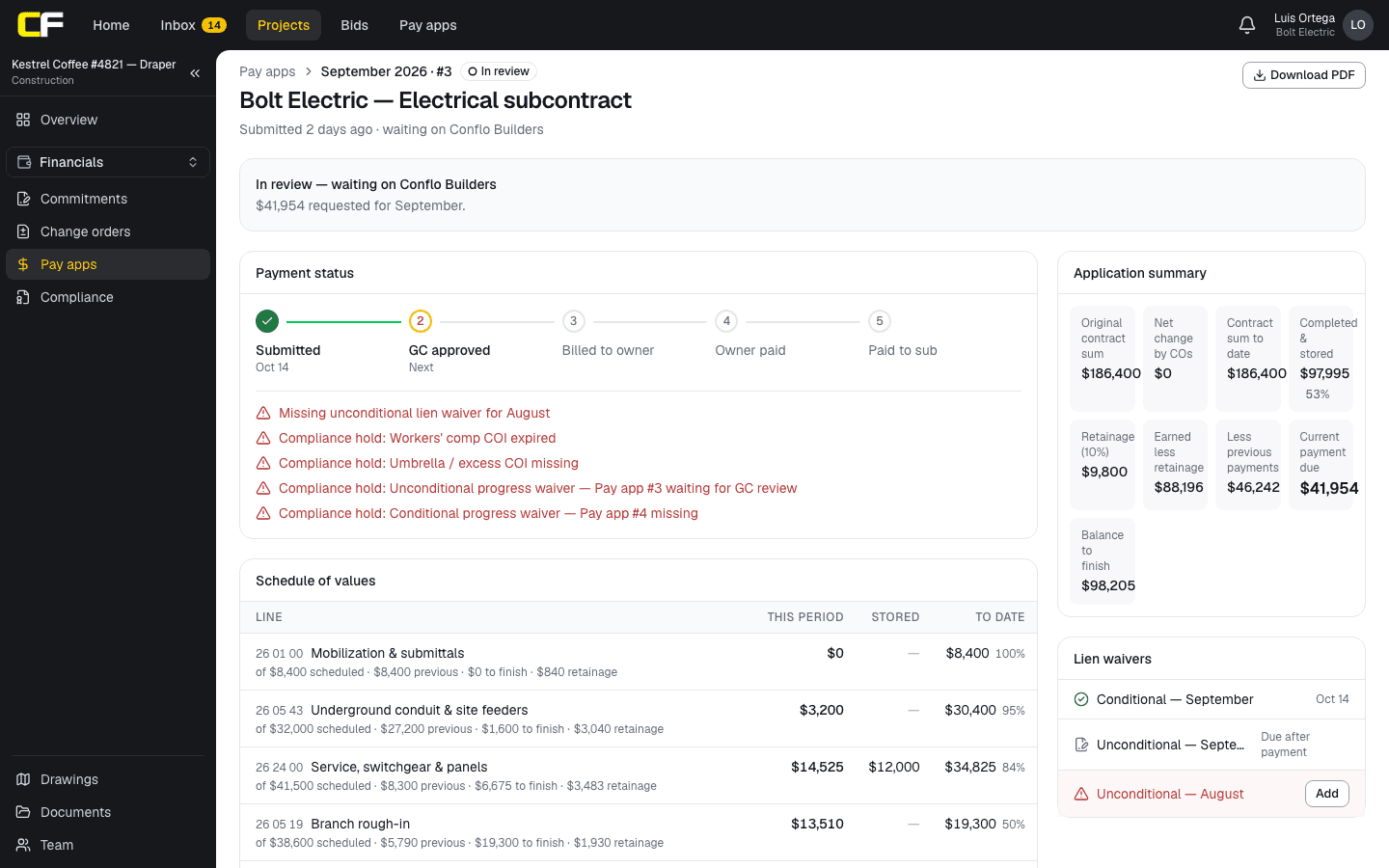
On a Conflo pay app, every schedule-of-values line has a this-period percent and a Stored amount in dollars. Stored counts toward completed to date and the balance, and the GC's pay app to the owner has a This period panel showing the work completed, materials stored and retainage held. The form refuses a line that would bill past 100% of its scheduled value.
Conflo counts a stored amount once: on the next pay app it is part of that line's Previous, so when the material is installed you bill only the work that is new, such as the installation labor. In the example, pay app 5 would show $58,400.00 stored and pay app 6 $11,000.00 of work this period. Limit today: one Stored amount per line, with no field for where it is stored or whether it is on site or off.
The bottom line
Stored materials are billable when the contract allows them and the backup proves cost, location, insurance and title. Bill them at invoice cost on their own line.
Move them to work completed as they are installed, and attach a short summary each month so nobody wonders whether anything is billed twice.
Sources
- FAR 52.232-5, Payments under Fixed-Price Construction Contracts — Acquisition.gov, U.S. General Services Administration. Read October 22, 2026.
- Section 01 29 00, Payment Procedures (master construction specification) — University of Houston, Facilities Planning and Construction. Read October 22, 2026.
- Summary: G703–1992, Continuation Sheet — AIA Contract Documents (The American Institute of Architects). Read October 22, 2026.
Questions
What are stored materials on a pay application?
Materials or equipment delivered for the job and paid for but not yet installed. Where the contract allows it, they are billed in the stored-materials column of their line and move to work completed when installed.
Can you bill for materials stored off site?
Only if your contract allows it. Federal contracts allow it only where the contract specifically authorizes it and the contractor shows it has title and the material will be used on the contract; owners usually also ask for insurance and a storage agreement.
Do you add markup to stored materials?
Often not. Some owner specifications, such as the University of Houston's, say to bill stored materials at the documented amount with no overhead and profit. Check yours.
What happens to stored materials when they are installed?
They move out of the stored column and into work completed. The line's completed-to-date total doesn't change for the material itself; only new work, such as installation labor, is new billing.
Is retainage held on stored materials?
Usually, at the same rate as work completed, unless your contract says otherwise.
Related
Money
How Does a Subcontractor Fill Out a Pay Application?
A subcontractor's pay app bills percent complete and stored materials per schedule-of-values line, less retainage and prior payments, with a lien waiver.
· 9 min read
Template
Free Pay Application Template With Schedule of Values
A free Excel pay application: a summary sheet and a schedule of values with change orders, stored materials and retainage, calculated. No email needed.
· 4 min read
Money
How Do You Bill a Change Order on a Pay App?
Add an executed change order to your pay app: its own line, the new contract sum, partial billing, deducts and retainage, with a worked example.
· 7 min read
Money
How Does a GC Review a Subcontractor's Pay App?
Check each line against the field, stored materials against backup, change orders against approvals, then the math and the lien waivers. With an example.
· 7 min read
Role hub
The Subcontractor's Guide: Bidding to Getting Paid
Every step of a commercial job from the subcontractor's seat: bidding, the subcontract, submittals, RFIs, change orders, pay apps, retainage and closeout.
· 9 min read