
What Are Prompt Payment Acts in Construction?
By Wyatt Cooper · Published · 8 min read
Key takeaways
- A prompt payment act is a statute that sets deadlines for paying contractors and subcontractors and charges interest or a penalty when a payment is late.
- On federal construction, interest runs on an approved progress payment unpaid more than 14 days after the agency receives the request, and the prime must pay subs within 7 days of being paid (31 U.S.C. §§ 3903 and 3905).
- States have their own acts: in four of the five largest construction states a GC has seven days after being paid to pay its subs on private work, and on Texas public work it has 10 days.
- The clock starts on a date you can prove: when the payment request was received, or when the GC was paid; keep both, because every interest claim is counted from them.
Prompt payment acts are laws that require owners, contractors and subcontractors to pay within set deadlines and add interest or penalties when they do not. The federal Prompt Payment Act, 31 U.S.C. § 3901 and following, covers federal agencies and requires primes to pay subs within 7 days of being paid. Each state has its own rules for state, local and often private jobs, such as 35 days for a Texas private owner. Deadlines, exceptions and rates differ, so read the statute that governs your job.
What a prompt payment act does
Construction money moves down a chain: owner to general contractor, GC to subcontractor, sub to sub-tier and supplier. A prompt payment act puts a deadline on each link. Most do three things: set when a payment is due, limit what may be withheld (often only an amount in good faith dispute), and add interest or a penalty to a late payment. Some also let an unpaid contractor suspend work after notice.
The federal Prompt Payment Act, 31 U.S.C. § 3901 and following
The federal act applies when a federal agency buys property or services, including construction (31 U.S.C. ch. 39, U.S. Code 2024 edition). For construction, the key rules are:
- Progress payments. Interest is owed on a progress payment approved as payable that "remains unpaid for a period of more than 14 days after receipt of the payment request" by the designated office, or a longer period stated in the solicitation for inspection (§ 3903(a)(6)(A)).
- Retainage. Approved retainage not paid by the date in the contract, or "by the 30th day after final acceptance" if none is set, also draws interest (§ 3903(a)(6)(B)).
- Defective invoices. An agency must return an improper invoice "not later than 7 days" after receipt with its reasons, or lose days from its own deadline (§ 3903(a)(7)).
- Subcontractors. Every federal construction contract must require the prime to include in each subcontract a clause to pay the sub "for satisfactory performance under its subcontract within 7 days out of such amounts as are paid to the prime contractor," with an interest penalty if late, and the same clauses must flow to every lower tier (§ 3905(b) and (c)).
- Interest rate. Interest is computed at the rate the Secretary of the Treasury sets and publishes in the Federal Register (§ 3902(a)); it changes, so look it up for the period.
A prime may still withhold from a sub under the subcontract, but to avoid interest it must give the sub written notice of the withholding before the payment is due and send a copy to the government (§ 3905(d) and (e)).
State prompt payment acts in the five largest construction states
Every state sets its own rules, and many have separate acts for public and private work. Here are the main deadlines in the five states with the most construction work, by the Census Bureau's 2022 Economic Census.
| State | Owner to GC | GC to sub | Late payment |
|---|---|---|---|
| California (private) | Within 30 days after notice demanding payment under the contract, unless otherwise agreed in writing (Civ. Code § 8800) | Not later than seven days after receipt of each progress payment, unless otherwise agreed in writing (Bus. & Prof. Code § 7108.5, private and public, with an exception) | 2% per month (both sections) |
| Texas (private) | Not later than the 35th day after the owner receives a written payment request (Prop. Code § 28.002(a)) | Not later than the seventh day after receiving the owner's payment (§ 28.002(b)) | 1.5% per month (§ 28.004) |
| Texas (public) | Overdue on the 31st day after the later of delivery, completion or the invoice (Gov't Code § 2251.021) | Not later than the 10th day after the vendor receives payment (§ 2251.022) | Prime rate plus 1% (§ 2251.025) |
| Florida (private) | When the contract says, once the request, the waivers and affidavits are in (§ 715.12(4)) | Once paid by the party above for that work (§ 715.12(4)) | The § 55.03 rate plus 12% a year, from the 14th day after due (§ 715.12(5)) |
| New York (private, $150,000 or more) | Approve or disapprove within 12 business days; pay within 30 days after approval (Gen. Bus. Law § 756-a) | Seven days after receipt of good funds (§ 756-a) | 1% per month (§ 756-b) |
| North Carolina (private) | Not set in Chapter 22C | Within seven days of receiving each periodic or final payment (G.S. 22C-3) | 1% per month from the eighth day (G.S. 22C-5) |
Two details matter as much as the days. North Carolina says payment to the contractor "is not a condition precedent for payment to a subcontractor" and makes a contrary agreement unenforceable (G.S. 22C-2). Florida says an obligee "may not waive the right to receive interest before a payment is due" (Fla. Stat. § 715.12). Sources: Cal. Civ. Code § 8800, Cal. Bus. & Prof. Code § 7108.5, Tex. Prop. Code ch. 28, Tex. Gov't Code ch. 2251, N.Y. Gen. Bus. Law § 756-a and § 756-b.
Worked example: a federal pay request, day by day
A fictional concrete subcontractor, "Ridgeback Concrete", works for a GC on a fictional federal courthouse annex. The GC's October pay request includes Ridgeback's $86,400.00 of work, and the contract sets no longer inspection period.
- 1October 2, 2026The agency's designated office receives the GC's payment request
- 2By October 9If the request is improper, the agency must return it with reasons within 7 days (§ 3903(a)(7))
- 3After October 16An approved progress payment still unpaid more than 14 days after receipt starts to draw interest (§ 3903(a)(6)(A))
- 4October 14The agency pays the GC, on time
- 5By October 21The GC must pay Ridgeback its $86,400.00 share, less retainage the subcontract allows, within 7 days, or owe interest (§ 3905(b))
The count: October 2 plus 7 is October 9, plus 14 is October 16, and October 14 plus 7 is October 21. Ridgeback's best evidence is the date the GC was paid, which is why subs ask for it. If the GC withholds part of the payment for a performance problem, it must send Ridgeback written notice before October 21 and a copy to the agency.
How to use prompt payment rules as a subcontractor
- Find which act applies: federal, the state's public-works act, or its private act. The project's owner and state decide it, not where your office is.
- Read your subcontract's payment clause against the statute. Many statutes allow "unless otherwise agreed in writing"; others void a waiver.
- Submit a complete pay application on the GC's schedule, with the lien waivers it requires: see how to fill out a pay application as a subcontractor and how to fill out a conditional lien waiver.
- Record two dates for every payment: when your request was received and when the GC was paid. Interest and penalties are counted from them.
- When a payment is late, ask in writing, cite the statute and the dates, and state the interest; talk to an attorney before suspending work.
For more ways to shorten the wait, see how a subcontractor can get paid faster.
How it works in Conflo
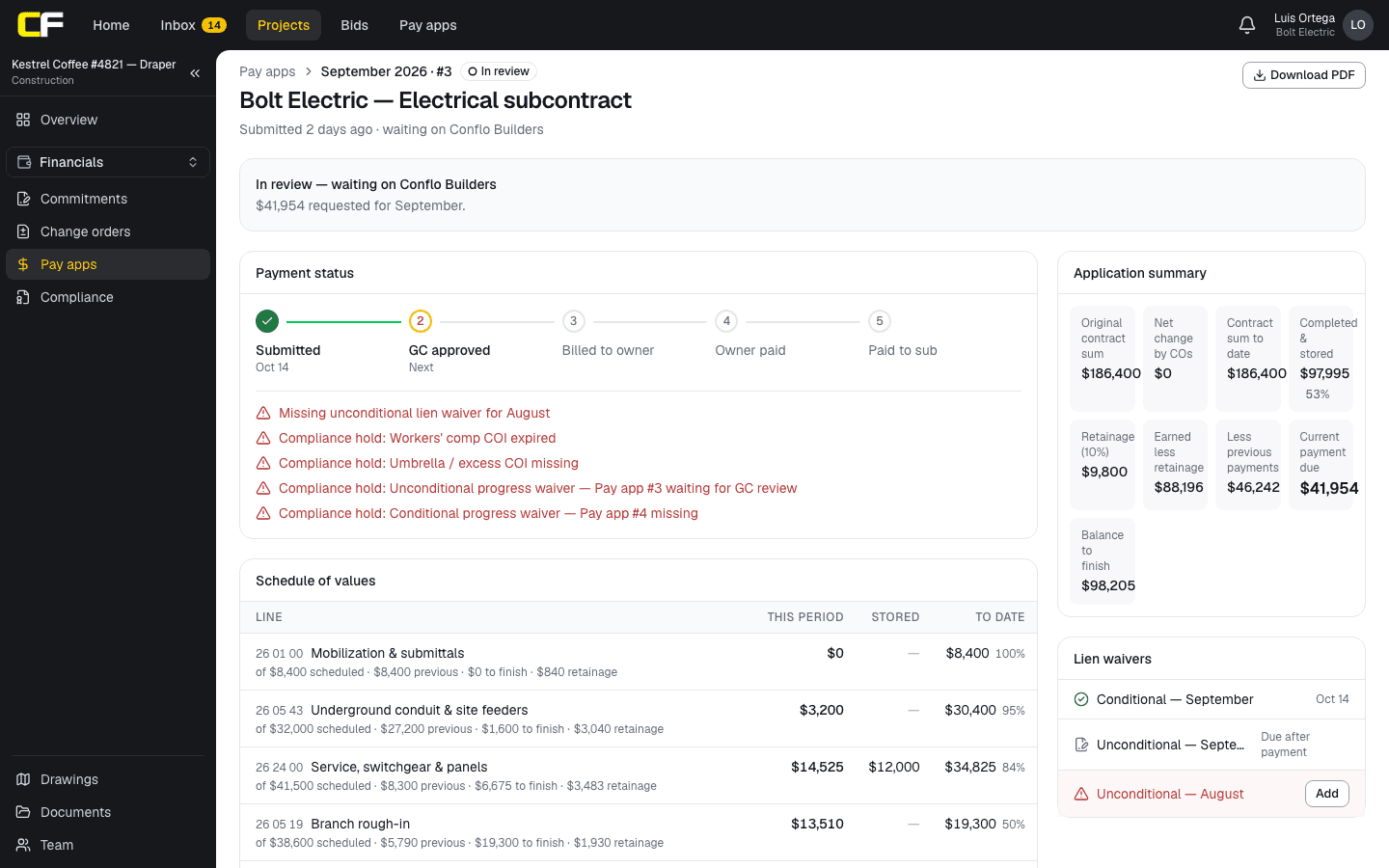
On Conflo's pay applications, each sub pay app has a payment tracker that records the date of every step: submitted, GC approved, billed to owner, owner paid and paid to sub. The sub sees the same tracker on its own pay app, so both dates a prompt-pay claim counts from (when the request went in and when the GC was paid) are on the record.
Not built: prompt-pay deadline reminders, statutory interest calculations or notices of withholding.
The bottom line
Prompt payment acts turn "pay when you can" into dates: 14 days for a federal agency on a progress payment, 35 days for a Texas private owner, and about a week for a GC to pass payment down in most of the largest states.
Find the act that governs your next job before you start it, note the deadline for each link in the chain, and keep the receipt and payment dates for every pay app.
Sources
- 31 U.S.C. Chapter 39, Prompt Payment (U.S. Code, 2024 edition) — U.S. Government Publishing Office, govinfo. Read October 16, 2026.
- California Civil Code § 8800 — California Legislative Information. Read October 17, 2026.
- California Business and Professions Code § 7108.5 — California Legislative Information. Read October 17, 2026.
- Texas Property Code Chapter 28, Prompt Payment to Contractors and Subcontractors — Texas Legislature. Read October 16, 2026.
- Texas Government Code Chapter 2251, Payment for Goods and Services — Texas Legislature. Read October 16, 2026.
- Florida Statutes § 715.12 (2026), Construction Contract Prompt Payment Law — The Florida Senate. Read October 16, 2026.
- New York General Business Law § 756-A — New York State Senate. Read October 16, 2026.
- New York General Business Law § 756-B — New York State Senate. Read October 16, 2026.
- North Carolina G.S. Chapter 22C, Payments to Subcontractors — North Carolina General Assembly. Read October 16, 2026.
Questions
What is a prompt payment act in construction?
A statute that sets deadlines for paying contractors and subcontractors and adds interest or a penalty to late payments. The federal act covers federal agencies and their contractors; each state has its own acts for public and often private work.
How many days does a GC have to pay a subcontractor?
It depends on the statute. On federal jobs, 7 days after the prime is paid. In California, Texas private work, New York covered private work and North Carolina, seven days after the contractor receives payment; on Texas public work, 10 days. Check your state and your subcontract.
Does the federal Prompt Payment Act apply to subcontractors?
Yes, through the subcontract. 31 U.S.C. § 3905 requires every federal construction contract to make the prime include a 7-day payment clause and an interest penalty clause in each subcontract, and to flow the same clauses to every lower tier.
Can a GC withhold payment under a prompt payment act?
Usually only for a good faith dispute or a reason the contract allows, and often only up to a limit, such as 150% of the disputed amount in California. On federal jobs, the prime must give the sub written notice before the payment is due.
What interest is owed on a late construction payment?
Whatever the governing statute says: 2% per month in California, 1.5% per month on Texas private work, 1% per month in New York and North Carolina, prime plus 1% on Texas public work, and the Treasury rate on federal jobs.
Related
Money
How Can a Subcontractor Get Paid Faster?
Subcontractors get paid faster by billing on the GC's cutoff, sending clean pay apps and waivers, and using the prompt-pay dates that start the clock.
· 6 min read
Money
How Does a Subcontractor Fill Out a Pay Application?
A subcontractor's pay app bills percent complete and stored materials per schedule-of-values line, less retainage and prior payments, with a lien waiver.
· 9 min read
Money
Retainage Laws in the Five Largest Construction States
Retainage caps and release deadlines in California, Texas, Florida, New York and North Carolina, from each state's statutes, private and public.
· 10 min read
Money
How Do You Fill Out a Conditional Lien Waiver?
Fill out a conditional lien waiver field by field: the claimant, customer, through date, check details and exceptions, tied to the pay app's figures.
· 8 min read
Role hub
The Subcontractor's Guide: Bidding to Getting Paid
Every step of a commercial job from the subcontractor's seat: bidding, the subcontract, submittals, RFIs, change orders, pay apps, retainage and closeout.
· 9 min read