
What Is a Pay Application in Construction?
By Wyatt Cooper · Published · 3 min read
Key takeaways
- A pay application (pay app) is a contractor's request for a progress payment, usually monthly, for work completed and materials stored to date.
- It has a one-page summary and a line-by-line sheet billed against the schedule of values; the amount due is the to-date total less retainage and previous payments.
- Unlike an invoice, it is reviewed and certified before payment, often by the architect or the owner's representative.
A pay application, or pay app, is a construction contractor's formal request for a progress payment. It lists work completed and materials stored to date against each line of the schedule of values, then subtracts retainage and previous payments to show the amount due. The paying party, often through the architect, reviews and certifies it before paying.
What is on a pay application
Most pay apps have two parts. The summary carries the contract sum, net change by change orders, completed and stored to date, retainage, previous payments and the current payment due. The continuation sheet shows each schedule-of-values line. The AIA's G702 is a widely used summary form, described by the AIA as "both the contractor's application and the architect's certification" (AIA G702 summary); many owners and GCs use their own forms with the same figures.
Public owners have their own versions. Federal contracts require each progress payment request to itemize the amounts by element of work and list what each subcontractor is owed and has been paid (FAR 52.232-5), and GSA's construction progress report runs from contract amount through retainage and previous payments to the amount of this payment (GSA Form 184).
Example
Pay application 3: summary
- 1. Original contract sum
- $240,000.00
- 2. Net change by approved change orders
- $4,850.00
- 3. Contract sum to date
- $244,850.00
- 4. Completed and stored to date
- $118,825.00
- 5. Retainage (10% of line 4)
- $11,882.50
- 6. Total earned less retainage
- $106,942.50
- 7. Less previous payments
- $65,520.00
- 8. Current payment due
- $41,422.50
- 9. Balance to finish, including retainage
- $137,907.50
The arithmetic: $118,825.00 − $11,882.50 = $106,942.50; less $65,520.00 is $41,422.50; $244,850.00 − $106,942.50 = $137,907.50. The free pay application workbook has this example in Excel, and how to calculate retainage explains line 5.
Pay application vs. invoice
An invoice bills a price for goods or a service delivered. A pay application bills progress on a contract that is still running: it is cumulative (every figure is to date), it holds back retainage, and it is checked against the work before it is paid. Subcontractors send theirs to the GC, and the GC rolls them into its own to the owner: see how a subcontractor fills out a pay application.
How it works in Conflo
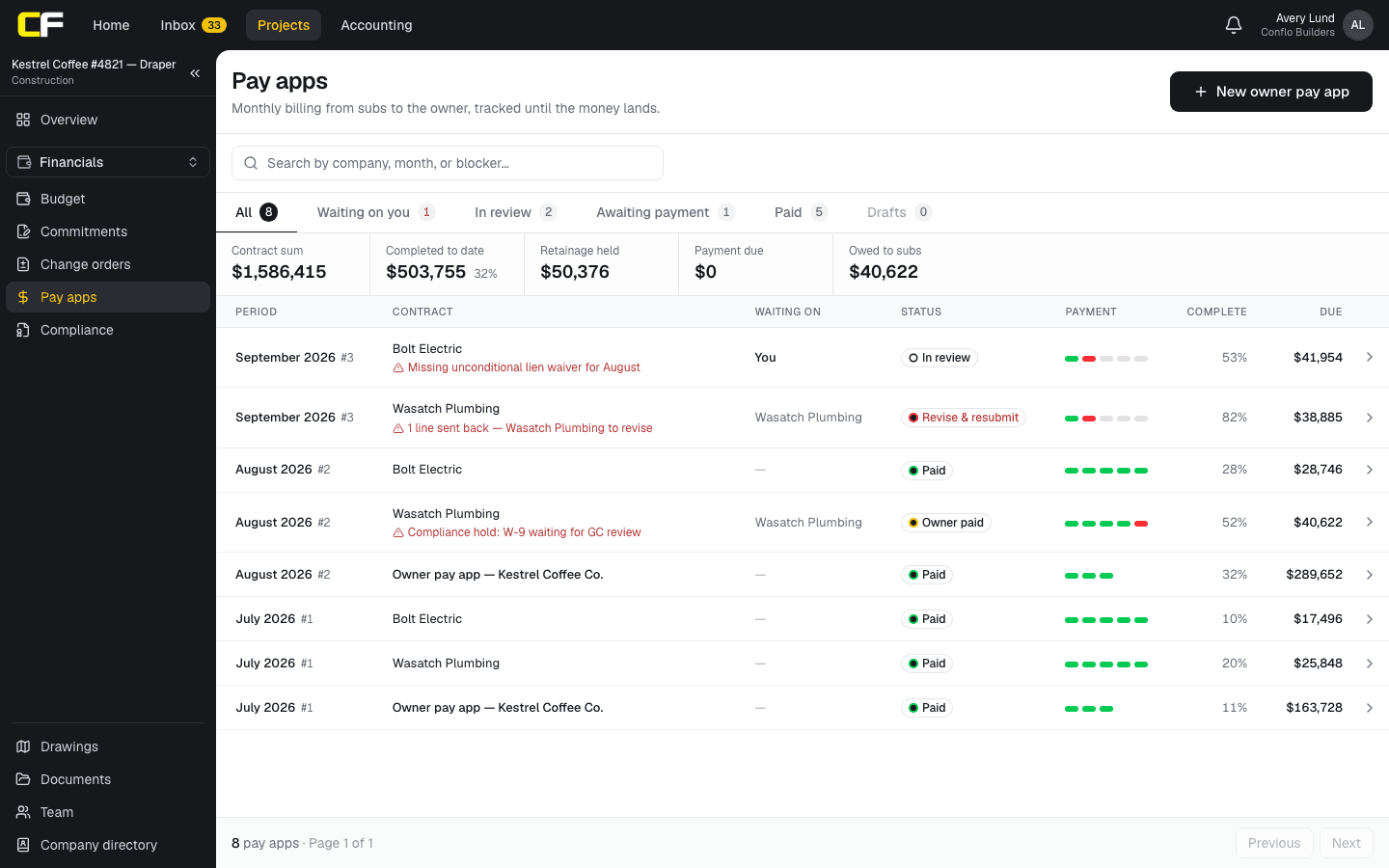
Conflo's pay apps calculate the summary and the line-by-line sheet from the schedule of values and earlier pay apps, in Conflo's own layout. Subs bill the GC, the GC reviews and rolls approved billing into the owner pay app, and the owner approves it.
The bottom line
A pay application is the monthly, cumulative bill on a construction contract: to-date progress against the schedule of values, less retainage and what has already been paid.
The form varies by owner; the arithmetic does not.
Sources
- Summary: G702–1992, Application and Certificate for Payment — AIA Contract Documents (The American Institute of Architects). Read October 16, 2026.
- FAR 52.232-5, Payments under Fixed-Price Construction Contracts — Acquisition.gov, U.S. General Services Administration. Read October 16, 2026.
- GSA Form 184, Construction Progress Report — U.S. General Services Administration. Read October 16, 2026.
Questions
How often are pay applications submitted?
Usually monthly, on a date the contract sets. Federal fixed-price construction pays progress monthly or at shorter intervals the contracting officer sets.
Do I have to use the AIA G702 and G703?
Only if your contract says so. Many owners and GCs require them or their own forms; the figures are the same either way.
Who certifies a pay application?
On many owner contracts, the architect certifies the amount due; on others, the owner's representative or, on federal work, the contracting officer approves it. On a subcontract, the GC reviews and approves the sub's pay app.
Related
Definition
What Is a Schedule of Values?
A schedule of values splits a construction contract sum into line items that every pay application bills against. Definition, example and how it differs.
· 3 min read
Money
How Does a Subcontractor Fill Out a Pay Application?
A subcontractor's pay app bills percent complete and stored materials per schedule-of-values line, less retainage and prior payments, with a lien waiver.
· 9 min read
Money
How Does a GC Review a Subcontractor's Pay App?
Check each line against the field, stored materials against backup, change orders against approvals, then the math and the lien waivers. With an example.
· 7 min read
Template
Free Pay Application Template With Schedule of Values
A free Excel pay application: a summary sheet and a schedule of values with change orders, stored materials and retainage, calculated. No email needed.
· 4 min read
Role hub
The General Contractor's Guide: Bid to Closeout
What a general contractor is responsible for at every phase of a commercial job, from bidding and buyout to RFIs, change orders, pay apps and closeout.
· 8 min read