
The Owner's Guide to a Commercial Building Project
By Wyatt Cooper · Published · 7 min read
Key takeaways
- The owner's biggest decisions come before construction: the delivery method, the contract form and who builds it.
- During construction the owner's job is to decide on time: approve or question each pay application, change order and design question that waits on you.
- Every dollar the owner pays should trace to a contract line, an approved change or a measured quantity; ask for the backup when it doesn't.
- Closeout is where owners lose the most leverage: hold retainage until the punch list, warranties, manuals and final lien waivers are in.
On a commercial building project the owner sets the goals, budget and schedule, chooses the delivery method and the team, signs the contracts, pays the contractor monthly, decides on changes, and accepts the finished building. The owner doesn't direct the trades; it decides, on time, what is waiting on it. This guide walks each phase and links the detailed guide for each step.
What the owner is responsible for
The Construction Management Association of America's owner's guide defines the owner as "the private or public organization ultimately responsible for the proper execution of the project". In practice that means five jobs no one else can do for you: set the program, budget and schedule; choose how the project is delivered and who delivers it; pay for the work as it is done; decide on changes to scope, price and time; and accept the building at the end.
The contract spells out the rest. Under the AIA's general conditions (A201–2017), for example, the owner furnishes surveys of the site (§2.3.4), gives the contractor reasonable evidence on request that it has arranged the financing (§2.2.1), and signs change orders with the contractor and architect (§7.2.1). Other contract forms divide the duties differently, so read yours before the job starts, not when a dispute does.
Most owners also hire help. The CMAA's guide describes an agency construction manager who acts as the owner's principal adviser through the job, and an owner's representative does a similar job on smaller projects. Neither replaces your decisions; they make sure you have what you need to make them on time.
Before design: choose how the project will be delivered
The delivery method sets how many contracts you sign, when the builder joins and when the price is fixed. Design-bid-build fixes the price by bid on finished drawings; design-build puts design and construction in one contract; construction manager at risk brings the builder in during design and caps the price before construction. The side-by-side is in design-bid-build vs design-build vs CM at risk.
If you choose CM at risk, the price you agree is usually a guaranteed maximum price: actual cost plus a fee, up to a ceiling, with savings returned or shared. What is a GMP contract works an example of both a saving and an overrun, so you can see what the contract's savings clause is worth before you sign it.
Questions to settle here: how certain is the scope, how fast must the building open, how much will the design change, and how much of your own staff time can the project take? The CMAA's guide lists the same considerations (time, flexibility, preconstruction help, design interaction and financing) as the basis for choosing a method.
Choosing the contractor
Shortlist on qualifications before you look at price: similar work, the named project manager and superintendent, financial strength and bonding, safety, and the schedule approach. The federal test of a "responsible" contractor (FAR 9.104-1) is a useful checklist even on private work. The full method, with a scoring example, is in how to choose a general contractor.
When proposals arrive, compare them line by line, not cover page to cover page. Price every exclusion and every short allowance from your own estimate so each total covers the same scope, then weigh schedule and terms. How to compare contractor proposals shows three proposals where the lowest cover page finishes second once the exclusions are priced.
Contractors do the same thing one level down when they choose their subcontractors; how GCs level sub bids shows what your GC's leveling sheet should look like, which is worth asking to see on a GMP job.
During construction: decide on time
Once work starts, the owner's calendar fills with decisions that hold up the job if they wait: questions from the contractor that need the owner's answer, change orders to approve, and a pay application every month.
- Pay applications: check that each line's percent complete matches what is in place, that stored materials are allowed by the contract and documented, and that retainage is held at the contract's rate. How retainage is calculated works the numbers, and how a sub fills out a pay app shows where the GC's billing comes from.
- Change orders: ask what changed, why, and how it was priced, with the subcontractor quotes and the markup the contract allows. How to price a change order shows a priced example from the contractor's side, which tells you what backup to ask for.
- Design questions: the contractor's RFIs go to the architect, but some answers change scope or cost and need your decision. How to write an RFI explains how they move and when an answer becomes a change order.
- Progress: ask for a weekly update with the schedule status, the issues and what is waiting on you, and attend the owner-architect-contractor meeting.
Pay attention to notice deadlines. Most contracts give the contractor a set number of days to claim added cost or time and give the owner a set number of days to answer; a decision that sits on your desk can become a delay claim.
Closeout: what to collect before final payment
Closeout starts at substantial completion, when the building is complete enough for you to occupy or use it for its intended purpose (A201–2017 §9.8.1). The contractor lists what is left, the architect inspects, and the contractor finishes those items. How to build a punch list shows how the list is made and closed.
Hold the final payment and the remaining retainage until you have what you are owed besides the building: operation and maintenance manuals, as-built drawings, warranties in your name, attic stock, training for your staff, and final lien waivers from the contractor and subs. Under A201–2017 the contractor also corrects nonconforming work found within one year after substantial completion (§12.2.2.1), on top of any longer warranties the documents require; put those dates on a calendar.
Every guide for owners
Definition
Hard Costs vs Soft Costs: What Is the Difference?
Hard costs pay for building the project; soft costs pay for everything else, from design fees to loan interest. Definitions and a worked owner's budget.
· 3 min read
Closeout
How Do You Collect O&M Manuals From Subcontractors?
How a GC collects O&M manuals from every trade: request them early by spec section, check them against what was installed, and send back the thin ones.
· 6 min read
Construction
How Do You Document a Weather Delay?
How a GC documents a weather delay that wins a time extension: the daily log entry, the critical path, comparing to normal weather, and the notice.
· 8 min read
Closeout
How Do You Get a Certificate of Occupancy?
The GC's sequence for a certificate of occupancy: plan the final inspections early, clear life safety first, and know when a temporary certificate helps.
· 6 min read
Preconstruction
How Do You Get Added as Additional Insured?
How a GC gets added as additional insured on a sub's policy: the subcontract wording, the endorsement to ask for, and why a certificate alone isn't enough.
· 6 min read
Preconstruction
How Do You Run a Preconstruction Kickoff Meeting?
How a GC runs the preconstruction meeting: who attends, a worked agenda of procedures to agree before work starts, and what to record.
· 7 min read
Construction
How Do You Run an OAC Meeting?
How a GC runs an owner-architect-contractor meeting: who attends, what each party brings, a worked agenda, and how open items carry to the next one.
· 8 min read
Construction
How Do You Update a Construction Schedule?
How to update a construction schedule each month: the data date, actual dates, remaining durations, the baseline comparison and a slip narrative.
· 7 min read
Construction
How Do You Write a Recovery Schedule?
How a GC writes a recovery schedule: measure the slip, price crews, overtime and resequencing, show the days each recovers, and keep the logic honest.
· 8 min read
Preconstruction
How Do You Write a Site Logistics Plan?
How a GC writes a site logistics plan: gates, deliveries, laydown, the crane, fire and exits, the OSHA minimums, and one plan per phase.
· 8 min read
Construction
How Do You Write a Weekly Owner Update?
How a GC writes a one-page weekly owner update: the numbers owners read, schedule status in one line, decisions needed, and an example.
· 7 min read
Preconstruction
How Does a Waiver of Consequential Damages Work?
What an owner gives up and gets under a mutual waiver of consequential damages, how liquidated damages fit, and what to ask before you sign it.
· 6 min read
Construction
How Does an Architect Write a Field Report?
How an architect writes a site visit field report: what to record, the words to use and avoid, a filled-in example, and carrying open items.
· 7 min read
Closeout
How Does Termination for Convenience Work?
What a termination for convenience clause lets an owner or GC do, what a sub must do on notice, and what it can recover, with a worked settlement.
· 6 min read
Money
How Should an Architect Review a Schedule of Values?
Review a contractor's schedule of values before the first pay app: the format checks, then front-loading spotted line by line against the bid.
· 7 min read
Bidding
How Should an Owner Build a Conceptual Estimate?
Build a conceptual estimate as GSA does: cost per square foot by system, then design contingency, markups, escalation and construction contingency.
· 7 min read
Money
How Should an Owner Read a GC's Cost Report?
Read a GC's monthly cost report on a GMP or cost-plus job: current budget, projected final, contingency drawdown and the questions to ask.
· 7 min read
Construction
How Should an Owner Respond to a GC's Delay Claim?
An owner's first 30 days after a contractor's delay claim: check the notice, sort the days by cause, test the schedule and money, answer in writing.
· 6 min read
Closeout
How Should an Owner Track Building Warranties?
An owner's method for tracking building warranties: one list with start dates and terms, expirations worked out, and walks before the clock runs out.
· 6 min read
Bidding
How Should an Owner Write an RFP for a GC?
What an owner's RFP to general contractors contains: the sections, a fee form that compares, stated evaluation weights, the schedule, and a worked example.
· 7 min read
Construction
How to Write Construction Meeting Minutes (With Example)
How to write construction meeting minutes: header, attendance, numbered old and new business, action items with owners and dates, and an example.
· 7 min read
Definition
Lump Sum vs Cost-Plus: What Is the Difference?
A lump-sum contract fixes the price; a cost-plus contract pays actual cost plus a fee. Definitions, a worked comparison, and where a GMP fits.
· 3 min read
Preconstruction
OCIP vs CCIP: How Does Wrap-Up Insurance Work?
OCIP vs CCIP for owners: who buys a wrap-up, what it covers, how bids change, where the gaps are, and how to tell whether it saves money on your project.
· 7 min read
Definition
What Are As-Built Drawings?
As-built drawings are the contract drawings marked up to show what was actually built. Definition, how they differ from record drawings, and an example.
· 3 min read
Definition
What Are Liquidated Damages in Construction?
Liquidated damages are a daily amount, fixed in the contract, that a contractor pays for finishing late. Definition, a worked example, LDs vs. penalties.
· 3 min read
Definition
What Are Performance and Payment Bonds?
A performance bond guarantees the work gets finished; a payment bond, that subs and suppliers get paid. Definitions, the Miller Act rule, an example.
· 3 min read
Definition
What Are Stored Materials on a Pay App?
Stored materials are delivered but not yet installed, billed in their own pay app column. Definition, the rules for on-site and off-site, and an example.
· 4 min read
Definition
What Are the Contract Documents in Construction?
The contract documents are the agreement, conditions, drawings, specifications, addenda and modifications that together make up a construction contract.
· 3 min read
Construction
What Do You Do After a Failed Building Inspection?
What a GC does after a failed building inspection: split the correction notice by trade, fix and check, book the reinspection, protect the schedule.
· 7 min read
Definition
What Is a Bid Alternate?
A bid alternate is a separately priced add or deduct option the owner may accept. Definition, a worked example, and alternate vs. allowance.
· 3 min read
Definition
What Is a Certificate of Occupancy?
A certificate of occupancy is the building department's approval to occupy a building. Definition, temporary COs, and how it differs from completion.
· 3 min read
Definition
What Is a Change Order in Construction?
A change order is a signed amendment to a construction contract that changes the work and adjusts price, time or both. Definition and a worked example.
· 3 min read
Definition
What Is a Committed Cost in Construction?
Committed cost is the value of signed subcontracts and POs on a job, billed or not. Definition, a budget example, and how it differs from actual cost.
· 3 min read
Definition
What Is a Cost Code in Construction?
A cost code is the number that tags every budget line, contract, invoice and change order to the same category of work. Definition and an example.
· 3 min read
Definition
What Is a Notice to Proceed?
A notice to proceed is the owner's written go-ahead to start work, and often starts the contract time. Definition, a worked date example, NTP vs. award.
· 3 min read
Definition
What Is an O&M Manual?
An O&M manual tells the owner how to operate, maintain and repair a building's equipment and systems. Definition, what goes in one, and an example.
· 3 min read
Definition
What Is an OAC Meeting?
An OAC meeting is the regular owner-architect-contractor meeting during construction. What it covers, an example minutes item, and how it differs.
· 3 min read
Definition
What Is Cost to Complete?
Cost to complete is what is still to be spent to finish a job or budget line. Definition, the formula with projected final cost, and a worked example.
· 3 min read
Definition
What Is the Warranty Period in Construction?
The warranty period is how long the contractor must fix defective work after completion. Definition, start dates, repaired work, and a worked example.
· 3 min read
Definition
What Is Value Engineering in Construction?
Value engineering delivers the same function for less without cutting what the owner needs. Definition, a federal savings-sharing example, VE vs. cuts.
· 3 min read
Preconstruction
When Should an Owner Hire an Owner's Rep?
When an owner should hire an owner's representative, what the rep does that the architect and GC don't, how reps are paid, and how to choose one.
· 6 min read
Preconstruction
Who Buys Builder's Risk Insurance on a Project?
Who buys builder's risk on a project, owner or contractor: how the contract decides it, what the policy should insure, and what to ask before you sign.
· 6 min read
Definition
Conditional vs Unconditional Lien Waiver
A conditional lien waiver takes effect only when payment clears; an unconditional one takes effect when signed. The difference, side by side, from statute.
· 3 min read
Closeout
How Do You Assemble a Construction Closeout Package?
A closeout checklist by spec section and company: O&M manuals, as-builts, warranties, attic stock, training, lien waivers. Build it at buyout. Example.
· 9 min read
Preconstruction
How Do You Build a Schedule of Values?
Split the contract sum into billable lines that follow the work, price each with its share of overhead and profit, and keep closeout real. With an example.
· 7 min read
Pricing explainer
How Much Does Procore Cost?
How Procore pricing works: an annual fee per product set by your construction volume, with unlimited users, and what to ask for in a quote.
· 5 min read
Bidding
How Should an Owner Choose a General Contractor?
How a commercial owner chooses a general contractor: pick the delivery method, shortlist on qualifications, check bonding and references, then price.
· 7 min read
Definition
What Are General Conditions in a Construction Bid?
General conditions in a bid are the contractor's cost of running the job: supervision, temporary facilities, site services. Not the A201 contract document.
· 4 min read
Definition
What Is Retainage in Construction?
Retainage is a percentage of each construction progress payment held back until the work is complete. Definition, an example, and how it differs.
· 3 min read
Closeout
How Does an Architect Decide Substantial Completion?
How the architect inspects for substantial completion: the contractor's list, who walks, what blocks use and what is a punch item, and the certificate.
· 8 min read
Money
How Much Contingency Should an Owner Carry?
Owner contingency in construction: design vs construction contingency, GSA's guidelines (7% new, 10% renovation), and how to size and track yours.
· 7 min read
Money
What Are Prompt Payment Acts in Construction?
Prompt payment acts set how fast owners and contractors must pay and what late payment costs. The federal act and five states' rules, with a timeline.
· 8 min read
Definition
What Is Substantial Completion?
Substantial completion is when the work is complete enough for the owner to use it as intended. What it triggers: retainage, warranties, delay damages.
· 3 min read
Money
How Should an Owner Review a Change Order?
How an owner reviews a contractor's change order: is it a change, is the price right, are the markups the contract's, are the days real. Worked example.
· 8 min read
Money
How Should an Owner Review a GC's Pay Application?
An owner's checklist for a contractor's pay application: work in place, stored materials, change orders, retainage, waivers and the math. With an example.
· 6 min read
Money
Texas Retainage Law: What Property Code Ch. 53 Says
Texas retainage from the statutes: the owner's 10% reserve, notice and lien deadlines for unpaid retainage, and the public-works caps of 10% and 5%.
· 9 min read
Definition
What Is a Punch List in Construction?
A punch list is the list of work still to be completed or corrected once a building is substantially complete. What goes on it, who writes it, an example.
· 3 min read
Money
California Retainage Law: Private and Public Jobs
California retention rules from the statutes: the new 5% private cap from 2026, the 5% public cap, release deadlines and the 2% monthly penalty.
· 8 min read
Definition
Design-Bid-Build vs Design-Build vs CM at Risk
Design-bid-build, design-build and CM at risk compared for owners: who holds which contract, when the price is fixed, and when each one fits.
· 4 min read
Definition
What Is a Pay Application in Construction?
A pay application is a contractor's monthly request for payment against the schedule of values, less retainage and earlier payments. With an example.
· 3 min read
Definition
What Is the Critical Path in Construction?
The critical path is the longest chain of linked activities in a construction schedule. A worked five-activity example, float, and what a delay does.
· 4 min read
Definition
Allowance vs Contingency: What Is the Difference?
An allowance is a set sum for a known item not yet chosen; a contingency is money for what nobody can foresee. How each is used and adjusted.
· 4 min read
Money
How Does an Architect Certify a Pay Application?
Review the draft, compare it with what you observed on site, then certify the full amount or a lower one with the changed figures initialed and explained.
· 5 min read
Money
Retainage Laws in the Five Largest Construction States
Retainage caps and release deadlines in California, Texas, Florida, New York and North Carolina, from each state's statutes, private and public.
· 10 min read
Definition
What Is a GMP Contract in Construction?
A GMP contract caps what the owner pays: the cost of the work plus a fee, up to a ceiling. A worked example of shared savings and an overrun.
· 4 min read
Preconstruction
AIA Contract Documents Explained, by Family
A plain map of AIA contract documents: the A, B, C, D, E, F and G series, the families by delivery method, and which forms you meet on a job.
· 8 min read
Definition
Change Order vs Construction Change Directive
A change order is an agreed change in scope, price and time; a construction change directive orders the work before price or time is agreed.
· 4 min read
Construction
How Does an Owner Read a Construction Schedule?
How an owner reads a contractor's schedule: the Gantt chart, milestones, the critical path, float, the baseline, and what to ask at each update.
· 6 min read
Bidding
How Should an Owner Compare Contractor Proposals?
How an owner compares general contractor proposals: put them on one sheet, price every exclusion and allowance, check schedule and terms, then decide.
· 6 min read
Template
Retainage Calculator for Pay Applications
Free retainage calculator: enter work to date and the rate to get retainage held, previous payments and the amount due, including a rate reduction.
· 3 min read
Definition
What Is a Mechanic's Lien?
A mechanic's lien is a legal claim against a property by someone who improved it and was not paid. Who can file one, how it works, and what it is not.
· 3 min read
Definition
What Is a Schedule of Values?
A schedule of values splits a construction contract sum into line items that every pay application bills against. Definition, example and how it differs.
· 3 min read
Closeout
What Should an Owner Get at Project Closeout?
The owner's closeout checklist: what you should get at substantial completion and before final payment, and how to check each document.
· 7 min read
How it works in Conflo
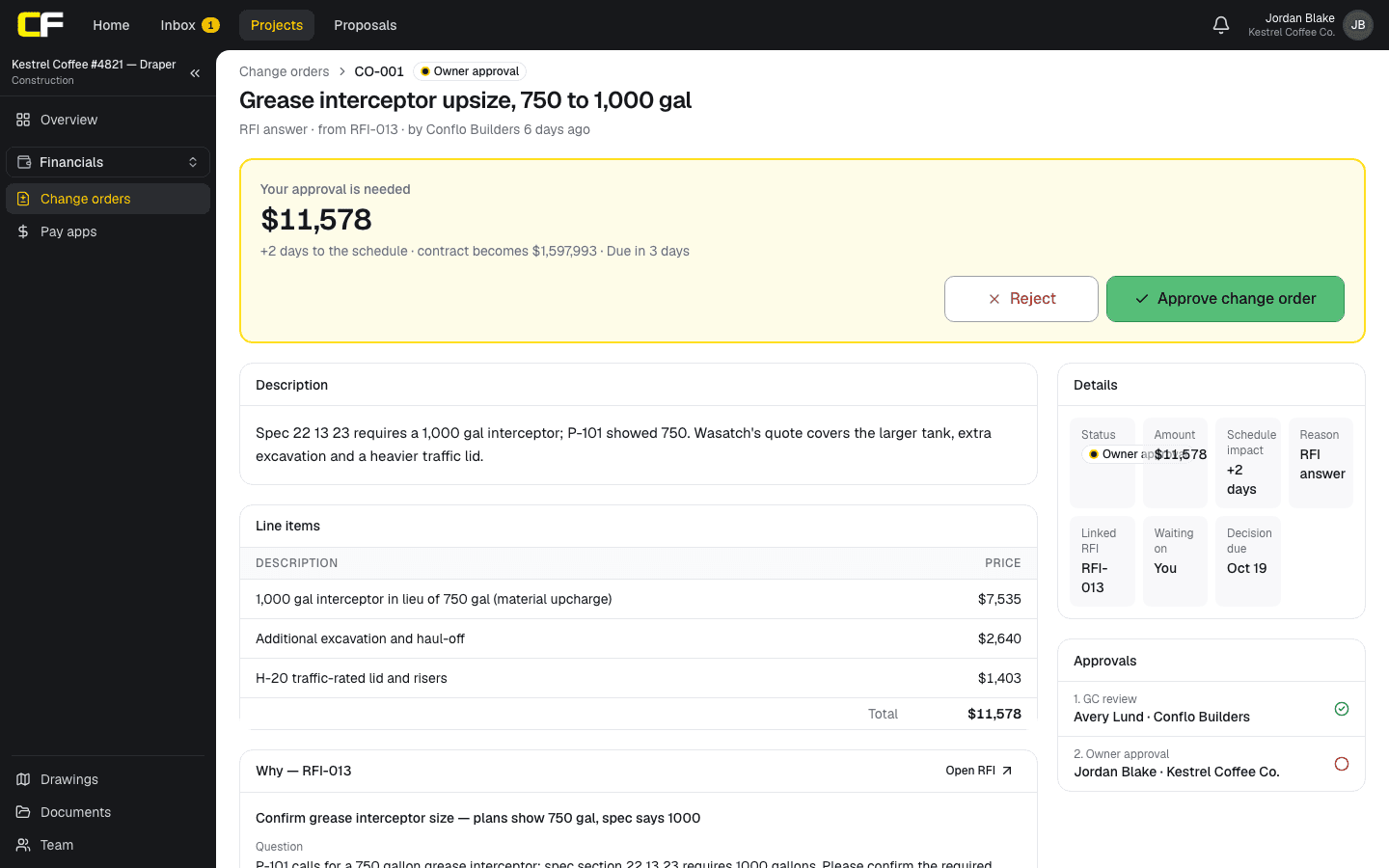
In Conflo the owner works on the same project as the GC. The owner reviews and approves the GC's pay applications, and approves or rejects change orders with the scope, price, reason and schedule impact in view (never the GC's cost lines or markup). It follows the closeout package and sees when it has been delivered, and sees every warranty on the building, when it ends and who to call.
Before award, a GC can send its proposal through Conflo: the owner reads it from an emailed link, which is view-only, and someone at the owner's company who can approve and sign accepts it, declines it or asks for a revision while signed in to an owner account. Conflo doesn't run an owner's request for proposals to several GCs or level their proposals side by side today.
The bottom line
The owner's job is to decide: the delivery method and the team before construction, pay applications and changes during it, and acceptance at the end. Decide early, decide on time, and hold back final payment until closeout is complete.
Conflo puts the owner, the GC, the design team and the subs on the same record from proposal to closeout. Join the waitlist to run your next project in it.
Sources
- An Owner's Guide to Construction and Program Management (2011) — Construction Management Association of America. Read October 16, 2026.
- Summary: A201–2017, General Conditions of the Contract for Construction — AIA Contract Documents. Read October 17, 2026.
- FAR 9.104-1, General standards (contractor responsibility) — Acquisition.gov (U.S. General Services Administration). Read October 16, 2026.
Questions
What is the owner's role in a construction project?
The owner sets the goals, budget and schedule, chooses the delivery method and the team, signs the contracts, pays for the work as it is done, decides on changes, and accepts the finished building. The contractor directs the work; the owner makes the decisions only it can make.
Does an owner need an owner's representative?
Not always. Owners without in-house construction staff often hire an owner's representative or an agency construction manager to advise them and manage the process. The larger and more complex the project, the more that help tends to pay for itself.
What should an owner check on a pay application?
That each line's percent complete matches the work in place, stored materials are allowed and documented, change orders billed are approved, retainage is held at the contract rate, and lien waivers for the last payment are attached.
When should an owner release retainage?
When the contract says, usually at substantial completion for part of it and at final completion for the rest, once the punch list, closeout documents and final lien waivers are in. State law may set deadlines, so check your contract and your state's law.
Related
Bidding
How Should an Owner Choose a General Contractor?
How a commercial owner chooses a general contractor: pick the delivery method, shortlist on qualifications, check bonding and references, then price.
· 7 min read
Definition
Design-Bid-Build vs Design-Build vs CM at Risk
Design-bid-build, design-build and CM at risk compared for owners: who holds which contract, when the price is fixed, and when each one fits.
· 4 min read
Money
How Should an Owner Review a GC's Pay Application?
An owner's checklist for a contractor's pay application: work in place, stored materials, change orders, retainage, waivers and the math. With an example.
· 6 min read
Role hub
The General Contractor's Guide: Bid to Closeout
What a general contractor is responsible for at every phase of a commercial job, from bidding and buyout to RFIs, change orders, pay apps and closeout.
· 8 min read
Pillar
The Construction Project Lifecycle: Bid to Closeout
The phases of a construction project, from planning and design to bidding, building and closeout, and what the owner, architect, GC and subs do in each.
· 7 min read