
How Should an Owner Compare Contractor Proposals?
By Wyatt Cooper · Published · 6 min read
Key takeaways
- Compare proposals line by line on one sheet, never cover page to cover page: base bid, alternates, unit prices, allowances, exclusions, schedule and validity.
- Put a dollar figure on every exclusion and every allowance that looks short, from your own estimate, so all the prices cover the same scope.
- A qualification that limits the contractor's price or liability is a change to your terms; resolve it in writing before you award.
- The lowest adjusted price, not the lowest cover-page price, is the one to negotiate with first.
To compare contractor proposals, put them on one sheet with the same rows: base bid, alternates, unit prices, allowances, exclusions, qualifications, schedule and how long the price is valid. Add your own estimate of every excluded item and every allowance that looks short, so each total covers the same scope. Then compare adjusted totals, durations and terms, and clear up anything unclear in writing before you award.
Set the rules before the proposals arrive
Comparison is easier when every contractor answers the same form. Send one bid form with your documents: a line for the base bid, each alternate, each unit price and each allowance you set, the proposed duration, and a box for exclusions and qualifications. Federal buyers are held to a rule worth copying: evaluate proposals "solely on the factors and subfactors specified in the solicitation" (FAR 15.305). Tell bidders how you will decide, then decide that way.
If you picked the shortlist on qualifications first (see how to choose a general contractor), price can carry most of the weight now. If not, score qualifications alongside price.
What to put on the comparison sheet
| Row | What to check | Why it matters |
|---|---|---|
| Base bid | That it covers the whole bid set, with every addendum acknowledged | A bid on an old addendum is priced on different documents |
| Alternates | Each one priced, as an add or a deduct | The alternates you accept change who is lowest |
| Unit prices | The rate for each unit you listed (rock excavation per cubic yard, for example) | They price the quantities nobody knows yet |
| Allowances | That each matches the amount you set, or is a sensible figure if you left it to them | A short allowance makes a bid look low and comes back as a change order |
| Exclusions | Every item they leave out, priced from your own estimate | This is where most of the gap between bids hides |
| Qualifications | Conditions on the price: escalation clauses, schedule assumptions, terms struck | They can change your contract's terms |
| Schedule | The proposed duration and start date | A longer job costs you rent, financing and staff |
| Validity | How many days the price holds | A short validity forces a rushed decision |
Public owners reject some conditions outright. FAR 14.404-2 requires rejecting a bid that imposes conditions that would modify the invitation's requirements or limit the bidder's liability, including one that protects against future cost increases when the total cost can't be determined. A private owner can negotiate instead, but treat those conditions as changes to your contract, not footnotes.
A worked example: three proposals on one sheet
A made-up owner, Harlow Clinics, receives three proposals for its outpatient clinic. The cover-page numbers make the second contractor look $220,000 cheaper than the first. The owner's estimator prices each exclusion and short allowance, and the order changes.
Harlow Clinics — proposals leveled to the same scope
- Ridgeway Builders
- Base bid $4,180,000 · no exclusions · 11 months · adjusted $4,180,000
- Calder & Moss Construction
- Base bid $3,960,000 · excludes winter protection (owner's estimate $85,000) and site utilities beyond 5 feet of the building (owner's estimate $120,000) · 13 months · adjusted $3,960,000 + $85,000 + $120,000 = $4,165,000
- Brightwater Contracting
- Base bid $4,050,000 · carries $60,000 for low-voltage cabling against the owner's $95,000 estimate · 12 months · adjusted $4,050,000 + $35,000 = $4,085,000
- Order by adjusted price
- Brightwater $4,085,000 · Calder & Moss $4,165,000 · Ridgeway $4,180,000
- Next step
- Interview Brightwater and Calder & Moss; ask Brightwater to confirm its low-voltage scope in writing
The lowest cover page (Calder & Moss) is second once its exclusions are priced, and it also takes two months longer than Ridgeway. If the owner values the earlier finish, Ridgeway's $15,000 premium over Calder & Moss may be the better buy. The sheet doesn't decide for you; it makes the trade-off visible.
Interview, clarify and award
- Interview the two or three lowest after adjustment, with the proposed project manager and superintendent in the room.
- Send each one written questions on its exclusions and qualifications, and get written answers.
- Ask for a revised price where the answers change the scope, by the same date for everyone.
- Decide which alternates to accept, then recheck who is lowest with them included.
- Award, and put the accepted alternates, unit prices, allowances and clarifications into the contract.
The CMAA's owner's guide notes that a fixed-price contract needs "some form of specific scope statement" so the parties can make "an accurate economic judgment as to cost or price". Clarifications written into the contract are that statement. Contractors level their subcontractors' bids the same way; how GCs level sub bids shows the other side.
How it works in Conflo
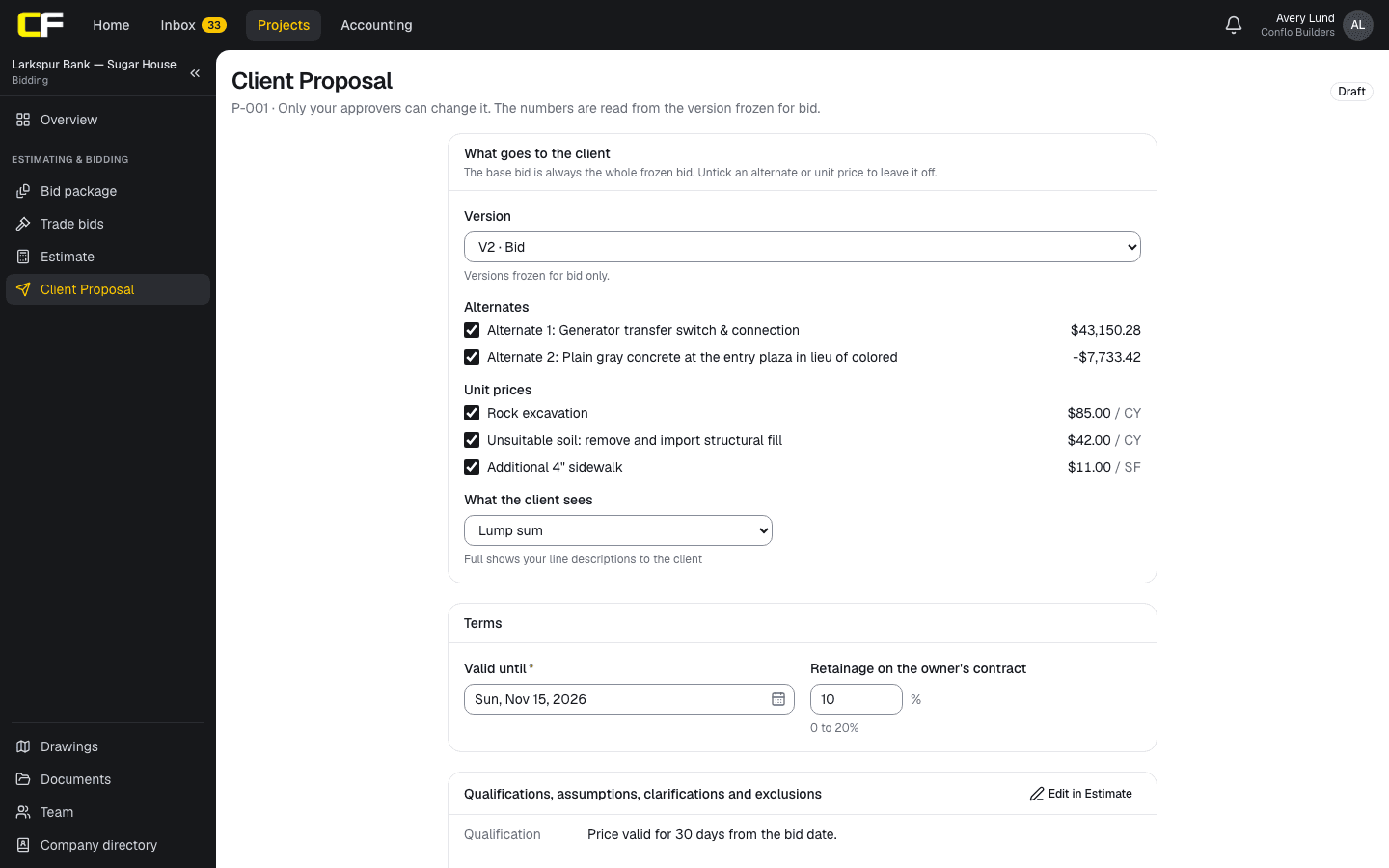
When a general contractor sends its proposal through Conflo's Bid to client tool, the owner gets an emailed link to the proposal, with the base bid, the alternates and unit prices offered, the qualifications and exclusions, and the date the price is good until. The figures are read from the estimate version the GC froze for bid, so they can't drift from it.
Signed in to an owner account, someone at the owner's company who can approve and sign answers it: accept it with a typed name and title and the alternates taken, decline it with a reason, or ask for a revision. Proposals sent to your company are listed together, but Conflo doesn't put several contractors' proposals side by side for an owner today: the leveling sheet in this guide is still yours to build.
The bottom line
Compare proposals on one sheet with the same rows, price every exclusion and short allowance from your own estimate, weigh the schedule and the terms, and award on the lowest adjusted price that fits your goals, with every clarification written into the contract.
If your GC sends its proposal through Conflo, you can read it, accept it, decline it or ask for a revision in one place. Join the waitlist to use it on your next project.
Sources
- FAR 15.305, Proposal evaluation — Acquisition.gov (U.S. General Services Administration). Read October 16, 2026.
- FAR 14.404-2, Rejection of individual bids — Acquisition.gov (U.S. General Services Administration). Read October 16, 2026.
- An Owner's Guide to Construction and Program Management (2011) — Construction Management Association of America. Read October 16, 2026.
Questions
How do you compare construction bids fairly?
Use one bid form for every bidder, then put the answers on one sheet with the same rows. Add your own estimate of each excluded item and each short allowance so every total covers the same scope, and compare those adjusted totals along with schedule and terms.
What is the difference between an exclusion and a qualification?
An exclusion leaves a piece of scope out of the price. A qualification puts a condition on the price or the terms, such as an escalation clause or a schedule assumption. Price the first; negotiate or reject the second.
What should I do if one bid is far below the others?
Ask the contractor to confirm its price and scope in writing before you award. A very low bid often means a missed scope or a misread addendum, and holding a contractor to a mistake usually costs the owner later.
Should alternates change who wins?
They can. Decide which alternates you will accept, add them to each bid, and recheck the order. A contractor that is low on the base bid can be high once the alternates you want are included.
Related
Bidding
How Should an Owner Choose a General Contractor?
How a commercial owner chooses a general contractor: pick the delivery method, shortlist on qualifications, check bonding and references, then price.
· 7 min read
Bidding
How Do You Level Subcontractor Bids?
Level subcontractor bids by pricing every scope gap, exclusion and missing addendum so each bid covers the same work, then compare the leveled totals.
· 9 min read
Definition
Design-Bid-Build vs Design-Build vs CM at Risk
Design-bid-build, design-build and CM at risk compared for owners: who holds which contract, when the price is fixed, and when each one fits.
· 4 min read
Role hub
The Owner's Guide to a Commercial Building Project
The owner's role on a commercial building project, phase by phase: delivery method, choosing the contractor, pay apps, change orders and closeout.
· 7 min read