
What Is a Bid Alternate?
By Wyatt Cooper · Published · 3 min read
Key takeaways
- An alternate is an option priced on its own: an add alternate adds work or upgrades it, a deduct alternate takes work out.
- Every bidder prices the same alternates, and the owner chooses which to accept, usually at award.
- On Defense Department and NASA jobs with limited funds, the low bidder is found by adding alternates in a stated priority order, skipping any that would exceed the funds.
A bid alternate is a separately priced option in a bid: a change to the base scope that the owner may accept or decline, such as upgraded flooring (an add alternate) or deleting a canopy (a deduct alternate). Every bidder prices each alternate on its own, and the owner picks which to accept, usually at award.
How alternates decide the low bid
Alternates let an owner bid a job whose budget is uncertain: bid the base, list the options in order, and buy as many as the money allows. Defense Department and NASA construction do this by rule. Before opening bids, the government fixes the funds available; the low bidder is the one with the lowest total for the base bid plus the additive or deductive items, in priority order, that "provide the most features within the funds determined available," and every bid is evaluated on the same items (DFARS 252.236-7007; NASA's version is NFS 1852.236-71).
Which alternates fit
- Offeror A base bid
- $85,000
- Add Alt 1 ($10,000)
- $95,000: fits
- Add Alt 2 ($8,000)
- $103,000: over, skipped
- Add Alt 3 ($6,000)
- $101,000: over, skipped
- Add Alt 4 ($4,000)
- $99,000: fits
- Offeror B, same items
- $80,000 + $16,000 + $4,000 = $100,000
- Low offeror
- A, at $99,000
Alternate vs. allowance vs. unit price
An alternate is a choice the owner makes, priced by each bidder. An allowance is a set amount for something known but not yet selected, adjusted later to actual cost. A unit price prices a quantity that may change. Alternates are usually voluntary for the owner, and a GC carries each sub's alternate prices through leveling so the owner's alternate prices are real.
How it works in Conflo
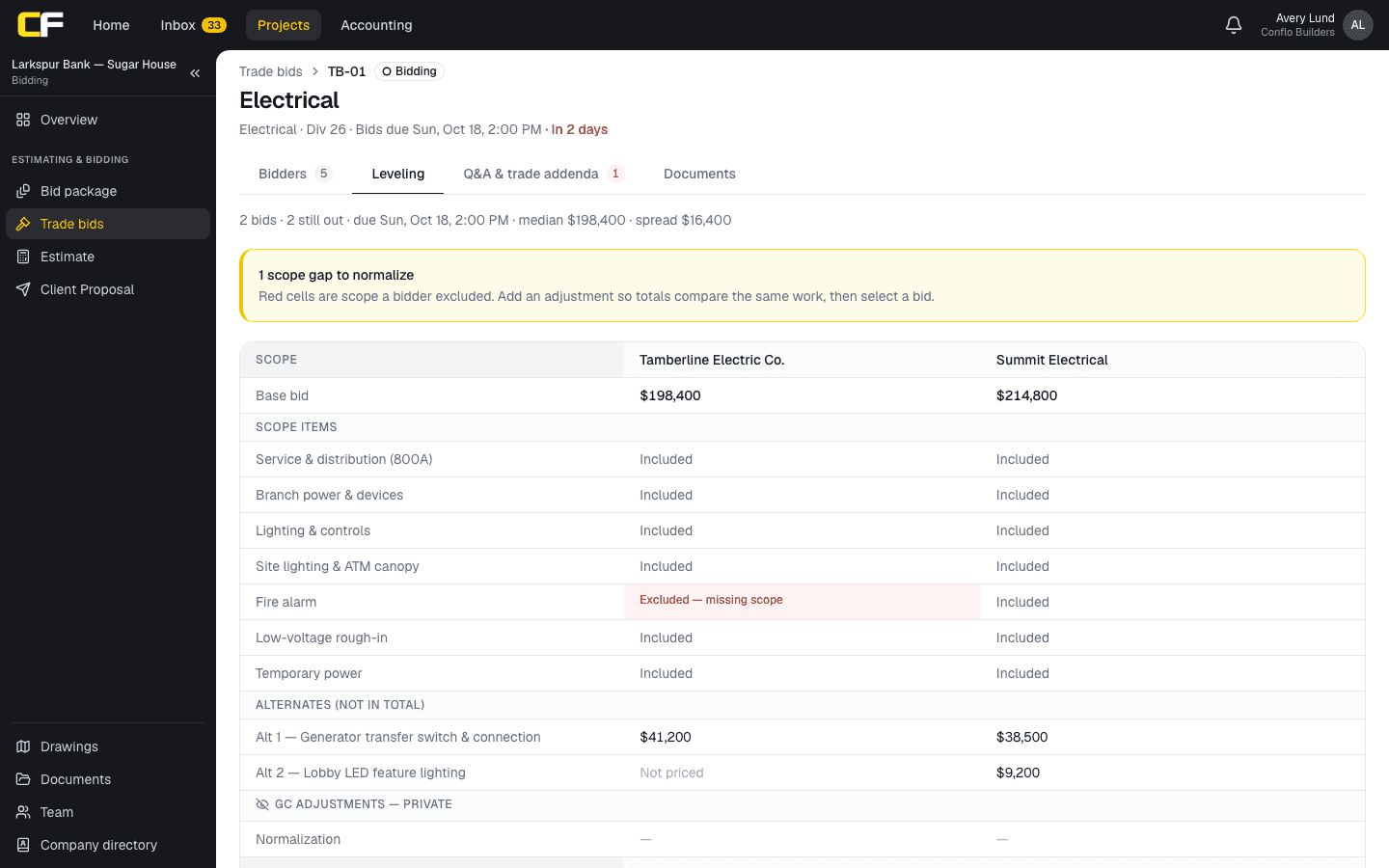
In Conflo's estimate, each alternate has a name, is an add or a deduct, and is priced with markups or at cost. In trade bids, each package lists the alternates every bidder prices, and the Leveling grid shows them side by side.
The bottom line
An alternate is a priced option: every bidder prices it the same way, and the owner decides whether to buy it.
List alternates in the order you would buy them, describe each one fully, and ask every trade affected to price it.
Sources
- DFARS 252.236-7007, Additive or Deductive Items — Acquisition.gov, U.S. General Services Administration. Read October 22, 2026.
- NFS 1852.236-71, Additive or deductive items — Acquisition.gov, U.S. General Services Administration. Read October 22, 2026.
Questions
Is an alternate the same as an option?
In bidding, mostly yes. Alternate is the construction word for a priced choice the owner makes, usually at award. Some contracts also let the owner accept an alternate later, for a stated period.
Can a bidder decline to price an alternate?
It can, but then its bid cannot be compared if the owner takes the alternate. If the bid form requires the price, a blank can make the bid nonresponsive.
Related
Bidding
How Do You Build an Estimate From Sub Bids?
Build a GC estimate from sub bids: plug each division, carry the leveled bid in place of the plug, add your own work and general conditions, then markups.
· 7 min read
Definition
Allowance vs Contingency: What Is the Difference?
An allowance is a set sum for a known item not yet chosen; a contingency is money for what nobody can foresee. How each is used and adjusted.
· 4 min read
Definition
What Is a Bid Form in Construction?
A bid form is the document a bidder fills in and signs to submit its price. What it holds, a filled-in example, and how it differs from a proposal.
· 3 min read
Bidding
How Do You Price a Bid Alternate?
Price add and deduct bid alternates: each trade's alternate price, your own work, the base bid's markups, and what each one includes.
· 6 min read
Role hub
The General Contractor's Guide: Bid to Closeout
What a general contractor is responsible for at every phase of a commercial job, from bidding and buyout to RFIs, change orders, pay apps and closeout.
· 8 min read