
How Should an Owner Review a GC's Pay Application?
By Wyatt Cooper · Published · 6 min read
Key takeaways
- Ask for a draft (pencil) copy before the formal application, walk the site against it, and settle disagreements before anything is signed.
- Pay only for work in place, stored materials with the backup your contract requires, and change orders you have approved.
- In the example below, removing a pending change order and undocumented off-site equipment cuts the payment due from $311,600.00 to $233,225.00.
- Check the lien waivers behind the application and pay the approved amount on time: many states set a deadline after the request arrives, such as 35 days on private work in Texas.
To review a general contractor's pay application, compare each schedule-of-values line with the work in place, ideally on a draft copy before the formal submission. Pay stored materials only with the documentation your contract requires, include only approved change orders, and check retainage, previous payments and the arithmetic. Confirm the lien waivers for the last payment, then approve, or approve a lower amount with a written reason for each change, and pay within your contract's and state's deadline.
Start from your contract's payment section
Your owner-contractor agreement and its general conditions set the payment date, the form, the retainage rate, what stored materials can be billed and who certifies the amount. On many projects the architect certifies the amount first and you pay on that certificate; the architect's side of that review, including how a lower amount is initialed and explained, is in how an architect certifies a pay application. Your checks below still apply to a certified application, because you hold the contract, the change-order log, the waivers and the payment deadline. If you have no architect in that role, you or your representative do the whole review yourself.
Specifications usually add the paperwork. One university's payment section asks for a draft copy seven days before the due date for the architect's and owner's review, a notarized application, lien waivers for the previous period, and, for stored materials, a certificate of insurance, evidence of title transfer, the surety's consent and paid invoices (University of Houston, Section 01 29 00).
What to check, in order
- Schedule of values: the lines and values match the approved schedule, and nothing was renamed or revalued.
- Work in place: each line's percent complete matches what you, your architect or your representative saw on site and what the schedule says should be done.
- Stored materials: each amount has the backup the contract requires, and off-site storage is allowed by the contract.
- Change orders: only executed change orders are billed, each on its own line, and the net change matches your change-order log.
- Retainage: the contract's rate on everything completed and stored, including any reduction you agreed in writing.
- Previous payments: line 7 equals what you actually paid on earlier applications.
- Lien waivers: the contractor's and subcontractors' waivers for the previous payment, on the form your contract or state requires.
- The arithmetic: completed and stored, less retainage, less previous payments, equals the amount requested.
Federal agencies run the same review on their own forms: the contractor's request must itemize work by element and list each subcontractor's amounts (FAR 52.232-5).
A worked review: the sixth pay application
A fictional general contractor, "Northgate Builders", submits its sixth pay application on a fictional medical office building, the "Maple Street Clinic". Retainage is 5%. Earlier applications certified $1,812,000.00 completed and stored to date. Pay app 6 claims $2,140,000.00 to date. The owner's representative finds two problems: an $18,500.00 change order that is still pending, and $64,000.00 of air handlers stored off site without the insurance certificate and title documents the contract requires.
| Line | As submitted | As approved |
|---|---|---|
| Completed and stored to date | $2,140,000.00 | $2,057,500.00 |
| Retainage (5%) | $107,000.00 | $102,875.00 |
| Total earned less retainage | $2,033,000.00 | $1,954,625.00 |
| Less previous payments ($1,812,000.00 less 5%) | $1,721,400.00 | $1,721,400.00 |
| Current payment due | $311,600.00 | $233,225.00 |
The arithmetic: $2,140,000.00 − $18,500.00 − $64,000.00 = $2,057,500.00; 5% is $102,875.00; less that is $1,954,625.00; less $1,721,400.00 is $233,225.00. The cut, $78,375.00, is 95% of the $82,500.00 removed, because 5% of it would have been retained anyway.
- 1GCSends the draft pay app a week before the due date
- 2Owner's representativeWalks the site, flags the pending change order and the undocumented stored equipment
- 3GCRemoves both, or supplies the documents, and submits the signed application
- 4Architect or ownerCertifies or approves $233,225.00 with the reasons in writing
- 5OwnerPays by the contract's and state's deadline; the GC pays its subs their share
Pay the approved amount on time
Withholding the disputed part doesn't let you hold the rest. On private projects in Texas, for example, an owner must pay an amount allowed under the contract no later than the 35th day after receiving the contractor's written request, less amounts withheld as the statute allows, and in a good-faith dispute on work other than a one- to four-family home, the owner may withhold no more than the difference between the two sides' figures (Texas Property Code §§ 28.002 and 28.003). Other states set different periods, and public owners have their own prompt-payment rules.
The contractor's subcontractors are waiting on your payment too. For what the GC does with theirs, see how a GC reviews a subcontractor's pay app; for the retainage line, how to calculate retainage.
How it works in Conflo
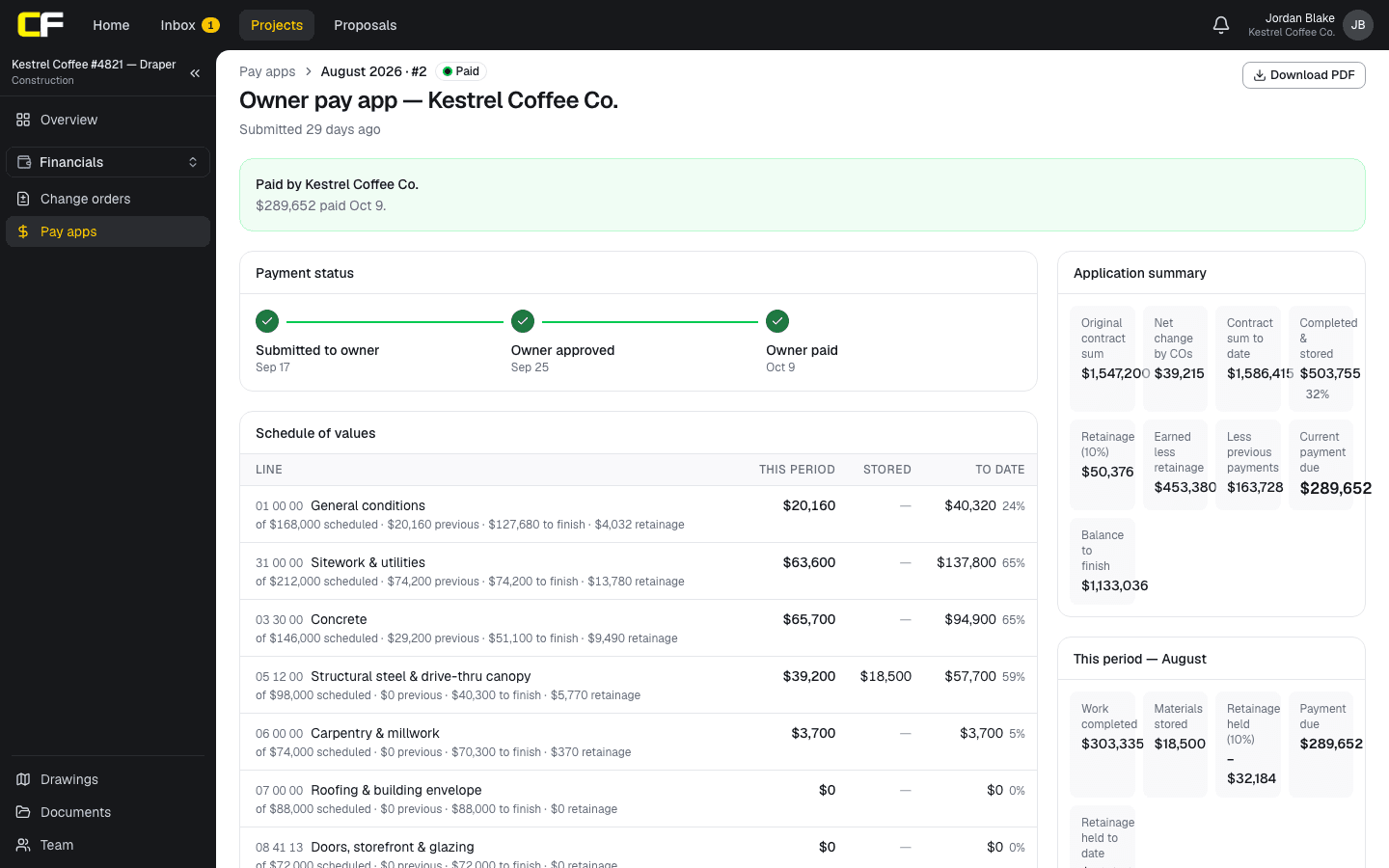
On Conflo's pay apps, the owner sees the GC's pay applications once they are submitted (never drafts), with the summary, a This period panel, the schedule of values line by line and the payment steps from submitted to owner approved to owner paid. The owner approves the application, or rejects it with a reason so the GC can revise and resubmit. Behind each owner pay app, the lien waivers of every subcontractor billed on it are listed. The owner can't approve a partial amount in Conflo today: a disputed application goes back to the GC to revise.
The bottom line
An owner's review is a site walk and a paperwork check done every month the same way: work in place, stored materials with backup, approved changes only, retainage and the math, then the waivers. Done on a draft, it avoids rejected applications and late payments.
Write your review routine into the contract's payment section before the job starts, so the contractor knows what each application needs.
Sources
- Section 01 29 00, Payment Procedures (master construction specification) — University of Houston, Facilities Planning and Construction. Read October 16, 2026.
- FAR 52.232-5, Payments under Fixed-Price Construction Contracts — Acquisition.gov, U.S. General Services Administration. Read October 16, 2026.
- Texas Property Code Chapter 28, Prompt Payment to Contractors and Subcontractors — Texas Legislature. Read October 16, 2026.
Questions
What should an owner check on a contractor's pay application?
That each line matches the work in place, stored materials have the required backup, only approved change orders are billed, retainage is at the contract rate, previous payments match what was paid, the lien waivers are in and the arithmetic is right.
Can an owner pay less than the amount requested?
Usually, for reasons the contract allows, such as work not in place or missing documentation, with the reasons in writing. Many statutes still require prompt payment of the undisputed part.
How long does an owner have to pay a pay application?
As long as the contract and state law allow. On private work in Texas, for example, the owner pays an amount allowed under the contract by the 35th day after receiving the request, less amounts the statute lets it withhold.
Does the architect approve the pay application or the owner?
Often both: on many contracts the architect certifies the amount due and the owner pays on that certificate. Your contract says who certifies and who approves.
Related
Money
How Does a GC Review a Subcontractor's Pay App?
Check each line against the field, stored materials against backup, change orders against approvals, then the math and the lien waivers. With an example.
· 7 min read
Money
How Does an Architect Certify a Pay Application?
Review the draft, compare it with what you observed on site, then certify the full amount or a lower one with the changed figures initialed and explained.
· 5 min read
Money
How Do You Calculate Retainage on a Pay App?
Retainage is a percentage of work completed and stored to date, held back each pay period. How to calculate it, reduce it, release it, with an example.
· 9 min read
Definition
What Is a Pay Application in Construction?
A pay application is a contractor's monthly request for payment against the schedule of values, less retainage and earlier payments. With an example.
· 3 min read
Role hub
The Owner's Guide to a Commercial Building Project
The owner's role on a commercial building project, phase by phase: delivery method, choosing the contractor, pay apps, change orders and closeout.
· 7 min read