
How Does an Owner Read a Construction Schedule?
By Wyatt Cooper · Published · 6 min read
Key takeaways
- Start with the milestones you care about (substantial completion, turnover, opening) and compare each with its baseline date.
- Then find the critical path: the chain of linked work with no float that sets the finish date.
- Read the update, not just the chart: what finished, what slipped, what changed in the logic, and why.
- Ask the same five questions at every update, and ask for the contractor's narrative in writing.
To read a construction schedule as an owner, start with the milestones that matter to you and compare each with its baseline date. Then find the critical path, the linked chain of work with no float that sets the finish. At each update, ask what finished, what slipped and why, whether the critical path moved, how much float is left, and whether any logic or durations changed.
The parts of a Gantt chart
Most contractors send the schedule as a Gantt chart: a list of activities on the left, a bar for each on a calendar on the right. Here is what each mark means.
| On the chart | What it is | What to look for |
|---|---|---|
| Rows grouped under headings | Phases or areas (sitework, foundations, shell) and the activities in them | Whether the work you care about is broken down enough to track |
| Bars | Each activity's start, finish and duration, usually in working days | Very long bars hide detail; the Corps of Engineers caps most at 20 working days |
| Diamonds | Milestones: zero-duration events such as permit issued or substantial completion | The dates in your contract |
| Lines or arrows between bars | Links: this work can't start or finish until that one does | Activities with no links are guesses, not logic |
| Red bars | The critical path, in most tools | Which chain sets your finish date |
| Thin grey bars | The baseline: the plan everyone agreed to | How far each bar has drifted from its baseline |
| Vertical line | Today, or the data date the update was taken on | Bars left of it should be done or showing progress |
| Percent complete | How much of each activity is done | Activities stuck at the same percent for weeks |
The critical path and float
The critical path is the longest chain of linked work, so its length sets the finish date. Microsoft's guide to Project puts it simply: if any task on the critical path is late, the whole project is late. Everything else has float: days it can slip before it moves the finish.
Float is worth asking about by name. On federal jobs, UFGS 01 32 01.00 10 says the float belongs to the project, available to the government and the contractor alike. Your contract may say something different, so read it before an argument about who used up the float.
Reading an update: a worked example
A made-up retail job. The baseline put substantial completion on Friday, November 13. The October update shows it on Friday, November 20.
October update, Ridgeview Retail: what the owner's representative wrote down
- Milestone check
- Substantial completion: Nov 20 against a Nov 13 baseline, 5 working days late (Nov 16–20). Store opening: Dec 14, also 5 working days behind its baseline.
- What moved it
- Permanent power: Oct 20 against an Oct 15 baseline, 3 working days late (Oct 16, 19, 20). It is on the critical path, so the finish moved.
- The rest of the slip
- Final inspection moved 5 working days, 2 more than power. The narrative says the inspection could not be booked until 2 days after power was on.
- Float left
- Storefront glazing: 4 working days of float before it becomes critical.
- Logic changes
- Two links added between power and the inspection; no durations shortened.
- Questions for the meeting
- What is the recovery plan for the 5 days? Can the inspection be pre-booked? What would make the glazing critical?
The note doesn't take the chart's word for it: it ties the late finish to one critical activity, checks that the numbers add up (3 days on power plus 2 waiting for the inspection is the 5-day slip), and turns what it found into questions. The day counts skip weekends.
Five questions for every schedule update
- Did any milestone in our contract move, and by how many working days against the baseline?
- What is on the critical path now, and did it change since last month?
- What finished, what started, and what slipped, and why?
- How much float is left on the next path behind the critical one?
- Were any links, durations or calendars changed, and who approved it?
Ask for the answers in writing. Federal schedule specifications require a narrative with each update describing the critical path and changes in logic and durations, and the federal schedules clause, where a contract includes it, lets the contracting officer require a revised schedule when the work falls behind (FAR 52.236-15). On a private job, check what your contract requires the contractor to send, and how often.
How it works in Conflo
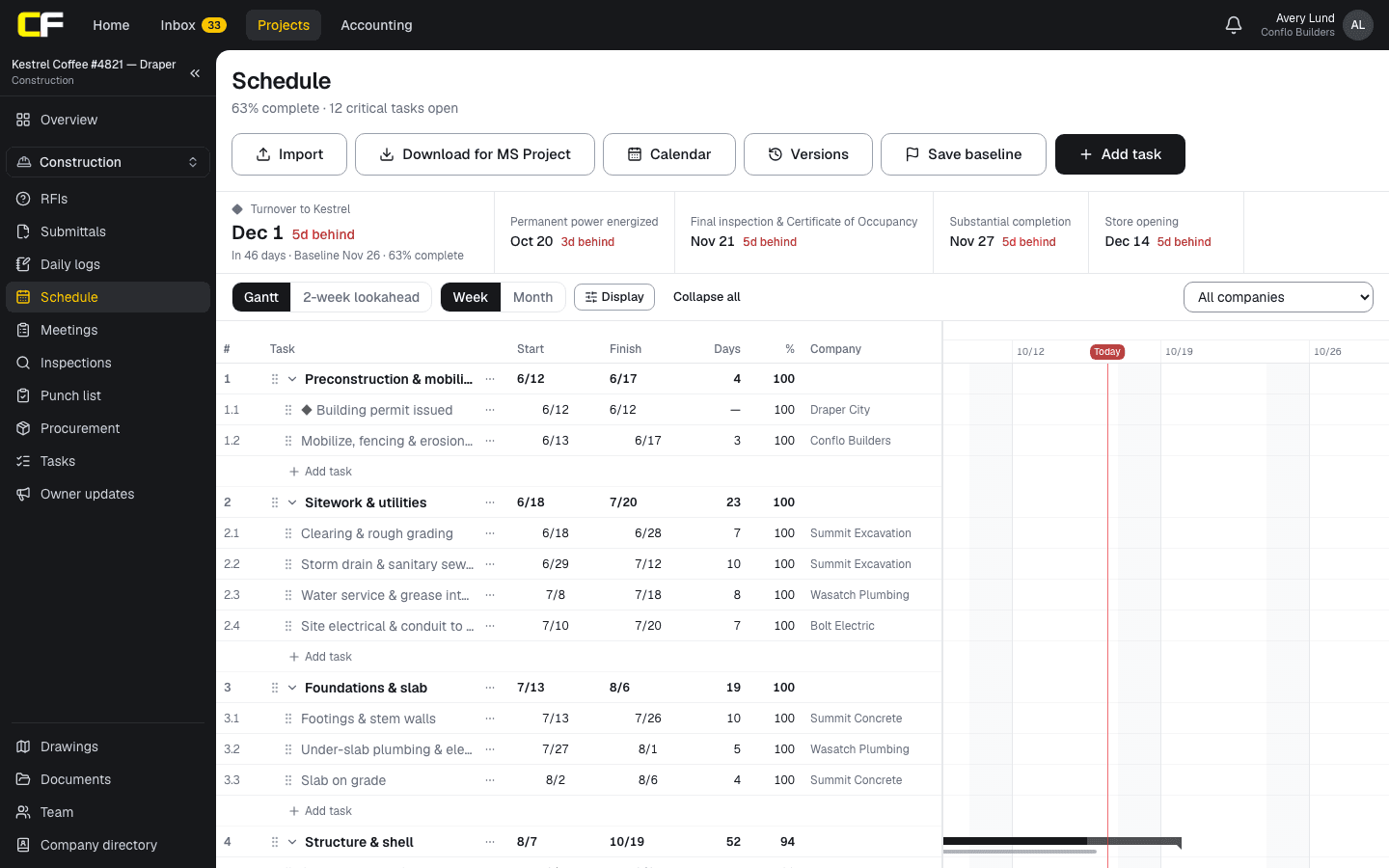
In Conflo, an owner invited to the project sees the schedule and its key dates, each with how many days it is ahead of or behind its baseline, and a Gantt with every task's dates, progress and company. The general contractor builds and edits the schedule; the owner reads it. The GC can also add buffer days to the dates an owner sees, so ask your contractor whether the dates you are shown include any.
The bottom line
Read a schedule from the milestones down: where are the dates you care about against the baseline, which chain is driving them, and how much float is left behind it.
Ask the same five questions every month, in writing, and the schedule becomes a conversation instead of a picture.
Sources
- UFGS 01 32 01.00 10, Project Schedule (August 2026), §3.3.2, §3.5 and §3.10 — U.S. Army Corps of Engineers (Whole Building Design Guide). Read October 16, 2026.
- FAR 52.236-15, Schedules for Construction Contracts — Acquisition.gov (General Services Administration). Read October 16, 2026.
- Show the critical path of your project in Project — Microsoft Support. Read October 16, 2026.
Questions
What is a baseline schedule?
The schedule as agreed at the start of the job, saved so later updates can be compared with it. The difference between an activity's current dates and its baseline dates is its variance.
Why are durations in working days?
Construction schedules count the days crews work, usually Monday to Friday less holidays, on the project's calendar. A 10-day activity that starts on a Monday therefore takes two calendar weeks.
What does it mean when the finish date shows negative float?
The schedule's logic can no longer meet a required date, usually the contract completion date. The number is how many working days the contractor needs to recover on that path.
How often should an owner get a schedule update?
Monthly is common, often with the pay application. Your contract sets it; some contracts also ask for a short look-ahead each week.
Related
Definition
What Is the Critical Path in Construction?
The critical path is the longest chain of linked activities in a construction schedule. A worked five-activity example, float, and what a delay does.
· 4 min read
Definition
What Is Float in a Construction Schedule?
Float is how many working days an activity can slip. Total float vs free float, worked on a five-activity network, and who owns the float.
· 4 min read
Money
How Do You Calculate Retainage on a Pay App?
Retainage is a percentage of work completed and stored to date, held back each pay period. How to calculate it, reduce it, release it, with an example.
· 9 min read
Role hub
The Owner's Guide to a Commercial Building Project
The owner's role on a commercial building project, phase by phase: delivery method, choosing the contractor, pay apps, change orders and closeout.
· 7 min read