
How Should an Owner Track Building Warranties?
By Wyatt Cooper · Published · 6 min read
Key takeaways
- Keep every warranty on one list: what it covers, who stands behind it, the start date, the term, the expiration and who to call.
- Get each start date in writing; the general warranty usually starts at substantial completion or acceptance, but equipment warranties may start at startup or shipment.
- Flag anything expiring within 90 days and walk the building before the general one-year warranty ends.
- Keep the maintenance each warranty requires, because a manufacturer can refuse a claim on equipment that was not maintained as its manual says.
Track building warranties on one list, with a line for each warranty: what it covers, the company that stands behind it, the start date, the term, the expiration date and the service contact. Get start dates in writing, since equipment warranties may start at startup rather than substantial completion. Flag anything expiring within 90 days, walk the building before the one-year warranty ends, and keep the maintenance records each warranty requires.
Why warranties get lost
At handover an owner receives a stack of warranty letters, each with its own start, term and contact, in a binder that goes on a shelf. The general contractor's one-year warranty ends quietly, the roof warranty outlives everyone who knew it existed, and a compressor fails a month after its five years ran out. The fix is a list sorted by expiration date, not a binder sorted by spec section.
The start date is the first thing to pin down. On AIA-based contracts, the certificate of substantial completion establishes the date "for the purpose of commencement of applicable warranties" (AIA's G704 summary). On federal construction contracts that include the FAR warranty clause, the contractor's warranty runs "for a period of 1 year from the date of final acceptance of the work", or from when the Government takes possession of a part early, and work repaired under warranty gets a new year from the repair (FAR 52.246-21). For what you should receive at handover, see what an owner gets at closeout; for the whole job, the owner's guide and the project lifecycle.
What goes on the list
The federal closeout guide specification is a good model for what to capture. For each warranted item it asks for the name of the item, model and serial numbers, where it is installed, the manufacturer or supplier, the warranty terms, the "starting point and duration of warranty period", the maintenance needed to keep the warranty in force, and who to call for service, with separate expiration dates for anything warranted longer than one year (UFGS 01 78 00, §1.9.1).
| Field | Why it matters | Where it comes from |
|---|---|---|
| Item and location | So staff can find what is covered | The warranty letter and O&M manual |
| Company | Who stands behind it: GC, sub or manufacturer | The warranty letter |
| Start date | Every expiration depends on it | The certificate of substantial completion, or the startup report |
| Term | One year, five years, twenty years | The specification and the warranty letter |
| Expiration | Start date plus term; sort the list by it | Worked out from the two above |
| Maintenance required | A missed filter change can void a claim | The O&M manual |
| Service contact | Who to call when it fails | The warranty letter or closeout package |
If you still need the manuals behind the warranties, the GC's side is in how to collect O&M manuals.
Walk the building before the clock runs out
Find defects while someone is still bound to fix them. UFGS 01 78 00 schedules joint warranty inspections at 4 and 9 months after acceptance with the contractor (UFGS 01 78 00, §1.9.1). A private owner can do the same: one walk after the first season, one about two months before the general warranty ends, so there is time to report and fix what you find. Report defects in writing, with photos, before the expiration date.
A worked example: a fictional office building
The owner is fictional: "Juniper Ridge Holdings". Its office building reached substantial completion on March 3, 2026. The rooftop units were started up on January 15, 2026 and their manufacturer's warranty runs from startup. The facilities manager checks the list on December 10, 2026.
Juniper Ridge Holdings: building warranties
- Landscaping and irrigation (landscape sub)
- Started Mar 3, 2026, 6 months; expired Sep 3, 2026
- General warranty, all work (GC)
- Started Mar 3, 2026, 1 year; expires Mar 3, 2027: expiring, 83 days left
- Below-grade waterproofing (waterproofing sub)
- Started Mar 3, 2026, 2 years; expires Mar 3, 2028: active
- Rooftop unit compressors (manufacturer)
- Started at startup Jan 15, 2026, 5 years; expires Jan 15, 2031: active
- Roof membrane (roofing manufacturer)
- Started Mar 3, 2026, 20 years; expires Mar 3, 2046: active
The count for the general warranty: from December 10 to December 31 is 21 days, plus 31 in January, 28 in February and 3 in March, is 83 days, inside the 90-day window. The manager schedules a walk with the GC for the first week of January, reports what it finds in writing, and the 4- and 9-month walks (July 3 and December 3) are already done.
How it works in Conflo
When the GC runs the job in Conflo, warranties lists every warranty on the building: the item, the company that stands behind it, the spec section, the start date and term in months, and the service contact's name, phone and email. Conflo works out each expiration from the start date and term and sorts the list by it.
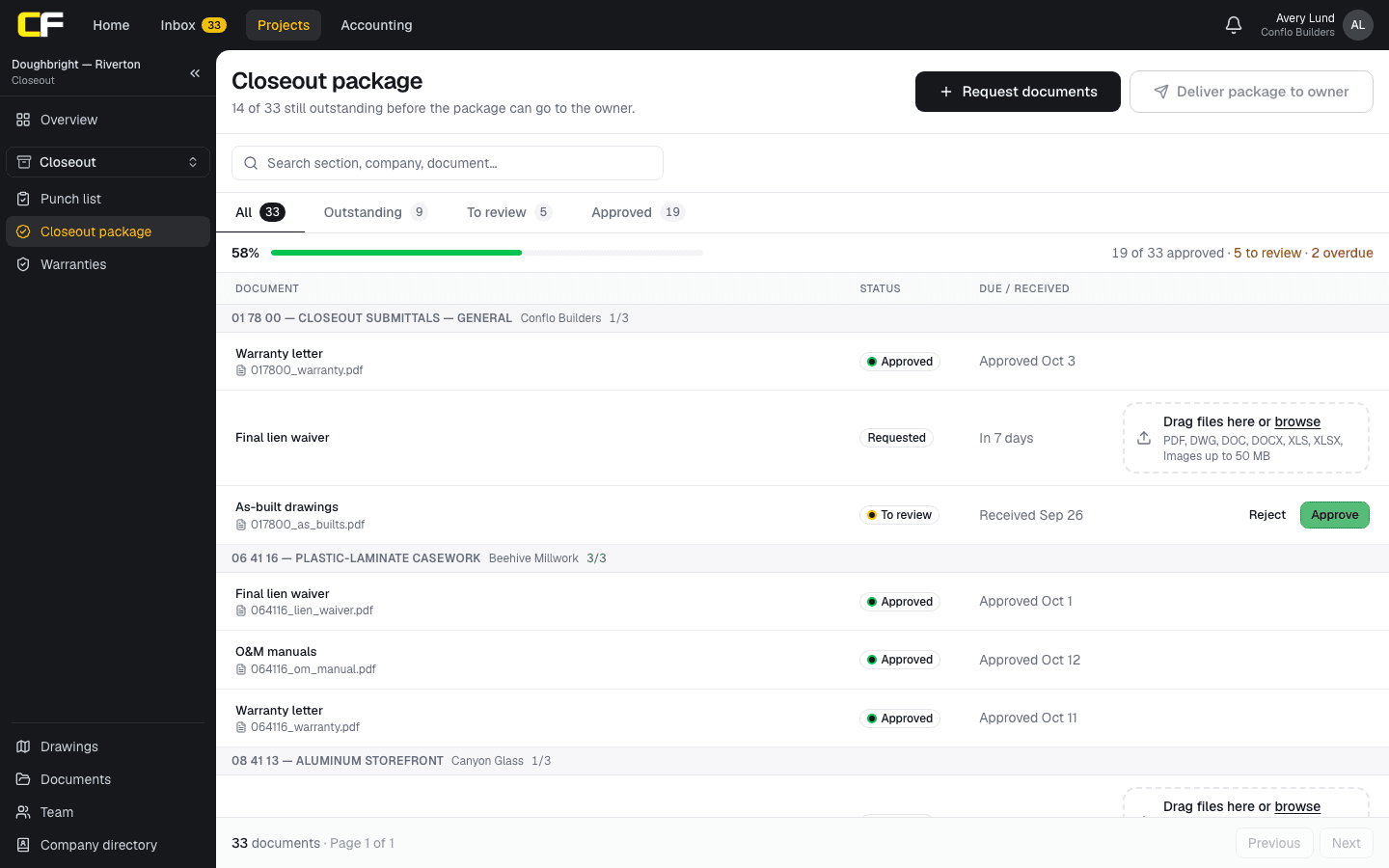
Tabs show what is active, expiring soon and expired; a warranty ending within 90 days counts as expiring soon, and the page says how many are. The GC adds each warranty to the list by hand, usually as its letter is approved in the closeout package; the owner sees the list. Conflo is free for owners; the GC's plan covers the project.
The bottom line
Track warranties on one list sorted by expiration, with the start date, term, company and contact for each, and get every start date in writing.
Flag what ends within 90 days, walk the building before the one-year warranty runs out, and keep the maintenance records that keep each warranty valid.
Sources
- UFGS 01 78 00 Closeout Submittals (August 2026), §1.9.1 — Whole Building Design Guide, USACE / NAVFAC / AFCEC. Read October 22, 2026.
- FAR 52.246-21, Warranty of Construction — Acquisition.gov, U.S. General Services Administration. Read October 22, 2026.
- Summary: G704–2017, Certificate of Substantial Completion — AIA Contract Documents (The American Institute of Architects). Read October 22, 2026.
Questions
When does a construction warranty start?
Usually at substantial completion on AIA-based contracts, or at final acceptance on federal contracts that include the FAR warranty clause. Equipment warranties may start at startup or shipment, so get each start date in writing.
How long is a typical construction warranty?
The contractor's general warranty is commonly one year. Roofs, equipment and some systems carry longer warranties from the manufacturer or installer, often several years; the specification sets each term.
What should an owner do before the one-year warranty ends?
Walk the building with the GC about three months before it ends, list every defect with photos and send it in writing, so the repairs are claimed while the warranty is in force.
Can a warranty be voided by poor maintenance?
Often, yes. Many equipment warranties require the maintenance in the O&M manual. Keep the records of filter changes, inspections and service visits.
Related
Closeout
What Should an Owner Get at Project Closeout?
The owner's closeout checklist: what you should get at substantial completion and before final payment, and how to check each document.
· 7 min read
Closeout
How Do You Assemble a Construction Closeout Package?
A closeout checklist by spec section and company: O&M manuals, as-builts, warranties, attic stock, training, lien waivers. Build it at buyout. Example.
· 9 min read
Closeout
How Do You Collect O&M Manuals From Subcontractors?
How a GC collects O&M manuals from every trade: request them early by spec section, check them against what was installed, and send back the thin ones.
· 6 min read
Role hub
The Owner's Guide to a Commercial Building Project
The owner's role on a commercial building project, phase by phase: delivery method, choosing the contractor, pay apps, change orders and closeout.
· 7 min read