
How Does an Architect Decide Substantial Completion?
By Wyatt Cooper · Published · 8 min read
Key takeaways
- The test is the contract's definition: on AIA documents, whether the owner can occupy or use the work for its intended use, not whether every item is finished.
- Start from the contractor's own list and a pre-check, so the formal inspection is held only when the work is likely to pass.
- Sort every finding into one of two piles: items that stop the intended use, which must be fixed before the certificate, and punch items, which go on the list attached to it.
- The certificate records the date, the attached list, the time to finish it, and who takes on security, maintenance, utilities and insurance; warranties usually start that day.
The architect decides substantial completion by inspecting the work against the contract's definition: can the owner occupy or use it for its intended purpose? Start from the contractor's list of items to complete or correct, walk with the owner and consultants, and separate findings that block use from punch items. If nothing blocks use, prepare the certificate with the date, the attached list and the handover of responsibilities. If something does, list it and reinspect.
Start with the contract's definition, not a feeling
Substantial completion is a contract status, so the first step is the definition you are certifying against. AIA A201-2017 Section 9.8.1 defines it as the stage when the work "is sufficiently complete in accordance with the Contract Documents so that the Owner can occupy or utilize the Work for its intended use" (AIA Contract Documents). Other forms and public owners word it differently. See what substantial completion is for what the date triggers.
Then list what the documents add to it: a certificate of occupancy, accepted life-safety systems, startup and testing reports, commissioning, training, or specific closeout submittals due before the certificate. Owners often write these into Division 01. If a requirement is in the specifications, it is part of your test; if it is not, it is not.
Get the contractor's list and pre-check before the walk
On AIA-based contracts the contractor starts the process: when it considers the work substantially complete, it prepares the list of items to be completed or corrected, and the architect verifies and amends it (AIA's G704 summary). A good GC has already built a punch list area by area; its list should be short.
Pre-check before you schedule the formal inspection. Alaska DOT&PF's construction manual has the project engineer, once the contractor gives its expected substantial completion date, "review the project to verify that it is likely to be ready for a final inspection". A failed inspection costs everyone a day and resets the owner's move-in plans.
Walk with the owner, the consultants and the people who will run the building
Invite the owner, your engineers for the systems they designed, the contractor and its key subs, and the owner's facilities or maintenance staff. San Diego State University's closeout procedures schedule a separate acceptance walk-through with its facility services after the architect's inspection for the certificate; the people who will maintain the building see things a designer does not.
Walk every space in a fixed order, operate what can be operated, and log findings one per problem with a location, as on any punch list. Bring the contractor's list and mark what you agree, what you add, and what you think is wrong on it.
Sort findings: what blocks use, and what is a punch item
This is the decision. Ask of each finding: does it stop the owner using this space for its intended use, or is it a correction the owner can live with for a few weeks? The same finding can fall either way on different projects; the intended use decides it.
| Finding | Usually | Why |
|---|---|---|
| Fire alarm not yet accepted by the authority having jurisdiction | Blocks | The space typically cannot be legally occupied |
| Cooling not running in an occupied area in summer | Blocks | The space cannot be used as intended |
| Required certificate of occupancy not issued | Blocks, where the contract requires it | Occupancy depends on it |
| Exam room sink with no hot water at a clinic | Blocks for that room | The room cannot do its job |
| Paint touch-ups, scuffed base, stained ceiling tile | Punch item | Cosmetic; use is not affected |
| Missing cover plate, door closer out of adjustment | Punch item | A quick correction; use is not affected |
| Attic stock or O&M manuals not yet delivered | Depends on the specifications | Some owners require them before the certificate, others before final payment |
If any finding blocks use, the work is not substantially complete. Say so in writing, with the list of what must be done before you reinspect. Alaska's manual does the same with a Report of Final Inspection: the date, who attended, the additional work required, and a reminder that contract time keeps running.
A worked example: a fictional clinic
The project is fictional: a single-story clinic for "Sagebrush Family Health", designed by a fictional architect and built by a fictional GC. The contractor submits its list of 38 items and asks for an inspection on May 28.
- 1GCSubmits its list of 38 items and the date it expects substantial completion
- 2ArchitectPre-checks on May 23: the fire alarm acceptance test is scheduled for May 27
- 3Architect, owner, engineers, facilities lead, GCWalk on May 28 and add 14 items, so the list has 52
- 4ArchitectFinds 2 items that block use: no hot water at exam room 4, and the waiting room thermostat not controlling its unit
- 5GCFixes both on May 30 and sends a note with photos and the test readings
- 6ArchitectReinspects the two items on June 2 and prepares the certificate dated June 2 with the 50 remaining items attached
Certificate of substantial completion — Sagebrush Family Health clinic
- Work covered
- The entire work under the contract
- Date of substantial completion
- June 2
- Items to complete or correct
- 50 items, attached list dated June 2
- Time to complete them
- 30 days, by July 2
- Owner takes on
- Security, maintenance, utilities and property insurance from June 3
- Warranties start
- June 2, the date of substantial completion
- Signed by
- Architect, contractor and owner
The arithmetic: 38 items from the GC plus 14 added on the walk is 52; the two blocking items were fixed before the certificate, so 52 − 2 = 50 items go on the attached list. June 2 plus 30 days is July 2.
Write the certificate, and handle partial occupancy
The AIA's summary of G704 lists what the parties agree on the certificate: the time allowed to complete or correct the remaining items, the date the owner will occupy, and who is responsible for maintenance, heat, utilities and insurance; warranties start on the date of substantial completion unless the parties say otherwise. Get those agreed before the certificate goes out, not after.
When the owner wants part of the building early, certify that designated portion on its own, if the contract allows it. On federal work, the government may take possession of a completed or partly completed part, gives the contractor a list of the work remaining, and possession is not acceptance (FAR 52.236-11). Private contracts often have a similar clause; write down which warranties and responsibilities start for that portion.
How it works in Conflo
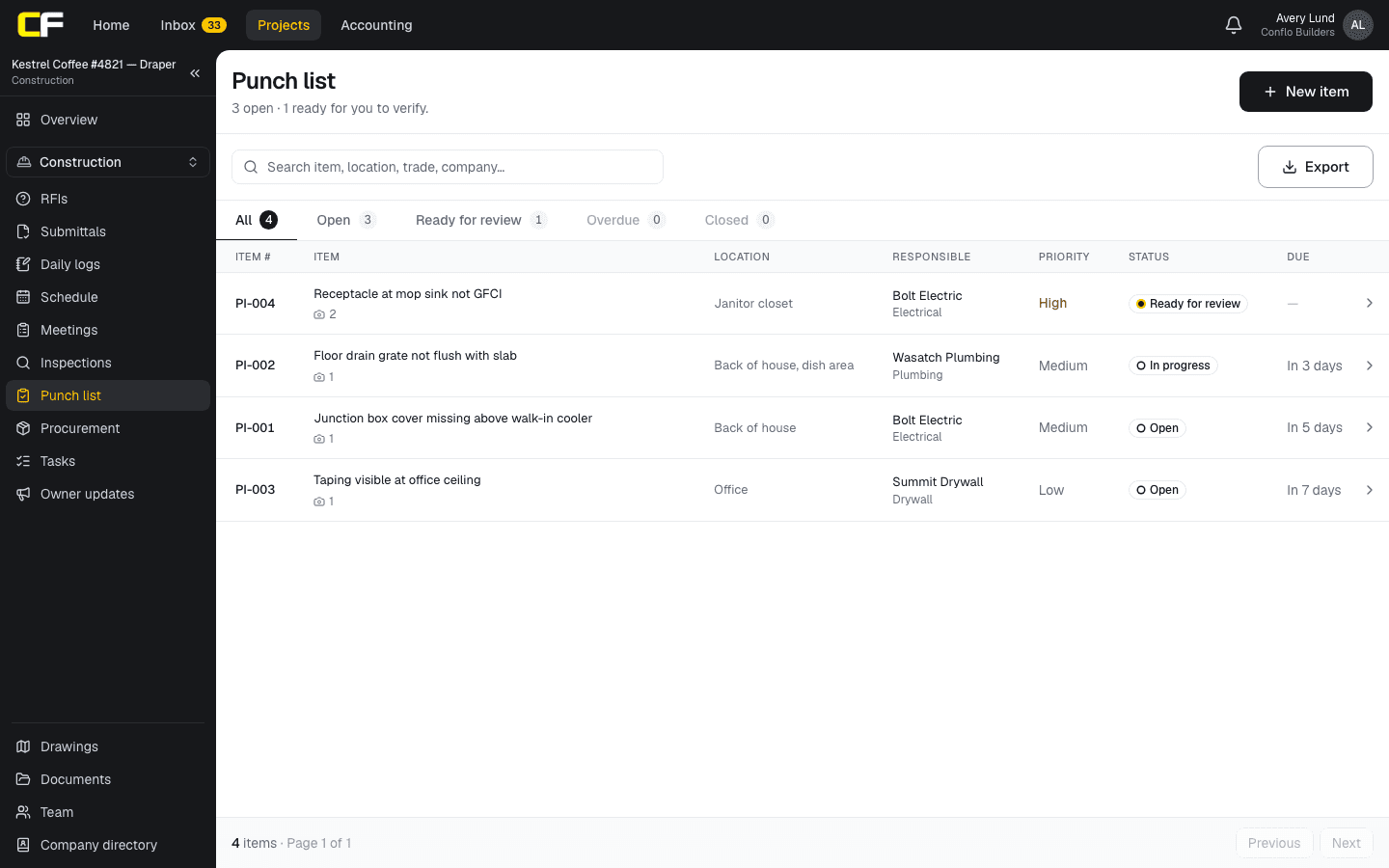
On a project in Conflo, the design team sees the whole punch list: every item's location, company, priority, status and due date, with the issue photo and the sub's fix photo. Architects and owners can comment on an item. Only the GC adds items, closes them or sends them back, so the items you add on your walk go to the GC to log. Conflo does not produce the certificate of substantial completion; that is your contract's form.
The bottom line
Deciding substantial completion is one question asked of every finding: does it stop the intended use? Start from the contract's definition and the contractor's list, walk with the people who will run the building, and put only true punch items on the certificate.
A pre-check a few days ahead keeps the formal inspection to one visit.
Sources
- The Construction Schedule – Substantial Completion Considerations — AIA Contract Documents (The American Institute of Architects). Read October 16, 2026.
- Summary: G704–2017, Certificate of Substantial Completion — AIA Contract Documents (The American Institute of Architects). Read October 16, 2026.
- Alaska Construction Manual, Chapter 15: Final Field Construction Activities — Alaska Department of Transportation & Public Facilities. Read October 16, 2026.
- Facilities Design Guidelines, Section 01 77 00: Closeout Procedures — San Diego State University, Facilities Planning. Read October 16, 2026.
- FAR 52.236-11, Use and Possession Prior to Completion — Acquisition.gov, U.S. General Services Administration. Read October 16, 2026.
Questions
Who signs the certificate of substantial completion?
On AIA's G704 the architect signs, certifying the date of substantial completion right after the description of the work, and the form is prepared for the contractor and the owner to accept, with the list of items to complete or correct attached. Other contract families use their own forms.
Can the architect refuse to certify substantial completion?
Yes, if the inspection finds work that stops the owner from using the space for its intended use. Put the reasons in writing with the list of what must be done before you reinspect.
Do all punch list items need to be done for substantial completion?
No. Punch items are by definition the items left after substantial completion. They go on the list attached to the certificate with a time to finish them; final completion waits for them.
When do warranties start?
On AIA documents, on the date of substantial completion unless the certificate says otherwise. Some owners and federal contracts start them at final acceptance, so check the contract.
What if the owner moves in before the certificate?
Treat it as partial occupancy: agree in writing which areas the owner uses, who is responsible for them, and when their warranties start. On federal work, possession is not acceptance of the work.
Related
Definition
What Is Substantial Completion?
Substantial completion is when the work is complete enough for the owner to use it as intended. What it triggers: retainage, warranties, delay damages.
· 3 min read
Closeout
How Do You Build a Punch List?
Build a punch list by walking the job room by room before substantial completion, logging each item with location, trade, photo and due date. With example.
· 9 min read
Closeout
What Should an Owner Get at Project Closeout?
The owner's closeout checklist: what you should get at substantial completion and before final payment, and how to check each document.
· 7 min read
Role hub
The Architect's Guide to Construction Administration
The construction administration phase from the architect's seat: site visits, RFIs, ASIs, submittals, pay certification, changes and closeout.
· 8 min read