
What Is the Critical Path in Construction?
By Wyatt Cooper · Published · 4 min read
Key takeaways
- The critical path is the longest chain of linked activities from start to finish: it sets the earliest date the job can finish.
- Activities on it have zero total float, so a day lost on any of them is a day lost at the end unless the work is resequenced or sped up.
- The critical path can move: a delay to a non-critical activity bigger than its float puts that chain on the critical path.
The critical path in construction is the longest chain of linked activities from the start of the job to its finish. Its length sets the earliest possible completion date, and its activities have zero total float: if any of them finishes a day late, the whole job finishes a day late unless other work is resequenced or sped up.
A five-activity example
A made-up slab-on-grade job, in working days, every link finish-to-start. Excavation (3 days) comes first. Then footings (5 days) and underground plumbing (2 days) start together; the under-slab inspection (1 day) follows the plumbing; the slab (2 days) waits for both the footings and the inspection.
| Path | Activities | Length | Critical? |
|---|---|---|---|
| 1 | Excavate (3) → Footings (5) → Slab (2) | 10 working days | Yes: the longest path |
| 2 | Excavate (3) → Plumbing (2) → Inspection (1) → Slab (2) | 8 working days | No: 2 days of float |
The job can't finish before day 10, so path 1 is the critical path. If the footings take 6 days, the slab finishes on day 11. If the plumbing takes 3 days instead of 2, nothing moves: path 2 still has a day to spare. If the plumbing runs 3 days late, path 2 becomes 11 days long, and it is now the critical path. How much an activity can slip is its float.
What the specifications say
Public owners write the definition into the contract. The Army Corps of Engineers' project schedule section, UFGS 01 32 01.00 10, says it plainly: "The critical path is defined as the longest path." It also asks for a narrative on each update covering the critical path and the next float path after it.
Scheduling software marks critical activities from their float. Microsoft's Critical field page says a task is critical when its total slack is at or below a threshold, zero days by default, and its guide notes the critical path is "a chain of linked tasks that directly affects the project finish date". So the critical path is only as true as the logic: a missing link or a hard-typed date can hide the real one. Owners: here is how to read a construction schedule.
How it works in Conflo
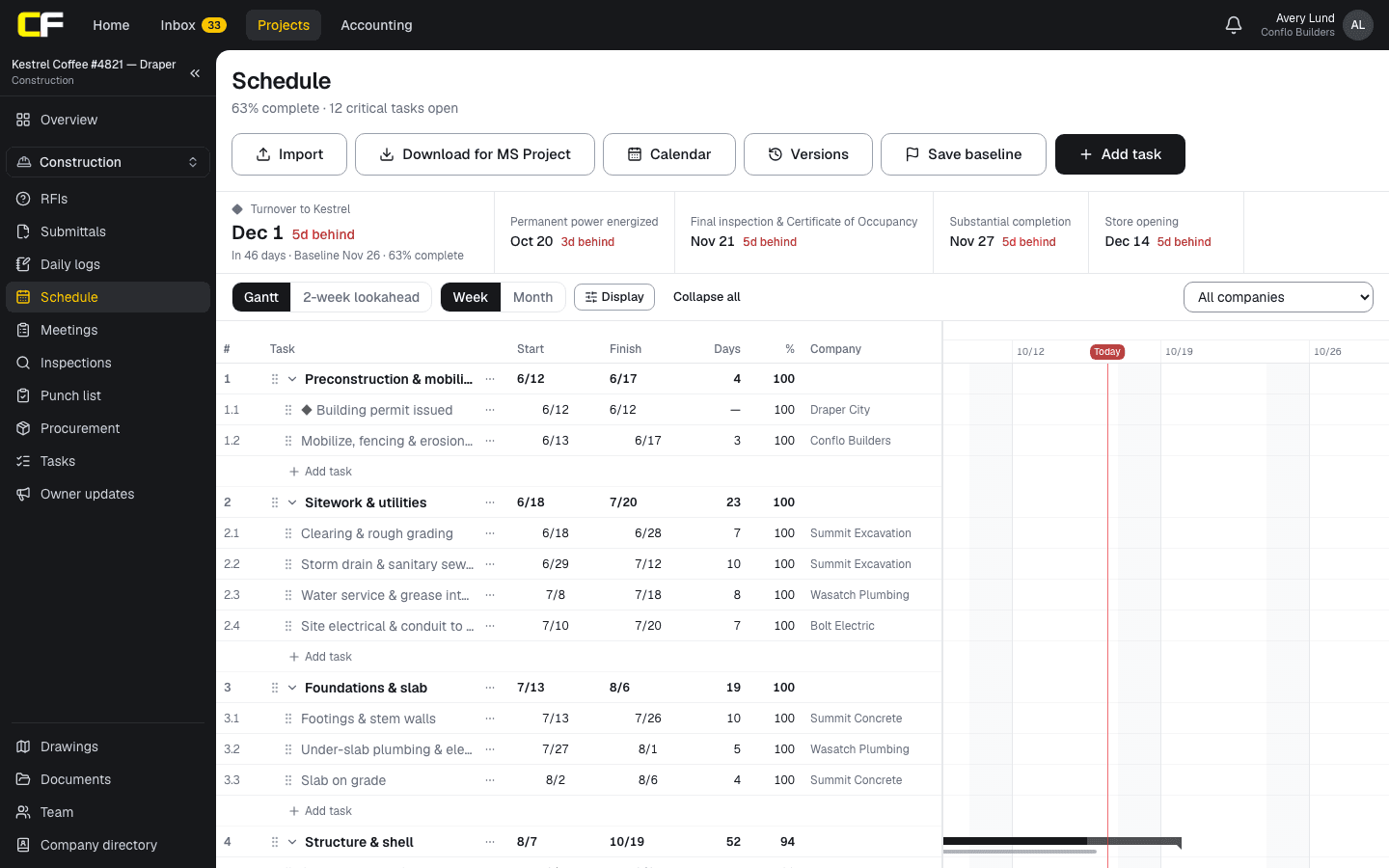
In Conflo's schedule, tasks are linked finish-to-start, start-to-start, finish-to-finish or start-to-finish, with lead or lag in working days on the project's calendar. Conflo calculates total float from the dates on the schedule and marks tasks with none as critical; the header counts the critical tasks still open. It shows one critical path and doesn't calculate free float.
The bottom line
The critical path is the longest chain of linked work, and it sets the finish date. Watch it at every update, because it moves when non-critical work slips past its float.
If you build a schedule for owners and subs to read, link every activity so the critical path you show is the real one.
Sources
- UFGS 01 32 01.00 10, Project Schedule (August 2026), §3.5.4.3 Critical Path — U.S. Army Corps of Engineers (Whole Building Design Guide). Read October 16, 2026.
- Show the critical path of your project in Project — Microsoft Support. Read October 16, 2026.
- Critical fields — Microsoft Support. Read October 16, 2026.
Questions
Can a schedule have more than one critical path?
Two chains can tie for longest, and then both are critical. Some tools also show a separate critical path for each chain that ends at its own milestone. Either way, the job finishes no sooner than the longest one.
Is the critical path the most important work?
It is the work that sets the finish date, not the most expensive or the hardest. A long-lead submittal can be on the critical path while the structural steel is not.
How do you shorten the critical path?
Overlap activities that were in sequence (fast-tracking), add crews or hours to critical activities (crashing), or change the logic, for example by splitting a pour into areas. Shortening it can make another path critical, so recalculate after each change.
Related
Definition
What Is Float in a Construction Schedule?
Float is how many working days an activity can slip. Total float vs free float, worked on a five-activity network, and who owns the float.
· 4 min read
Construction
How Does an Owner Read a Construction Schedule?
How an owner reads a contractor's schedule: the Gantt chart, milestones, the critical path, float, the baseline, and what to ask at each update.
· 6 min read
Comparison
Conflo vs Microsoft Project for Construction Schedules
Conflo vs Microsoft Project for construction schedules: critical path, float, baselines, lookaheads, resources and file exchange, from their own pages.
· 6 min read
Pillar
The Construction Project Lifecycle: Bid to Closeout
The phases of a construction project, from planning and design to bidding, building and closeout, and what the owner, architect, GC and subs do in each.
· 7 min read
Role hub
The General Contractor's Guide: Bid to Closeout
What a general contractor is responsible for at every phase of a commercial job, from bidding and buyout to RFIs, change orders, pay apps and closeout.
· 8 min read