
Allowance vs Contingency: What Is the Difference?
By Wyatt Cooper · Published · 4 min read
Key takeaways
- An allowance is a sum in the contract for a known item whose selection or quantity is not settled yet, adjusted by change order to the real cost.
- A contingency is money set aside for things nobody planned, such as concealed conditions; it is spent only by approved change and unused amounts go back as the contract says.
- Keep them apart in the estimate: GSA's cost policy requires allowances and contingencies to be separately identified, never hidden inside unit prices.
An allowance is a set amount in the contract for a known item not yet selected or measured, such as signage or tile, adjusted to the actual cost by change order. A contingency is money held for events nobody planned, such as concealed conditions: an allowance covers what you know you will buy, a contingency what you do not know.
Known but undefined, or not known at all
The U.S. General Services Administration's cost policy puts it in one line each: allowances are for planned project items until they can be better defined, and are part of the construction estimate; contingencies are for unintended, not directly controllable occurrences, and are part of the project estimate. It also requires the two to be separately identified, never concealed in unit prices or quantities (GSA P120).
A specification section shows how an allowance works in a contract. The University of Houston's Section 01 21 00 (Allowances) lists lump-sum, unit-cost, quantity, contingency, and testing and inspecting allowances. Unless stated otherwise, the contractor's handling, labor, installation, overhead and profit for allowance items are in the contract sum, not the allowance. An adjustment is a change order for the difference between the purchase amount and the allowance, and unused contingency and testing allowances are credited to the owner by change order at closeout.
| Allowance | Contingency | |
|---|---|---|
| Covers | A known item not yet selected or measured | Events nobody planned |
| Example | Signage, finishes, a quantity of rock removal | Concealed conditions, design coordination |
| Spent by | Selection, then a change order for the difference | An approved change order |
| Left over | Credited by change order | Back to the holder, as the contract says |
Example
On a fictional retail fit-out, the contract carries a $14,000.00 signage allowance, and the owner holds a $42,000.00 contingency. The signage chosen costs $16,350.00, so a change order adds $16,350.00 − $14,000.00 = $2,350.00; under a specification like Houston's, no markup is added, because the GC's overhead and profit on the signage were already in the contract sum. Separately, demolition uncovers a buried footing: a $9,800.00 change order is drawn from the owner's contingency, leaving $42,000.00 − $9,800.00 = $32,200.00.
For how much contingency to carry, see how much contingency an owner should carry; for pricing the change orders that adjust both, see how to price a change order and how to handle a change order on a remodel.
How it works in Conflo
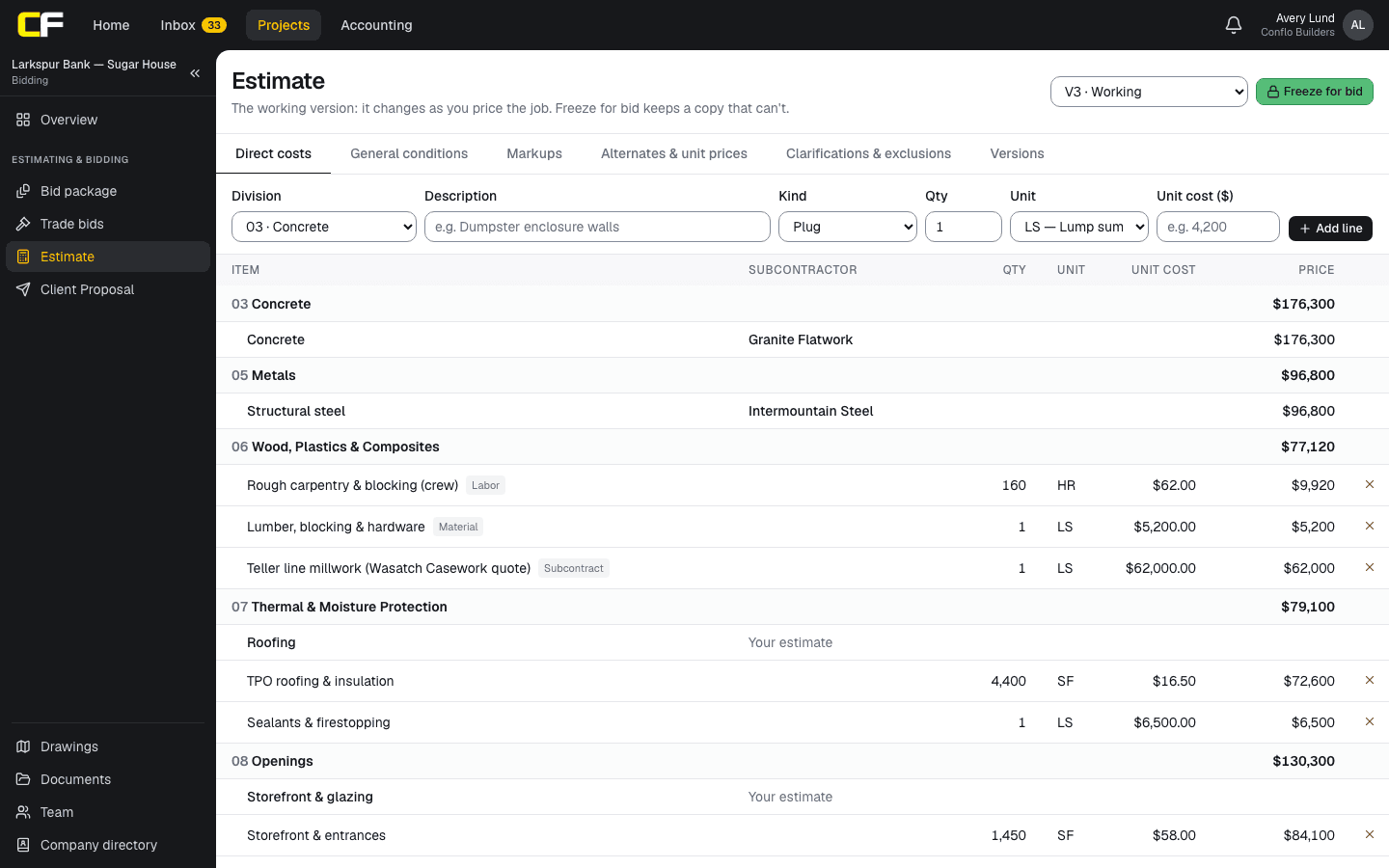
In Conflo's Estimate, an allowance is a line kind of its own ("a set amount for something not chosen yet"), and the estimate lists the allowances included. Contingency is one of the markups you add to the estimate, with insurance, bond, fee, tax and escalation, each showing what it is charged on. When the job is awarded, the contingency becomes its own budget line, on cost code 01 21 16. An allowance adjustment is written as an ordinary change order; there is no field that ties a change order to the allowance it adjusts.
The bottom line
An allowance is for a known item you have not chosen yet; a contingency is for what nobody saw coming. Show both separately, adjust allowances by change order to the real cost, and spend contingency only on approved changes.
Credit what is left as the contract says.
Sources
- P120, Public Buildings Service Cost and Schedule Management Policy Requirements (GSA Order PBS 1000.6B, November 7, 2022) — U.S. General Services Administration, via the Whole Building Design Guide. Read October 16, 2026.
- Section 01 21 00, Allowances (master specification) — University of Houston, Facilities Planning and Construction. Read October 16, 2026.
Questions
Is an allowance part of the contract price?
Yes. An allowance is included in the contract sum and adjusted up or down by change order once the real cost is known. Whether the contractor's markup is inside the allowance or elsewhere in the contract sum depends on the specification; check yours.
Who keeps unused contingency?
Whoever holds it, as the contract says. An owner's contingency stays with the owner. A contingency allowance in the contract is typically credited back to the owner by change order at closeout.
Is a design contingency an allowance?
GSA's policy says that, within the ASTM definitions it follows, the design or estimating contingency is technically an allowance for completing the defined scope, because it covers work expected but not yet drawn.
Related
Money
How Much Contingency Should an Owner Carry?
Owner contingency in construction: design vs construction contingency, GSA's guidelines (7% new, 10% renovation), and how to size and track yours.
· 7 min read
Money
How Do You Price a Change Order?
Price a change order from direct cost (burdened labor, materials, equipment, sub quotes), then the markups and time your contract allows. Worked example.
· 9 min read
Money
How Should a Remodeler Handle a Change Order?
Remodel change orders: in writing and signed before the work, with the scope, price added or credited, and effect on payments and finish date. Example.
· 6 min read
Role hub
The General Contractor's Guide: Bid to Closeout
What a general contractor is responsible for at every phase of a commercial job, from bidding and buyout to RFIs, change orders, pay apps and closeout.
· 8 min read