
Change Order vs Construction Change Directive
By Wyatt Cooper · Published · 4 min read
Key takeaways
- A change order records agreement: on AIA forms, the owner, contractor and architect sign it, and it settles the change in price and time.
- A construction change directive orders the contractor to proceed before the price or time is agreed; the adjustment is settled later, often by cost plus a fee.
- Federal contracts use the words differently: there, a change order is the government's one-sided order, and the agreed price is a bilateral modification.
A change order is a signed agreement between owner and contractor (on AIA forms, the architect too) that settles a change in the work and its price and time. A construction change directive is the owner's written order, usually prepared by the architect, to proceed with a change before price or time is agreed.
Agreed now, or settled later
AIA Contract Documents describes its change order form, G701, as being for changes agreed to by the owner, contractor and architect, and says executing it indicates agreement on all terms of the change, including the contract sum and time (AIA, G701 summary). Its construction change directive, G714, is for changes where the owner and contractor have not agreed on the price or time; on receiving one, the contractor must promptly proceed with the change (AIA, G714 instructions).
A directive keeps the job moving when waiting for a price would delay it. G714 offers three ways to set the adjustment: a lump sum, unit prices, or cost plus the contractor's fee. The contractor signs if it agrees with the proposed adjustment; if not, it tells the architect, and the method in A201 §7.3.4 applies. Once price and time are agreed, a change order records them.
| Change order | Construction change directive | |
|---|---|---|
| Price and time | Agreed and stated | Not yet agreed; a method is proposed |
| Who signs | Owner and contractor (AIA: and architect) | Architect and owner; the contractor signs only if it agrees with the proposed adjustment |
| The work | Proceeds as agreed | Proceeds now, priced later |
| Federal words | Bilateral modification (supplemental agreement) | Change order, signed only by the contracting officer |
The federal meaning is the other way round
In the Federal Acquisition Regulation, a change order is a written order signed by the contracting officer directing a change the changes clause allows without the contractor's consent (FAR 2.101). It is a unilateral modification; the negotiated price adjustment that follows is a bilateral modification, signed by both, also called a supplemental agreement (FAR 43.103). Meanwhile the contractor keeps working: the disputes clause requires it to proceed diligently pending resolution of a claim (FAR 52.233-1).
Example
On a fictional office job, the owner needs added firestopping at new penetrations before an inspection next week, and the GC's price is still under review. The architect prepares a directive on a cost-plus basis with a 10% fee, and the owner signs it. The GC proceeds and tracks the cost: $18,240.00. Fee: 10% × $18,240.00 = $1,824.00. Once both sides check the records, a change order for $20,064.00 and zero days closes it.
Pricing the change order itself is the same either way: how to price a change order and the change order pricing calculator. An owner deciding whether to sign either one can follow how to review a change order as an owner.
How it works in Conflo
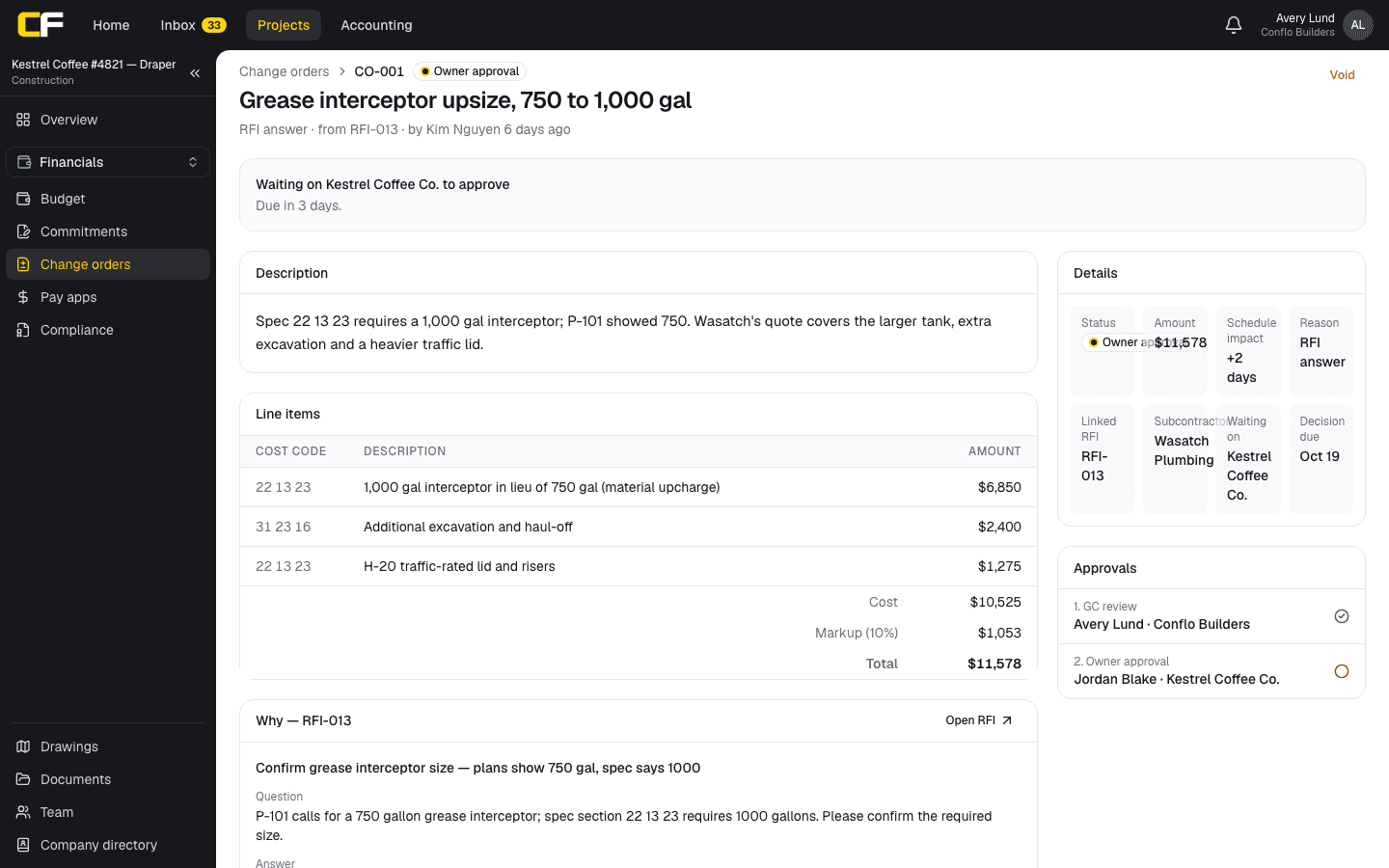
Conflo's change orders are the agreed kind: priced lines, the GC's markup, schedule days, GC review, then owner approval, which executes the change. There is no separate construction change directive record today; a directive's paper can be attached to a change order's files while its price is worked out.
The bottom line
A change order is agreement on the change, its price and time; a construction change directive is an order to proceed first and settle the price later.
Either way, track the cost from day one.
Sources
- Summary: G701–2017, Change Order — AIA Contract Documents. Read October 16, 2026.
- Instructions: G714–2017, Construction Change Directive — AIA Contract Documents. Read October 16, 2026.
- FAR 2.101, Definitions — Acquisition.gov, U.S. General Services Administration. Read October 16, 2026.
- FAR 43.103, Types of contract modifications — Acquisition.gov, U.S. General Services Administration. Read October 16, 2026.
- FAR 52.233-1, Disputes — Acquisition.gov, U.S. General Services Administration. Read October 16, 2026.
Questions
Does a contractor have to follow a construction change directive?
Under AIA's G714, yes: on receipt, the contractor must promptly proceed with the change, and the price and time are settled afterward. Other contracts set their own rules. Check yours.
How is a construction change directive priced?
By the method it states: a lump sum, unit prices, or the cost of the work plus the contractor's fee. Once the parties agree on the amount and days, a change order records them.
Related
Money
How Do You Price a Change Order?
Price a change order from direct cost (burdened labor, materials, equipment, sub quotes), then the markups and time your contract allows. Worked example.
· 9 min read
Money
How Should an Owner Review a Change Order?
How an owner reviews a contractor's change order: is it a change, is the price right, are the markups the contract's, are the days real. Worked example.
· 8 min read
Money
How Does a Subcontractor Write a Change Order Request?
A sub's change order request: notice first, then scope, priced direct cost, your markup, days and backup the GC can pass to the owner. Worked example.
· 9 min read
Definition
What Is a Change Order in Construction?
A change order is a signed amendment to a construction contract that changes the work and adjusts price, time or both. Definition and a worked example.
· 3 min read
Role hub
The General Contractor's Guide: Bid to Closeout
What a general contractor is responsible for at every phase of a commercial job, from bidding and buyout to RFIs, change orders, pay apps and closeout.
· 8 min read