
How Do You Build a Punch List?
By Wyatt Cooper · Published · 9 min read
Key takeaways
- Start your own punch walks weeks before substantial completion, area by area, so the architect's walk finds a short list instead of a long one.
- Every punch item needs five things: an exact location, the responsible trade or company, a one-line description, a photo and a due date.
- On AIA-based contracts the contractor prepares the list of items to be completed or corrected, and the architect verifies and adds to it at substantial completion.
- An item is closed only when the GC has checked the fix in person or by photo, never because the subcontractor said it was done.
To build a punch list, walk the finished work area by area before substantial completion and log every item that is incomplete or wrong. Give each item an exact location, the responsible trade, a short description, a photo and a due date, then send each sub only its items. Verify every fix before closing it. When your list is short, invite the owner and architect to walk; the architect adds items, and that list goes with the certificate of substantial completion.
The punch list is the gate between substantial and final completion
A punch list is the list of work still to be completed or corrected once a project, or a part of it, is substantially complete: usable for its purpose, but not finished. Typical items are paint touch-ups, a missing cover plate, a door that does not latch, a stained ceiling tile, damaged base.
On contracts that use AIA documents, the punch list is part of the certificate of substantial completion. The AIA's summary of G704 says the contractor prepares the list of items to be completed or corrected, the architect verifies and amends it, and the parties agree the time allowed to finish them. On federal construction contracts, the inspection clause has the contractor keep an inspection system that ensures the work conforms, and correct or replace work the government rejects (FAR 52.246-12).
The list matters for money. Many contracts release most retainage at substantial completion and hold back an amount for the open punch items, and final payment waits until the list is closed. Check your contract for how it ties the two.
Start before substantial completion, one area at a time
Do not wait for the whole building to be finished. Punch an area as soon as its finishes are in: a floor, a wing, a unit, a room type. Early walks catch problems while the trade is still on site and before other trades cover or damage them.
Public owners write the same timing into their manuals. Alaska DOT&PF's construction manual has project staff review the whole project when significant items of work are nearing substantial completion, prepare "a comprehensive list of items the contractor must complete", and give the contractor a copy to plan its resources; after the final inspection, the group revises that list with anything else not in acceptable condition.
- 1Each subSelf-punches its own work and fixes what it finds
- 2GC superintendentWalks each area and logs items, one per problem
- 3Responsible subFixes its items and shows the fix with a photo or a note
- 4GC superintendentVerifies each fix: closes it, or sends it back with the reason
- 5Owner and architectWalk the area when the GC's list is near zero and add items
- 6GC and subsFix and verify the added items the same way, then close the list
Walk room by room in the same order every time
Walk each room in a fixed order so nothing is skipped: the door and frame on the way in, then clockwise around the walls, then the ceiling, then the floor, then fixtures and equipment. Use the room numbers on the drawings, not "the room by the stairs".
Bring the finish schedule and the door hardware schedule. Check that every device works: switches, outlets, fixtures, faucets, door closers, window operators. A list of only cosmetic items, with nothing tested, is half a punch list.
Log one item per problem. "Paint touch-ups throughout" is not an item; "Room 104, north wall, scuffs at 4 ft, touch up" is.
Give every item a location, a trade, a description, a photo and a due date
| Field | What to write | Example | Common mistake |
|---|---|---|---|
| Location | Room number and where in the room | Op 3 (Room 107), east wall, above counter | "Upstairs" or "near the lobby" |
| Trade / company | The company responsible for the fix | Bramble Painting (fictional) | Assigning to "GC" by default |
| Description | What is wrong and what done looks like | Drywall nail pops, two places; patch and repaint | "Fix wall" |
| Photo | One photo with the problem visible | The nail pops, circled in pencil | No photo, or a photo of the whole room |
| Due date | A specific date, set with the sub | November 17 | "ASAP" |
| Priority | Whether it blocks occupancy or an inspection | High: affects the fire inspection | Every item marked high |
Punch item 4 — Nail pops above counter, Op 3
- Project
- Juniper Street Dental (fictional)
- Location
- Op 3 (Room 107), east wall, above the counter
- Company
- Bramble Painting (paint)
- Description
- Drywall nail pops in two places. Reset the fasteners, patch, and repaint the wall corner to corner
- Photo
- Nail pops circled in pencil, taken on the walk
- Priority
- Medium
- Due
- November 17
- Status
- In progress
A worked example: a fictional dental office fit-out
The job is fictional: "Juniper Street Dental", a single-story tenant fit-out built by a fictional GC. The superintendent walks the operatories and the sterilization room on November 10, two weeks before the planned substantial completion date, and logs these items. All companies are fictional.
| # | Location | Company (trade) | Description | Due | Status |
|---|---|---|---|---|---|
| 1 | Op 1 (Room 105), door | Keystone Doors (doors and hardware) | Closer slams; adjust speed so the door closes and latches | Nov 14 | Closed |
| 2 | Op 1 (Room 105), north wall | Bramble Painting (paint) | Scuffs at 4 ft beside sink cabinet; touch up | Nov 17 | Closed |
| 3 | Op 2 (Room 106), ceiling | Corner Ceilings (acoustical) | Stained tile at grid line C; replace | Nov 17 | Ready for review |
| 4 | Op 3 (Room 107), east wall | Bramble Painting (paint) | Nail pops, two places, above counter; patch and repaint | Nov 17 | In progress |
| 5 | Op 3 (Room 107), counter | Larchmont Millwork (casework) | Countertop seam open 1/16 in at sink; re-seam | Nov 19 | Open |
| 6 | Sterilization (Room 110), wall | Halvorsen Electric (electrical) | Cover plate missing at counter outlet; install | Nov 14 | Closed |
| 7 | Sterilization (Room 110), sink | Rook Plumbing (plumbing) | Hot water slow to arrive; check recirculation and report | Nov 14 | Rejected once, open |
| 8 | Corridor outside 105–107, base | Fieldstone Flooring (resilient flooring) | Rubber base lifting at corner; re-adhere | Nov 17 | Open |
| Status | Items | Item numbers |
|---|---|---|
| Open | 3 | 5, 7, 8 |
| In progress | 1 | 4 |
| Ready for review | 1 | 3 |
| Closed | 3 | 1, 2, 6 |
| Total | 8 |
The counts add up: 3 + 1 + 1 + 3 = 8. Bramble Painting has two items (2 and 4), one closed and one in progress; Larchmont Millwork, Rook Plumbing and Fieldstone Flooring each have one still open. Every item has a photo taken on the walk.
Item 7 shows why a fix needs proof: the plumber marked it fixed, the superintendent ran the tap, the hot water was still slow, and the item went back to open with the reason.
Send each sub only its own items, and verify before closing
Send each company the items that are theirs, not the whole list. A painter does not need forty plumbing items to find its four. Agree the due dates when you send them.
A fix is not a closed item. Close it only after you have looked at it, or seen a photo good enough to judge. If it is still wrong, send it back with the reason, and count how often that happens; a sub with repeated rejections needs a conversation, not more items.
Before the owner and architect walk, your open list for the area should be close to zero. Their items join the same list, with the same five fields, and are verified the same way. When a punch item turns out to be a design question, it becomes an RFI.
Common punch list mistakes
- Starting at substantial completion instead of weeks before.
- Vague locations that send a sub hunting.
- One item for many problems, so it never closes.
- Closing on the sub's word without checking.
- No due dates, so the list drifts into the warranty period.
- Testing nothing: cosmetic items logged, devices never operated.
- Keeping the list in several places (a notebook, an email, a spreadsheet), so no one knows which is current.
How it works in Conflo
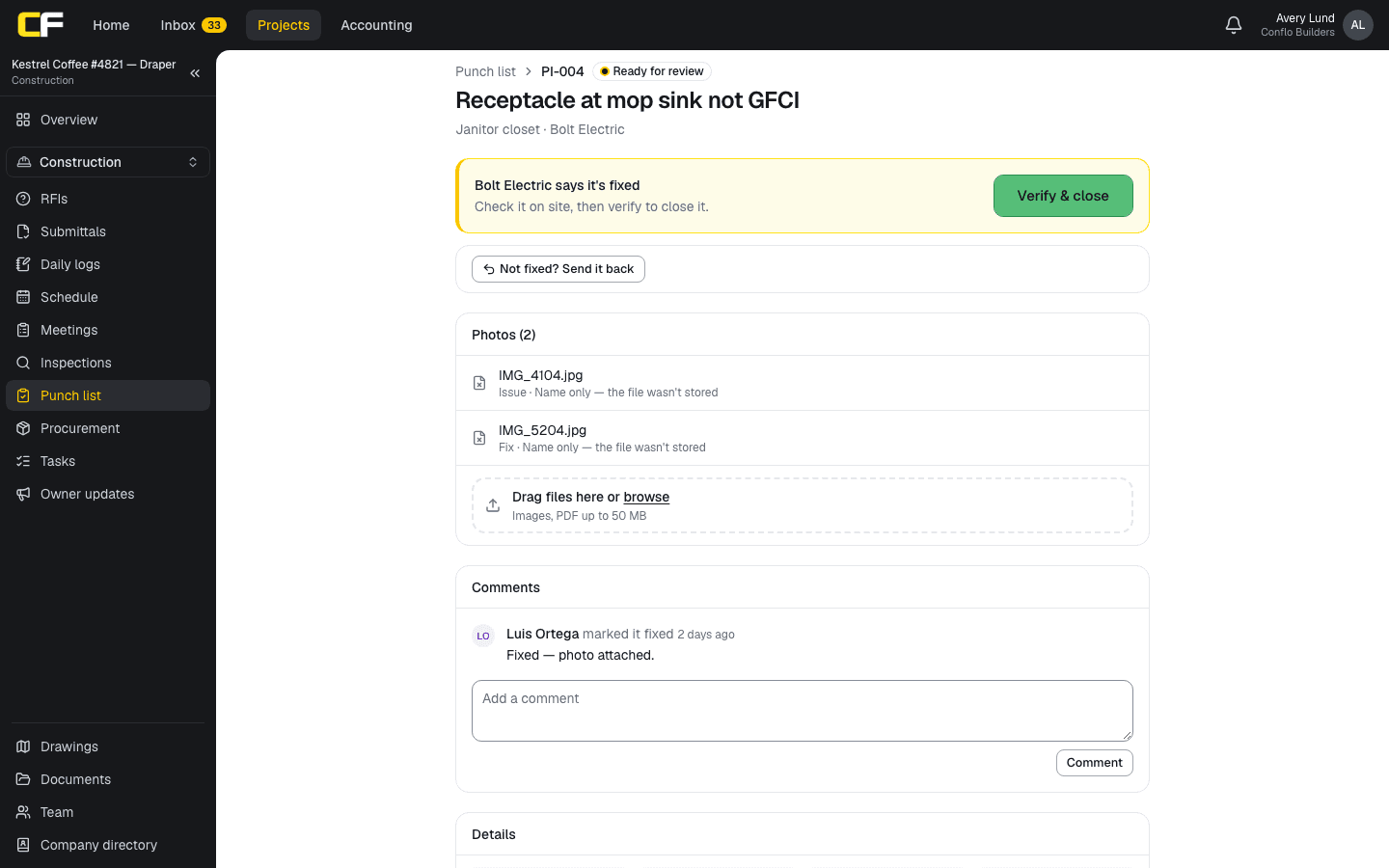
In Conflo's punch list, the GC logs items on the walk: what is wrong, where it is, the company that fixes it, a priority and a due date, with an optional photo. Each item is assigned to a company on the project and takes that company's trade. "Save and add another" keeps the form open with the same location filled in, for the next item in the room.
The sub sees only its own company's items, starts an item, and marks it fixed with a photo of the fix or a note. Only the GC closes an item, rejects it back to open with the reason, or reopens it; each rejection is counted on the item. The list puts overdue items first, then priority, then due date, and the same list carries into closeout alongside closeout documents.
The bottom line
A good punch list is built early, one area at a time, with items specific enough that a sub can find, fix and prove each one without a phone call. The owner's walk should confirm your list, not write it.
Start your first area walk as soon as that area's finishes are in, and close nothing you have not checked.
Sources
- Summary: G704–2017, Certificate of Substantial Completion — AIA Contract Documents (The American Institute of Architects). Read October 16, 2026.
- FAR 52.246-12, Inspection of Construction — Acquisition.gov, U.S. General Services Administration. Read October 16, 2026.
- Construction Manual (2021), Chapter 15: Final Field Construction Activities, 15.1 Final Inspection — Alaska Department of Transportation & Public Facilities. Read October 16, 2026.
Questions
How do you build a punch list?
Walk the finished work area by area before substantial completion and log every item that is incomplete or wrong, each with a location, the responsible trade, a description, a photo and a due date. Send each sub its own items, verify every fix, then invite the owner and architect to walk.
When should a punch list start?
Before substantial completion. Punch each area as soon as its finishes are in, while the trades are still on site. By the time the owner and architect walk, your own list for that area should be nearly closed.
Who prepares the punch list?
On contracts using AIA documents, the contractor prepares the list of items to be completed or corrected, and the architect verifies and adds to it when inspecting for substantial completion. Your contract may assign it differently, so check it.
What should each punch list item include?
An exact location (room number and where in the room), the company responsible, a one-line description of what is wrong and what done looks like, a photo, and a due date. A priority helps when some items block occupancy or inspections.
When is a punch item closed?
When the GC has checked the fix, in person or by a clear photo, and it is right. A sub marking an item fixed means it is ready for review, not closed. If it is still wrong, send it back with the reason.
Related
Template
Free Punch List Template (Excel)
A free punch list template in Excel: location, description, company, trade, priority, photo, due date and status, with a status count. No email needed.
· 4 min read
Definition
What Is a Punch List in Construction?
A punch list is the list of work still to be completed or corrected once a building is substantially complete. What goes on it, who writes it, an example.
· 3 min read
Closeout
How Does an Architect Decide Substantial Completion?
How the architect inspects for substantial completion: the contractor's list, who walks, what blocks use and what is a punch item, and the certificate.
· 8 min read
Closeout
How Do You Assemble a Construction Closeout Package?
A closeout checklist by spec section and company: O&M manuals, as-builts, warranties, attic stock, training, lien waivers. Build it at buyout. Example.
· 9 min read
Closeout
How Does a Sub Close Out Punch List Items?
A subcontractor's method for punch lists: sort your items by area, fix them in one trip, prove each fix with a photo, and get them closed the first time.
· 6 min read
Role hub
The General Contractor's Guide: Bid to Closeout
What a general contractor is responsible for at every phase of a commercial job, from bidding and buyout to RFIs, change orders, pay apps and closeout.
· 8 min read