
How Should an Owner Read a GC's Cost Report?
By Wyatt Cooper · Published · 7 min read
Key takeaways
- On a GMP or cost-plus job the GC's cost report is your window into the money: read the projected final cost, not the cost to date.
- Check that the current budget still adds up to the contract sum: contingency transfers move money between lines, while owner change orders change the total.
- Compare how much of the GC's contingency is used or spoken for with how far along the job is.
- In the worked example, a job 60% complete projects $57,000 over its lines, which would consume all but $15,000 of the GC's remaining $72,000 contingency.
To read a GC's cost report, start with the summary: the contract sum, the current budget by line, and the projected final cost. Check that the lines still add up to the contract, that contingency transfers are explained, and how much contingency is left compared with percent complete. Then read the lines projected over and ask what caused each overrun, what is pending, and whether the forecast includes the time left on the schedule.
When you get a cost report, and what it is for
On a lump-sum job the owner pays a fixed price and the GC's costs are its own business. On a guaranteed maximum price or cost-plus job the owner pays the GC's actual cost plus a fee, so the contract usually gives the owner an open book: a monthly cost report showing what was budgeted, what is committed and spent, and where each line is projected to finish. See what a GMP contract is.
The number that matters is the projected final cost, not the cost to date. GAO's cost guide defines the estimate at completion as "the latest revised estimate of cost at completion including estimated overruns and underruns for all authorized work", and notes that contractors are often asked for "three EACs – a best case, a worst case, and a most likely case" (GAO-20-195G). Asking your GC for a range is a fair request.
The columns and what each one tells you
| Column | What it is | What to check |
|---|---|---|
| Original budget | Each line as priced in the GMP or contract | Adds up to the original contract sum |
| Approved changes and transfers | Owner change orders, and moves from contingency into cost lines | Change orders change the total; transfers net to zero |
| Current budget | Original plus changes and transfers | Adds up to the current contract sum |
| Committed | Signed subcontracts and purchase orders | How much of the job is bought out |
| Cost to date | Billed or spent so far | Ties to the pay apps you have approved, once fee and retainage are accounted for |
| Projected final | Cost to date plus the forecast to finish | Lines over the current budget, and why |
| Variance | Current budget minus projected final | Who pays it: contingency, the GC's fee or the owner |
How to read it, step by step
- Check that the current budget adds up to the current contract sum: the original plus executed owner change orders.
- Read every contingency transfer since last month: what it paid for, and whether it was really a change in scope the owner should have priced.
- Compare contingency used and spoken for with percent complete. Using two-thirds of it a little over halfway through is a warning.
- Read the lines projected over budget, largest first, and ask what caused each one and what is pending on it.
- Check time-based lines, like general conditions, against the current schedule: a later finish should raise them.
- Tie cost to date to the pay applications you have approved.
- Ask for the best, worst and most likely projected final if the report shows only one.
- 1GC project managerCloses the month's cost and forecasts each line to completion
- 2GC project managerRecords contingency transfers with what each one paid for
- 3GCSends the cost report with the month's pay application
- 4OwnerTies cost to date to the pay application and reads the lines projected over
- 5OwnerAsks for causes, pending items and a range, and approves or questions the transfers
Keep two contingencies apart. The GC's contingency sits inside the GMP for the GC's risks. Your own owner's contingency sits outside it; GSA's policy says scope-change costs "must be accommodated by approved revisions to the project funding and not through the use of construction contingency" (GSA P-120). Sizing your own is covered in how much contingency an owner should carry, and the difference between the two terms in allowance vs contingency.
A worked example: month nine on a fictional GMP
The project is fictional: an $8,400,000 GMP for a three-story office, 60% complete in month nine. The GMP was built as $7,350,000 cost of the work, $480,000 general conditions, $220,000 GC contingency and a $350,000 fee. No owner change orders yet; $148,000 of contingency has been moved into cost lines.
| Line | GMP budget | Transfers | Current budget | Projected final | Variance |
|---|---|---|---|---|---|
| Cost of the work | $7,350,000 | +$148,000 | $7,498,000 | $7,530,000 | −$32,000 |
| General conditions | $480,000 | $0 | $480,000 | $505,000 | −$25,000 |
| GC contingency | $220,000 | −$148,000 | $72,000 | $72,000 (unspent) | $0 |
| Fee | $350,000 | $0 | $350,000 | $350,000 | $0 |
| Total | $8,400,000 | $0 | $8,400,000 | $8,457,000 | −$57,000 |
The current budget still adds up: $7,498,000 + $480,000 + $72,000 + $350,000 = $8,400,000, and the transfers net to zero. The lines project $57,000 over ($32,000 + $25,000). If the remaining $72,000 of contingency absorbs that, the projected total is $8,457,000 − $57,000 = $8,400,000 with $15,000 of contingency left: inside the GMP, but only just.
Read against progress, $148,000 used plus $57,000 projected is $205,000, or 93% of the $220,000 contingency, at 60% complete. The general conditions overrun points to a later finish. Questions for the GC: what the $148,000 of transfers paid for, which cost lines carry the $32,000, how many weeks the $25,000 reflects, and what happens above the GMP. On most GMP contracts the GC bears cost above it, but your contract decides that.
Red flags in a cost report
- Projected final equal to the budget on every line, month after month: nobody is forecasting.
- Contingency transfers with no description.
- Owner-requested scope paid from the GC's contingency instead of a change order.
- General conditions not moving after the schedule has slipped.
- Cost to date that does not tie to the pay applications.
- Buyout savings reported on signed trades while unbought trades still carry their original numbers.
The pay applications behind cost to date are covered in how to review a GC's pay application, and changes in how to review a change order as an owner. The rest of the owner's path is in the owner's guide.
How it works in Conflo
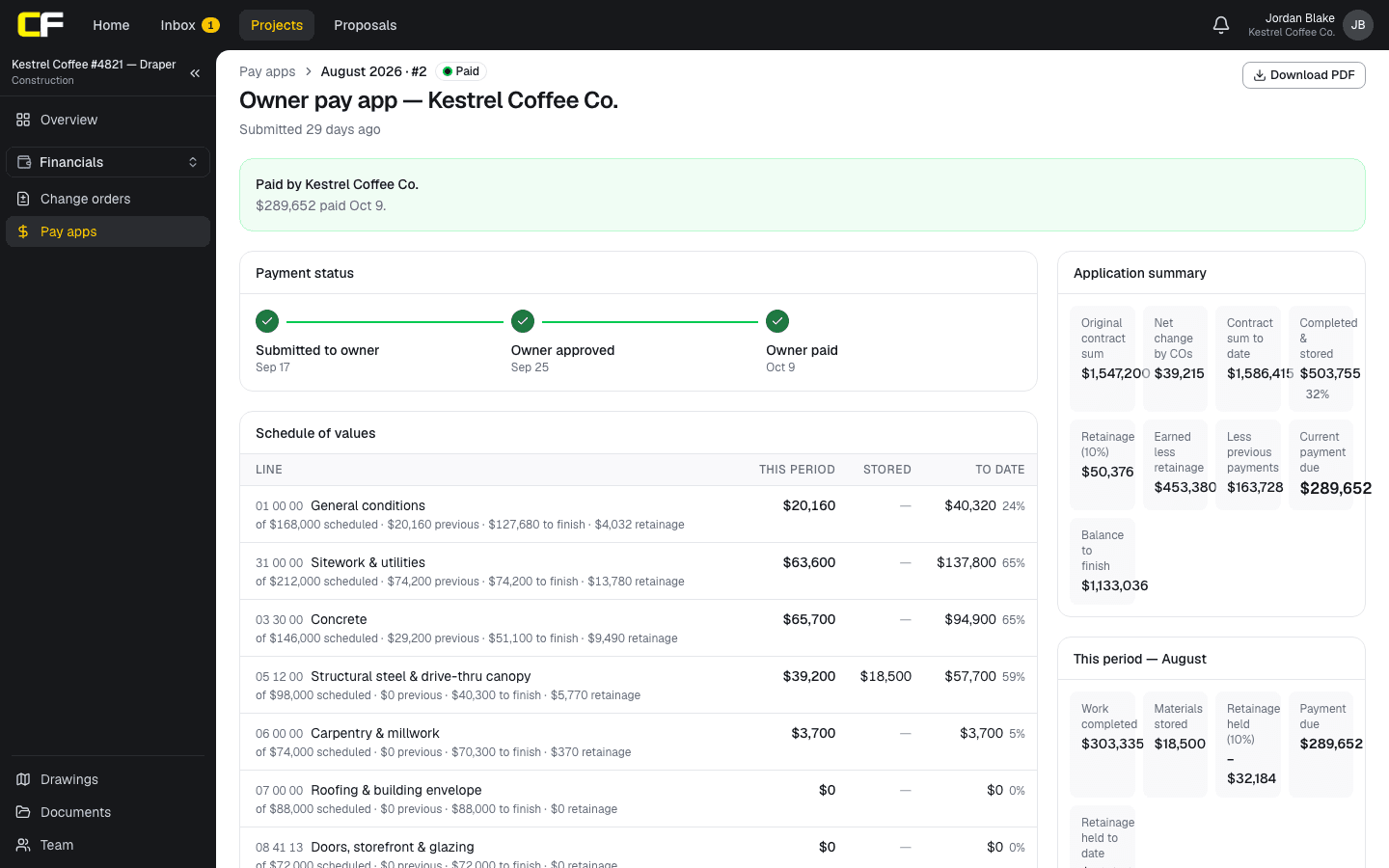
In Conflo the cost budget is the general contractor's own tool: owners, subcontractors and designers cannot open it, so a cost report on an open-book job is something the GC shares with you. What the owner sees directly is the money that reaches the contract. The GC's pay app shows its payment steps, the application summary with the net change by change orders, retainage and current payment due, and the schedule of values line by line with this period, stored and to-date amounts.
A change order waiting on the owner shows its price, any days added to the schedule, what the contract becomes, and its line items at the owner's price, with Approve and Reject.
The bottom line
A cost report is worth reading for three numbers: whether the lines still add up to the contract, how much contingency is left against how far along the job is, and the projected final.
Read the lines projected over and ask for causes, not totals. The month you ask is the month the GC can still recover.
Sources
- GAO-20-195G, Cost Estimating and Assessment Guide (March 2020) — U.S. Government Accountability Office. Read October 22, 2026.
- P-120, Public Buildings Service Cost and Schedule Management Policy Requirements (PBS 1000.6B, November 7, 2022) — U.S. General Services Administration (via WBDG). Read October 22, 2026.
Questions
Is the owner entitled to see the GC's cost report?
It depends on the contract. GMP and cost-plus contracts usually give the owner an open book and audit rights; a lump-sum contract usually does not. Check your contract.
What is a contingency transfer?
A move of money from the GC's contingency line into a cost line to cover a cost inside the GMP's scope. It does not change the contract sum. A change in scope is a change order instead.
Who pays if the projected final is over the GMP?
On most GMP contracts the GC pays cost above the guaranteed maximum, unless the owner changed the scope. Your contract's terms decide it, so read them.
How often should a GC send a cost report?
Monthly is common, alongside the pay application, so the owner can tie cost to date to what it is paying. The contract can set the schedule.
Related
Definition
What Is a GMP Contract in Construction?
A GMP contract caps what the owner pays: the cost of the work plus a fee, up to a ceiling. A worked example of shared savings and an overrun.
· 4 min read
Money
How Much Contingency Should an Owner Carry?
Owner contingency in construction: design vs construction contingency, GSA's guidelines (7% new, 10% renovation), and how to size and track yours.
· 7 min read
Money
How Should an Owner Review a GC's Pay Application?
An owner's checklist for a contractor's pay application: work in place, stored materials, change orders, retainage, waivers and the math. With an example.
· 6 min read
Money
How Do You Forecast Cost to Complete on a Job?
Forecast cost to complete line by line: remaining commitments, self-performed work at its real production rate, and time-based costs against the schedule.
· 6 min read
Role hub
The Owner's Guide to a Commercial Building Project
The owner's role on a commercial building project, phase by phase: delivery method, choosing the contractor, pay apps, change orders and closeout.
· 7 min read