
What Is a Committed Cost in Construction?
By Wyatt Cooper · Published · 3 min read
Key takeaways
- Committed cost is what the contractor is contractually bound to pay: signed subcontracts and purchase orders plus their approved change orders.
- It is not actual cost: a $286,000 subcontract is fully committed the day it is signed, even if nothing has been billed.
- Budget minus committed shows what is left to buy out on each cost code, which is where buyout savings or overruns first appear.
A committed cost is money a contractor has contractually agreed to spend on a job: the value of signed subcontracts and purchase orders, plus their approved change orders, whether or not anything has been billed yet. Tracked by cost code against the budget, committed cost shows how much of each line is bought out and what remains uncommitted.
Committed, actual and budget
A job's cost report has three money columns that are easy to confuse. The budget is what you planned to spend. Committed cost is what you have signed contracts for. Actual cost is what has been billed or paid. A line can be fully committed and barely billed, early in a subcontract, or billed with nothing committed, for the GC's own labor.
Words differ between worlds. In federal budgeting, a commitment is only "An administrative reservation of allotted funds" in anticipation of an obligation, and an obligation is the binding step, incurred when an agency "places an order, signs a contract" (GAO-05-734SP, Budget Glossary). A construction cost report's committed cost matches that binding step: signed, not just planned. Keeping it current is how a manager can "project costs forward to forecast project completion values" (LA Bureau of Engineering, 19.1); the forecast itself is cost to complete.
Example
Cost code 09 29 00, gypsum board
- Budget
- $310,000
- Drywall subcontract (signed)
- $286,000
- Approved change order on it
- +$6,500
- Committed
- $292,500
- Billed to date (actual)
- $120,000
- Uncommitted budget
- $17,500
The arithmetic: $286,000 + $6,500 = $292,500 committed; $310,000 − $292,500 = $17,500 still uncommitted. The $120,000 billed does not change the committed figure; it shows how much of the commitment has been earned. Buying out each line is covered in how to buy out a construction job, and the codes themselves in what a cost code is.
How it works in Conflo
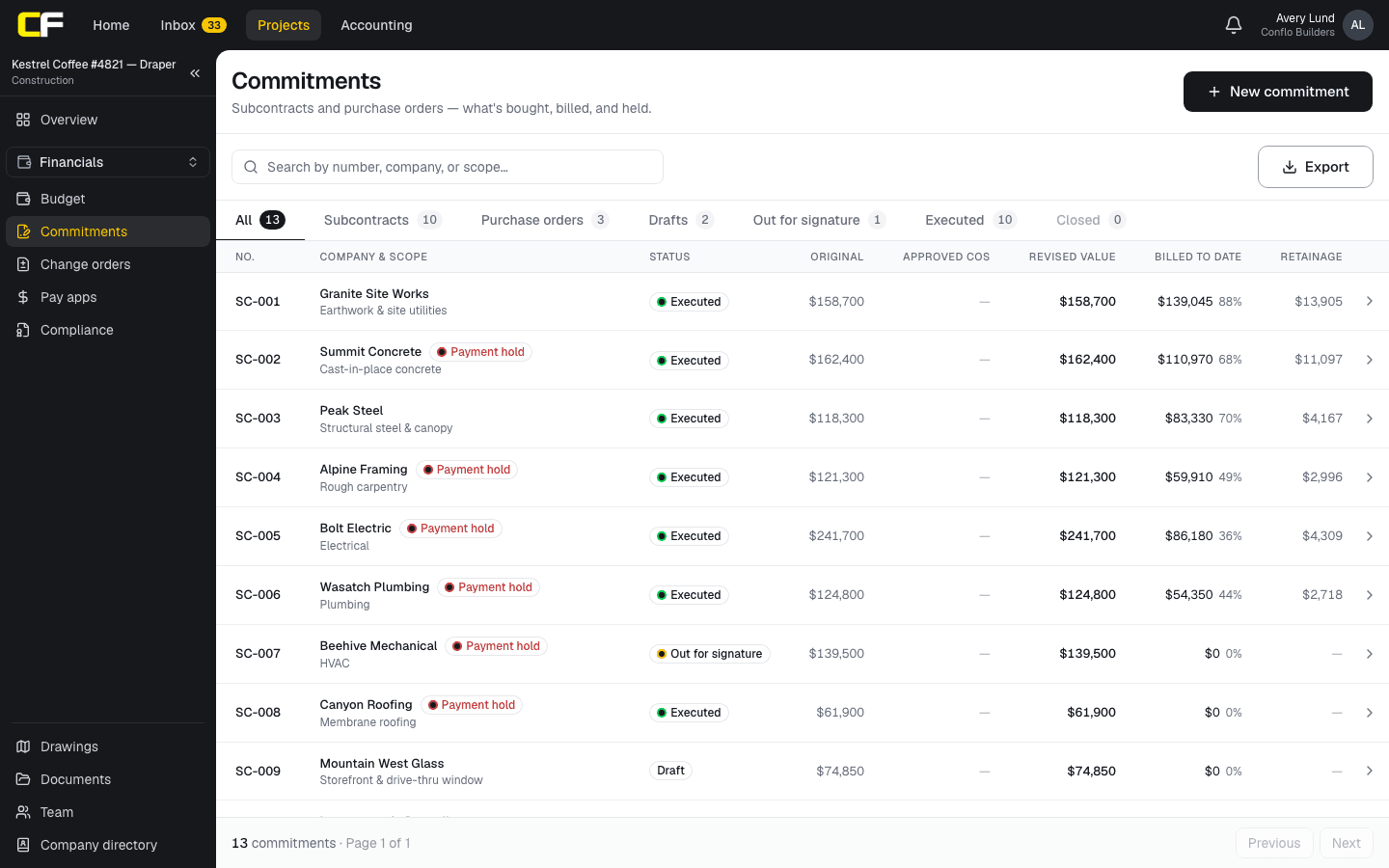
In Conflo, commitments are the subcontracts and purchase orders, each with a schedule of values by cost code. Once one is executed, its schedule-of-values lines count as committed on the matching cost codes of the budget, with its approved change orders added on the contract's first code; the budget shows committed on every line, the job's percent bought out, and a Not bought out tab for codes with no executed commitment.
The bottom line
Committed cost is what you have signed for, and it is the first number that tells you whether buyout went well.
Code every subcontract and PO to the budget, add change orders when they are approved, and watch the uncommitted balance.
Sources
- GAO-05-734SP, A Glossary of Terms Used in the Federal Budget Process — U.S. Government Accountability Office. Read October 22, 2026.
- 19.1 Purpose and Principles (Construction Cost Control) — City of Los Angeles, Bureau of Engineering, Project Delivery Manual. Read October 22, 2026.
Questions
Does a pending change order count as committed?
Usually not. Most cost reports count a change order once it is approved, and show pending changes separately as exposure.
Is a letter of intent a commitment?
It depends on its terms. Many teams commit only on a signed subcontract or PO, and track a letter of intent's authorized amount separately.
What is the difference between committed and actual cost?
Committed is what you have agreed to pay under signed contracts. Actual is what has been billed or spent so far.
Related
Preconstruction
How Do You Buy Out a Construction Job?
Construction buyout step by step: scope review, leveling, award, the subcontract and its exhibits, compliance documents, and savings against budget.
· 7 min read
Definition
What Is a Cost Code in Construction?
A cost code is the number that tags every budget line, contract, invoice and change order to the same category of work. Definition and an example.
· 3 min read
Definition
What Is Cost to Complete?
Cost to complete is what is still to be spent to finish a job or budget line. Definition, the formula with projected final cost, and a worked example.
· 3 min read
Money
How Do You Track a Budget Against Commitments?
Track a construction budget against committed cost by cost code: revised budget, signed commitments, buyout variance and exposure, with a worked table.
· 7 min read
Role hub
The General Contractor's Guide: Bid to Closeout
What a general contractor is responsible for at every phase of a commercial job, from bidding and buyout to RFIs, change orders, pay apps and closeout.
· 8 min read