
What Should an Owner Get at Project Closeout?
By Wyatt Cooper · Published · 7 min read
Key takeaways
- At substantial completion an owner should get the certificate with the punch list attached, keys and access, the warranty start date, emergency contacts, O&M manuals for critical systems and training.
- Before final payment the owner should have every punch item closed, final record drawings, every O&M manual and warranty, attic stock, test reports, signed-off permits and final lien waivers.
- Check each document, not just its arrival: warranties naming you with the right start date, O&M manuals for the installed models, as-builts that show the changes.
- Your contract and specifications decide what you are owed; read the final payment article and Division 01 before the last pay application arrives.
At project closeout an owner should get two handovers. At substantial completion: the certificate with the punch list, keys, the warranty start date, emergency contacts, critical O&M manuals and training. Before final payment: every punch item closed, final record drawings, all O&M manuals and warranties, attic stock, test reports, signed-off permits and final lien waivers. Your contract and specifications set the exact list, and final payment is your leverage to get it.
Closeout is two handovers, not one
The first handover is the building: at substantial completion you can occupy and use it, and you take on its security, maintenance, utilities and insurance. The second is the paper and the money: the closeout documents, the last punch items, and final payment. Owners lose leverage when they treat the first as the end.
On AIA-based contracts, the certificate of substantial completion records the date, the list of items still to complete or correct, the time to finish them, the date you will occupy, and who is responsible for maintenance, heat, utilities and insurance; warranties start that day unless it says otherwise (AIA's G704 summary). Read it before you sign it.
What you should get at substantial completion
Ask for what you need to run the building on day one. San Diego State University's closeout procedures are a good public model: at substantial completion the contractor turns over a turnover letter with the warranty start date, the current punch list, a list of the GC and subcontractors for critical equipment with 24/7 contacts for warranty items, O&M manuals for critical equipment, air and water balance reports, the training attendance sheet with its agenda, alarm points and set points, and the certificate of occupancy with any conditions.
- The signed certificate of substantial completion with the punch list attached.
- Keys, access cards and codes, with a list of who holds what.
- The warranty start date, in writing.
- Emergency and warranty contacts for every major system.
- O&M manuals for life-safety and critical equipment, and training for the people who will run it.
- The certificate of occupancy and any conditions attached to it.
What you should get before final payment
| Item | Why you need it | How to check it |
|---|---|---|
| Punch list, every item closed | The work is finished as the contract requires | Walk the items yourself or with the architect |
| Final record (as-built) drawings | Every future renovation and repair starts from them | Spot-check a change you know about; it should be drawn |
| O&M manuals for all equipment | Your maintenance staff run the building from them | Model numbers match the nameplates; schedules and parts lists included |
| Warranties | Who fixes a defect, for how long | Your name on each, scope and term per the spec, start date agreed, signed |
| Attic stock | Spare tile, carpet, paint and parts to match | Counted against the spec, labeled, receipt signed by your staff |
| Test, balance and commissioning reports | Proof the systems perform as designed | Final versions; open deficiencies closed |
| Signed-off permits | The building is legal to use | Copies of final inspections, conditions noted |
| Final lien waivers | No one can lien your property for unpaid work | From the GC and each sub and major supplier, final not progress, amounts matching |
Final payment is the point to insist. On federal fixed-price construction, for example, final payment follows "completion and acceptance of all work", a properly executed voucher and a release of all claims, and each progress payment request certifies that subcontractors and suppliers have been paid from earlier payments (FAR 52.232-5). Private contracts set their own conditions, and lien waiver rules vary by state, so check your contract and your state's law. For how retainage is held and released, see how to calculate retainage.
Check the documents, not just that they arrived
A binder on your desk is not a closeout package. Open the O&M manuals: Hawaii's public works guide specification expects a manual organized into facility information, primary systems information (operation, preventive maintenance, troubleshooting, repair) and product data organized by spec section (Hawaii DAGS TG 01770). A stack of catalog pages for every model the manufacturer makes does not meet that.
Read the warranty terms you are getting against what you were promised. On federal construction the contractor warrants the work for one year from final acceptance and must obtain the warranties normally given in commercial practice and, if the contracting officer directs, have them executed in writing for the government's benefit (FAR 52.246-21); on AIA documents the warranty clock usually starts at substantial completion. Acceptance can also limit later claims: federal acceptance is "final and conclusive" except for latent defects, fraud, gross mistakes amounting to fraud, or warranty rights (FAR 52.246-12). Ask your own adviser what final acceptance waives under your contract.
A worked example: a fictional office building
The owner is fictional: "Juniper Ridge Holdings", taking over a three-story office building. Its facilities manager tracks the handover with one checklist.
- 1ArchitectCertifies substantial completion on March 3 with 61 punch items attached and 30 days to finish them
- 2GCTurns over keys, the warranty start date of March 3, emergency contacts and critical O&M manuals
- 3Mechanical and controls subsTrain the owner's two building engineers; attendance and agenda go in the package
- 4GCDelivers the closeout package on April 9 after the last punch item closes
- 5OwnerChecks the package against the specs, finds 2 warranties naming the GC instead of the owner, and sends them back
- 6OwnerApproves final payment on April 20 with corrected warranties and final lien waivers in hand
- 7Owner and GCWalk the building in January, before the one-year warranties end on March 3
The dates: the punch list was due 30 days after March 3, which is April 2, and closed a week late; the closeout package came on April 9, final payment on April 20, and a warranty walk in January leaves about two months before March 3 to get anything found fixed under warranty.
After closeout: track the warranties
Put every warranty in one list with what it covers, who stands behind it, the start date, the term and the contact. Walk the building before the general one-year warranty ends and send the GC a list of what you find; a defect reported after the warranty ends is much harder to get fixed. Longer warranties, such as roofing or equipment, each get their own date.
San Diego State's procedures also hold quarterly meetings with the contractor, the building manager and facility services to discuss ongoing warranty issues. For the contractor's side of assembling all this, see how a GC assembles a closeout package.
How it works in Conflo
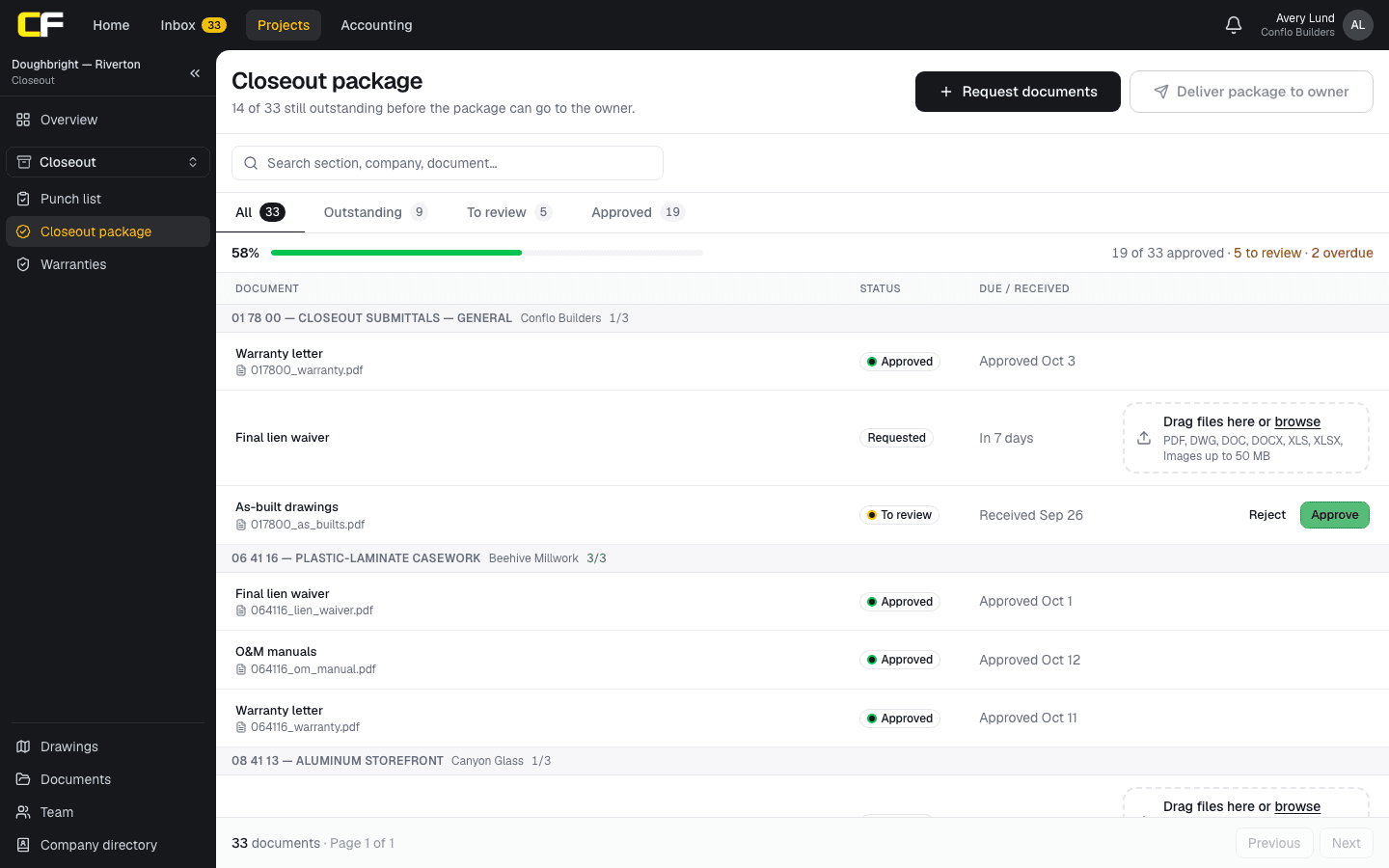
When your GC runs closeout in Conflo, you follow the closeout package as it fills: every document owed, by spec section and company, its status, the percent approved and anything overdue. The GC reviews and approves each document, and can deliver the package only once everything is approved; you see that it was delivered, when and by whom.
Warranties lists every warranty on the building with the company that stands behind it, the start date and term, the expiration Conflo works out from them, and the contact to call; warranties ending within 90 days are flagged. You also see the whole punch list and its status. Conflo is free for owners; the GC's plan covers the project.
The bottom line
Closeout gives an owner a building at substantial completion and the means to run it before final payment. Know the list before the job ends, check every document, and hold final payment until the package and the punch list are complete.
Then put every warranty and its end date where your facilities team will see it.
Sources
- Facilities Design Guidelines, Section 01 77 00: Closeout Procedures — San Diego State University, Facilities Planning. Read October 16, 2026.
- Technical Guide TG 01770: Closeout Procedures — Hawaii Department of Accounting and General Services, Public Works Division. Read October 16, 2026.
- Summary: G704–2017, Certificate of Substantial Completion — AIA Contract Documents (The American Institute of Architects). Read October 16, 2026.
- FAR 52.232-5, Payments under Fixed-Price Construction Contracts — Acquisition.gov, U.S. General Services Administration. Read October 16, 2026.
- FAR 52.246-21, Warranty of Construction — Acquisition.gov, U.S. General Services Administration. Read October 16, 2026.
- FAR 52.246-12, Inspection of Construction — Acquisition.gov, U.S. General Services Administration. Read October 16, 2026.
Questions
What closeout documents should an owner receive?
Usually the certificate of substantial completion with the punch list, record drawings, O&M manuals, warranties, attic stock, training records, test and balance reports, signed-off permits and final lien waivers. Your specifications, mainly Division 01, set the exact list.
Should an owner make final payment before getting the closeout documents?
Usually not. Many contracts make the closeout documents, a closed punch list and final lien waivers conditions of final payment, and it is the owner's main leverage. Read your contract's final payment article.
When does the warranty period start?
On AIA documents, at substantial completion unless the certificate says otherwise. Federal construction contracts run the contractor's warranty one year from final acceptance. Get the start date in writing.
Who gives the owner the closeout package?
The general contractor assembles and delivers it. Each subcontractor provides the documents for its own scope through the GC, and the architect often reviews the package for completeness.
Related
Closeout
How Do You Assemble a Construction Closeout Package?
A closeout checklist by spec section and company: O&M manuals, as-builts, warranties, attic stock, training, lien waivers. Build it at buyout. Example.
· 9 min read
Definition
What Is Substantial Completion?
Substantial completion is when the work is complete enough for the owner to use it as intended. What it triggers: retainage, warranties, delay damages.
· 3 min read
Money
How Do You Calculate Retainage on a Pay App?
Retainage is a percentage of work completed and stored to date, held back each pay period. How to calculate it, reduce it, release it, with an example.
· 9 min read
Closeout
How Should an Owner Track Building Warranties?
An owner's method for tracking building warranties: one list with start dates and terms, expirations worked out, and walks before the clock runs out.
· 6 min read
Closeout
How Do You Collect O&M Manuals From Subcontractors?
How a GC collects O&M manuals from every trade: request them early by spec section, check them against what was installed, and send back the thin ones.
· 6 min read
Role hub
The Owner's Guide to a Commercial Building Project
The owner's role on a commercial building project, phase by phase: delivery method, choosing the contractor, pay apps, change orders and closeout.
· 7 min read