
What Is Cost to Complete?
By Wyatt Cooper · Published · 3 min read
Key takeaways
- Cost to complete is the estimate of what remains to be spent; actual cost to date plus cost to complete is the projected final cost.
- Projected final cost minus the revised budget is the projected overrun or underrun, line by line and for the job.
- A good forecast starts from what is committed but not yet billed, then adds what is still unbought and any known exposure.
Cost to complete is the estimated amount still to be spent to finish a job or a budget line, from today to the end. Added to the actual cost to date, it gives the projected final cost; comparing that with the revised budget shows whether the line, or the whole job, is heading over or under budget.
How cost to complete is worked out
The relationship is the same everywhere: projected final cost = actual cost to date + cost to complete. Federal program guidance calls the projected figure an estimate at completion and describes two ways to get it, one from performance indices and "a bottom-up or comprehensive EAC" from "a detailed assessment of the effort remaining"; its index-based form is "EAC = ACWP (cumulative) + (BAC – BCWP (cumulative)) / efficiency index" (GAO-20-195G). On a building job, the bottom-up method is the usual one: go line by line through the budget.
The City of Los Angeles asks its construction managers to "know the project's costs to date but also be able to project costs forward to forecast project completion values" (LA Bureau of Engineering, 19.1). The inputs come from the cost report: committed cost not yet billed, budget still unbought, and pending changes. What an owner sets aside for the rest is in how much contingency an owner should carry.
Example
Cost code 23 00 00, HVAC
- Revised budget
- $412,000
- Committed (HVAC subcontract and change orders)
- $398,000
- Actual cost to date (billed)
- $250,000
- Committed but not yet billed
- $148,000
- Still to buy (test and balance, not yet let)
- $22,000
- Cost to complete
- $170,000
- Projected final cost
- $420,000
- Projected over budget
- $8,000
The arithmetic: $398,000 − $250,000 = $148,000; $148,000 + $22,000 = $170,000 to complete; $250,000 + $170,000 = $420,000 projected; $420,000 − $412,000 = $8,000 over. The $22,000 is the project manager's estimate for work not yet bought, which is why cost to complete is a forecast, not a sum.
How it works in Conflo
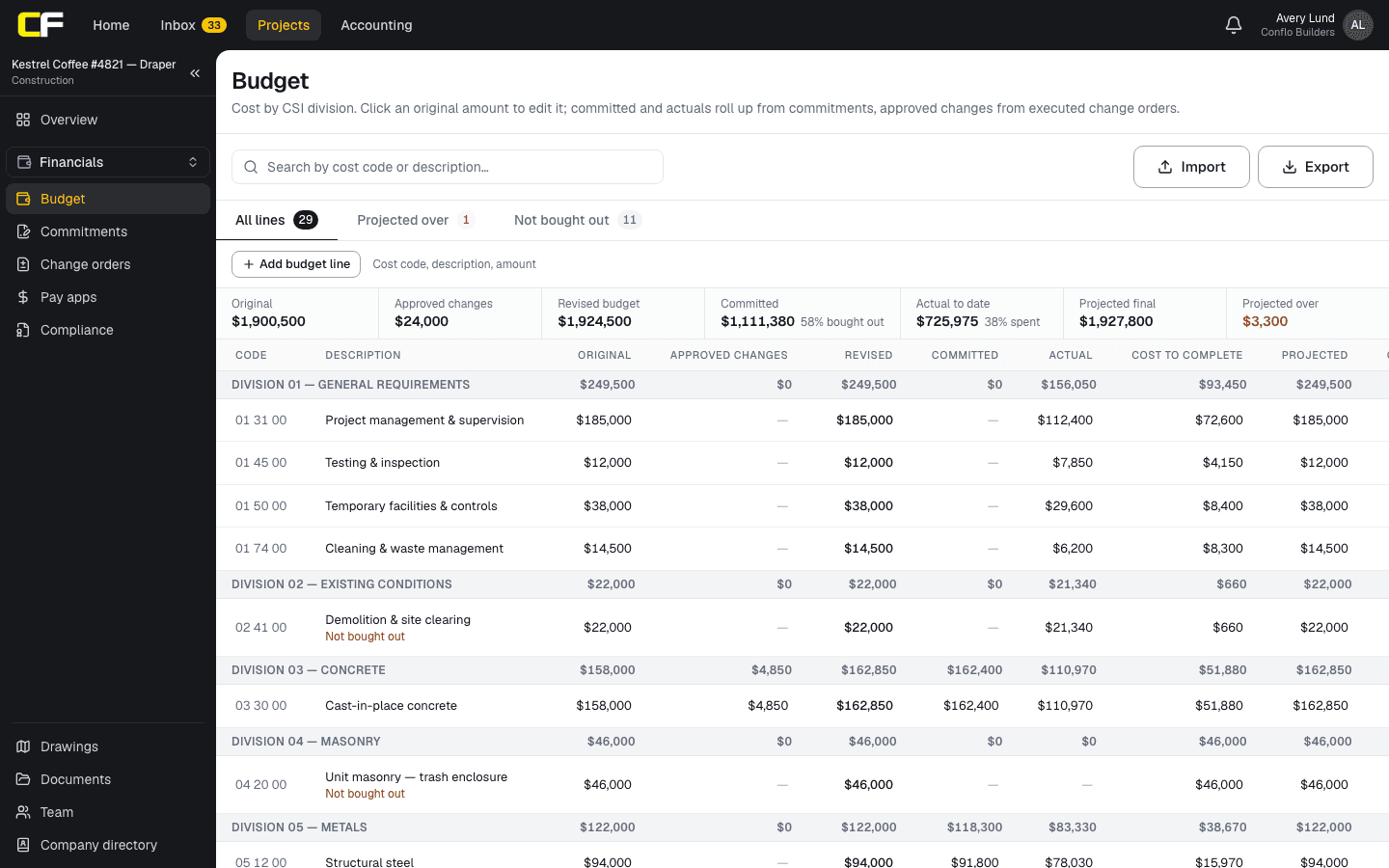
Conflo's budget shows cost to complete on every line as projected cost minus actual, where projected is the highest of the revised budget, the committed amount and actual spend, so a line never looks cheaper than what is already owed. In the example that is $412,000 − $250,000 = $162,000: a floor until the extra $22,000 is committed or a budget change is approved. Lines projected over budget are listed on their own tab, with the overrun in red.
The bottom line
Cost to complete is the money still to go out; with cost to date, it is your best estimate of where the job lands.
Forecast it line by line every month from committed, unbought and pending work, and act on the lines heading over.
Sources
- GAO-20-195G, Cost Estimating and Assessment Guide (March 2020) — U.S. Government Accountability Office. Read October 22, 2026.
- 19.1 Purpose and Principles (Construction Cost Control) — City of Los Angeles, Bureau of Engineering, Project Delivery Manual. Read October 22, 2026.
Questions
What is the difference between cost to complete and estimate at completion?
Cost to complete is what remains to be spent. Estimate at completion (projected final cost) is cost to date plus cost to complete.
How often should cost to complete be updated?
At least monthly, with the pay application cycle, and whenever a large change, buyout result or problem comes in.
Who forecasts cost to complete?
The contractor's project manager, line by line, often reviewed by the project executive. Owners do the same for the whole project budget.
Related
Definition
What Is a Committed Cost in Construction?
Committed cost is the value of signed subcontracts and POs on a job, billed or not. Definition, a budget example, and how it differs from actual cost.
· 3 min read
Money
How Much Contingency Should an Owner Carry?
Owner contingency in construction: design vs construction contingency, GSA's guidelines (7% new, 10% renovation), and how to size and track yours.
· 7 min read
Definition
Allowance vs Contingency: What Is the Difference?
An allowance is a set sum for a known item not yet chosen; a contingency is money for what nobody can foresee. How each is used and adjusted.
· 4 min read
Money
How Do You Forecast Cost to Complete on a Job?
Forecast cost to complete line by line: remaining commitments, self-performed work at its real production rate, and time-based costs against the schedule.
· 6 min read
Role hub
The General Contractor's Guide: Bid to Closeout
What a general contractor is responsible for at every phase of a commercial job, from bidding and buyout to RFIs, change orders, pay apps and closeout.
· 8 min read