
The Architect's Guide to Construction Administration
By Wyatt Cooper · Published · 8 min read
Key takeaways
- In construction administration the architect acts for the owner only as far as the contract says, and never controls the contractor's means, methods or safety.
- Most of the phase is answering: RFIs, submittals and pay applications, each within the contract's time limits or with reasonable promptness.
- The architect changes the work three ways: an ASI for minor changes with no cost or time, a change order, or a construction change directive.
- Closeout runs through the architect too: the substantial completion inspection, the certificate, the warranties forwarded to the owner and the final certificate for payment.
The construction administration phase is the architect's and engineers' work from the construction contract to final payment: visiting the site, answering RFIs, reviewing submittals, issuing supplemental instructions, certifying the contractor's pay applications, preparing change orders, and inspecting for substantial and final completion. Under AIA A201–2017 the architect is the owner's representative during this phase, with only the authority the contract gives. This guide walks the phase in order and links every guide for the design team.
The architect's role in construction
Under the AIA general conditions, A201–2017, the architect "will provide administration of the Contract" and "will be an Owner's representative during construction until the date the final payment is due", acting for the owner "only to the extent provided in the Contract Documents" (§4.2.1). The same section draws the line every CA architect must hold: the architect "will not have control over, charge of, or responsibility for the construction means, methods, techniques, sequences or procedures, or for the safety precautions" (§4.2.2). Those are the contractor's.
Some owners add a layer. Connecticut's public works agency hires a separate construction administrator, and its CA procedure manual has that firm route "requests for clarifications and interpretations of the Contract Documents" to the architect, monitor payments and run meetings. Know whether your job has one, and which letters go through it.
Bidding and award: the documents everyone prices
Before construction administration starts, the design team's documents are priced. On a design-bid-build job the architect usually answers bidders' questions by addendum, issued to every bidder so that all of them price the same set; a question answered for one bidder only becomes a scope gap later. The owner may also ask you to help compare the bids or proposals that come back, line by line against the documents: the owner's side is in how to compare contractor proposals.
Which contract you administer depends on the delivery method. In design-bid-build you work for the owner and the contractor is hired separately; in design-build you may be the design-builder's consultant rather than the owner's; under construction manager at risk the CM often joins during design and prices it as it develops. See delivery methods compared, and which AIA family your agreement and the general conditions come from in AIA contract documents explained.
Before construction starts
- Attend the preconstruction meeting and agree the channels. A201 §4.2.4 routes the architect's consultants through the architect and subcontractors through the contractor.
- Approve the submittal schedule. Under §4.2.7 your review time runs from it; without one, "with reasonable promptness".
- Agree the forms and numbering for RFIs, ASIs, proposal requests and change orders, and who signs each.
- Set the site-visit rhythm with the owner: "at intervals appropriate to the stage of construction, or as otherwise agreed" (§4.2.2).
Site visits and field reports
Site visits are where construction administration is most often misread. Under §4.2.2 the architect visits to become "generally familiar with the progress and quality" of the work, to "endeavor to guard the Owner against defects and deficiencies", and to determine "in general" whether the work will conform when complete, but "will not be required to make exhaustive or continuous on-site inspections". Write field reports in those terms: what you observed, where and when, and what you are asking the contractor to correct.
Report what you find. Section 4.2.3 has the architect keep the owner "reasonably informed" and promptly report known deviations from the contract documents and the schedule, and defects observed. Section 4.2.6 gives the architect authority to reject nonconforming work and to require inspection or testing. Use both in writing, and keep the report with the photos.
- Date, weather and who was on site, so the report can be placed on the schedule later.
- What you looked at, by area and grid line, and what you didn't.
- Each item that doesn't conform, with the sheet or spec section it departs from.
- What you asked for: correction, an RFI from the contractor, a test or a submittal.
- Open items from the last visit, closed or carried.
During construction: questions and submittals
The contractor's questions arrive as RFIs. The architect answers "in writing within any time limits agreed upon or otherwise with reasonable promptness" and, where appropriate, issues supplemental drawings and specifications (§4.2.14). For the contractor's side of the RFI, see how to write an RFI; for the difference between the two documents, ASI vs RFI.
Submittals are shop drawings, product data and samples. The architect reviews them "only for the limited purpose of checking for conformance with information given and the design concept" (§4.2.7), not for dimensions, quantities or means and methods, which stay with the contractor.
Both, step by step from the design team's seat: how to respond to an RFI, with the answer, the documents it relies on and whether it changes cost or time, and how to review a submittal, from the GC's review to your stamp. What should reach you, and what to send back when it doesn't, is in how a subcontractor prepares a submittal.
During construction: changes and payment
Changes take three forms (§7.1.2): the architect alone may order a minor change with no cost or time (an ASI; the AIA's form is G710); a change order is signed by owner, contractor and architect; a construction change directive is signed by owner and architect when the price isn't agreed yet. See how to write an ASI, and for pricing, how to price a change order.
Each month the contractor applies for payment, and within seven days of receiving it the architect certifies it in full, certifies a lesser amount with reasons, or withholds certification with reasons (§9.4.1). The certificate represents, to the best of the architect's knowledge, that the work has progressed to the point indicated and its quality conforms (§9.4.2). Know how the sub and GC build the application: how a subcontractor fills out a pay application and how retainage is calculated.
The checks to make before you sign, line by line against what you saw on site: how to certify a pay application. The owner reads the same application from its side, so expect its questions: how an owner reviews a GC's pay application.
Interpretations and decisions
Beyond answering RFIs, A201 makes the architect the first interpreter of the documents. Section 4.2.11 has the architect "interpret and decide matters concerning performance under, and requirements of, the Contract Documents" on written request of either party, and §4.2.12 requires those decisions to be consistent with the documents' intent, in writing, and impartial: the architect "will not show partiality to either". Decisions on aesthetic effect are final if consistent with that intent (§4.2.13). Write each one as you would want it read in a dispute: the question, the documents you relied on, and the decision.
Closeout
When the contractor believes the work is substantially complete, it sends the architect a list of items to finish or correct; the architect inspects, adds what isn't complete enough for the owner to use the building, and issues the certificate of substantial completion when it is (§9.8.2–9.8.4). The architect then receives and forwards the warranties to the owner and issues the final certificate for payment (§4.2.9). The contractor's side of that list is the punch list.
The phase doesn't quite end at final payment: §4.2.1 keeps the architect as the owner's representative "from time to time during the period for correction of Work", the one-year correction period after substantial completion. Your owner-architect agreement sets how much of that is in your fee, so read it.
The inspection itself, list in hand and room by room: how to determine substantial completion. What the owner should receive from it all, so you can check the package before you forward it: what an owner gets at closeout.
Every guide for architects and engineers
Preconstruction
How Do Architects Write Construction Specifications?
How architects write construction specifications: MasterFormat numbers, the three-part section, specs versus drawings, and an example section.
· 6 min read
Construction
How Do You Keep an RFI Log?
How a GC keeps an RFI log: the columns that matter, ball in court and days open, a filled-in log, and how to run it at the weekly meeting.
· 7 min read
Preconstruction
How Do You Run a Preconstruction Kickoff Meeting?
How a GC runs the preconstruction meeting: who attends, a worked agenda of procedures to agree before work starts, and what to record.
· 7 min read
Construction
How Do You Run an OAC Meeting?
How a GC runs an owner-architect-contractor meeting: who attends, what each party brings, a worked agenda, and how open items carry to the next one.
· 8 min read
Construction
How Does an Architect Issue a Drawing Revision?
How an architect issues a revised drawing sheet: clouds around what changed, a delta with the revision number, the revision block and the issue.
· 7 min read
Construction
How Does an Architect Write a Field Report?
How an architect writes a site visit field report: what to record, the words to use and avoid, a filled-in example, and carrying open items.
· 7 min read
Money
How Should an Architect Review a Schedule of Values?
Review a contractor's schedule of values before the first pay app: the format checks, then front-loading spotted line by line against the bid.
· 7 min read
Construction
How Should an Owner Respond to a GC's Delay Claim?
An owner's first 30 days after a contractor's delay claim: check the notice, sort the days by cause, test the schedule and money, answer in writing.
· 6 min read
Construction
How to Write Construction Meeting Minutes (With Example)
How to write construction meeting minutes: header, attendance, numbered old and new business, action items with owners and dates, and an example.
· 7 min read
Construction
Revise and Resubmit: What Should a Sub Do Next?
A submittal came back revise and resubmit. What a sub should do next: read every comment, answer each one, and get the next revision approved fast.
· 6 min read
Definition
What Are Means and Methods in Construction?
Means and methods are how the contractor builds the work: equipment, crews, sequence and safety. Definition, who is responsible, and an example.
· 3 min read
Definition
What Are the Contract Documents in Construction?
The contract documents are the agreement, conditions, drawings, specifications, addenda and modifications that together make up a construction contract.
· 3 min read
Definition
What Is a Shop Drawing?
A shop drawing shows exactly how a trade will fabricate and install part of the work, submitted for review before fabrication. Definition and an example.
· 4 min read
Definition
What Is a Substitution Request?
A substitution request asks to use a product other than the one specified, with proof it is equal. Definition, an example, and or-equal vs. substitution.
· 3 min read
Definition
What Is an Addendum in Construction?
An addendum is a written change to the bid documents issued before bids are due. Definition, an example, and how it differs from an ASI and a change order.
· 3 min read
Definition
What Is an OAC Meeting?
An OAC meeting is the regular owner-architect-contractor meeting during construction. What it covers, an example minutes item, and how it differs.
· 3 min read
Definition
What Is an RFI in Construction?
An RFI is a contractor's written question to the design team when the drawings or specs are unclear. Definition, an example, and what an RFI is not.
· 3 min read
Definition
What Is CSI MasterFormat?
CSI MasterFormat is the standard numbering for construction specifications, reused for bid packages, cost codes and closeout. Definition and an example.
· 3 min read
Definition
What Is Value Engineering in Construction?
Value engineering delivers the same function for less without cutting what the owner needs. Definition, a federal savings-sharing example, VE vs. cuts.
· 3 min read
Preconstruction
When Should an Owner Hire an Owner's Rep?
When an owner should hire an owner's representative, what the rep does that the architect and GC don't, how reps are paid, and how to choose one.
· 6 min read
Construction
How Do Architects and Engineers Review a Submittal?
How the design team reviews a submittal: what the review covers and what it doesn't, choosing the review code, writing comments, and returning it on time.
· 8 min read
Closeout
How Does an Architect Decide Substantial Completion?
How the architect inspects for substantial completion: the contractor's list, who walks, what blocks use and what is a punch item, and the certificate.
· 8 min read
Construction
How Should an Architect Respond to an RFI?
How the design team answers an RFI: check it against the documents, answer the question asked, cite the sheet and spec, and say if it changes the work.
· 8 min read
Definition
ASI vs RFI: What Is the Difference?
ASI vs RFI: an RFI is the contractor's question about the documents; an ASI is the architect's written instruction or minor change, with no cost or time.
· 4 min read
Definition
What Is Substantial Completion?
Substantial completion is when the work is complete enough for the owner to use it as intended. What it triggers: retainage, warranties, delay damages.
· 3 min read
Construction
How Does an Architect Write an ASI?
How an architect writes an ASI: what it may change, the parts of a good one, a filled-in example, and when it must become a change order.
· 8 min read
Money
How Should an Owner Review a Change Order?
How an owner reviews a contractor's change order: is it a change, is the price right, are the markups the contract's, are the days real. Worked example.
· 8 min read
Definition
What Is a Transmittal in Construction?
A transmittal is the cover sheet that records what was sent, to whom, when and why, such as a submittal sent to the architect. The fields, with an example.
· 3 min read
Money
How Does an Architect Certify a Pay Application?
Review the draft, compare it with what you observed on site, then certify the full amount or a lower one with the changed figures initialed and explained.
· 5 min read
Definition
What Is a Submittal in Construction?
A submittal is what the contractor sends the design team to show how it will meet the specs: shop drawings, product data, samples. Types and an example.
· 4 min read
Preconstruction
AIA Contract Documents Explained, by Family
A plain map of AIA contract documents: the A, B, C, D, E, F and G series, the families by delivery method, and which forms you meet on a job.
· 8 min read
Definition
Change Order vs Construction Change Directive
A change order is an agreed change in scope, price and time; a construction change directive orders the work before price or time is agreed.
· 4 min read
Definition
RFI vs Submittal: What Is the Difference?
An RFI asks the design team what the documents mean; a submittal shows how the contractor will meet them. The difference, side by side, with an example.
· 3 min read
Closeout
What Should an Owner Get at Project Closeout?
The owner's closeout checklist: what you should get at substantial completion and before final payment, and how to check each document.
· 7 min read
How it works in Conflo
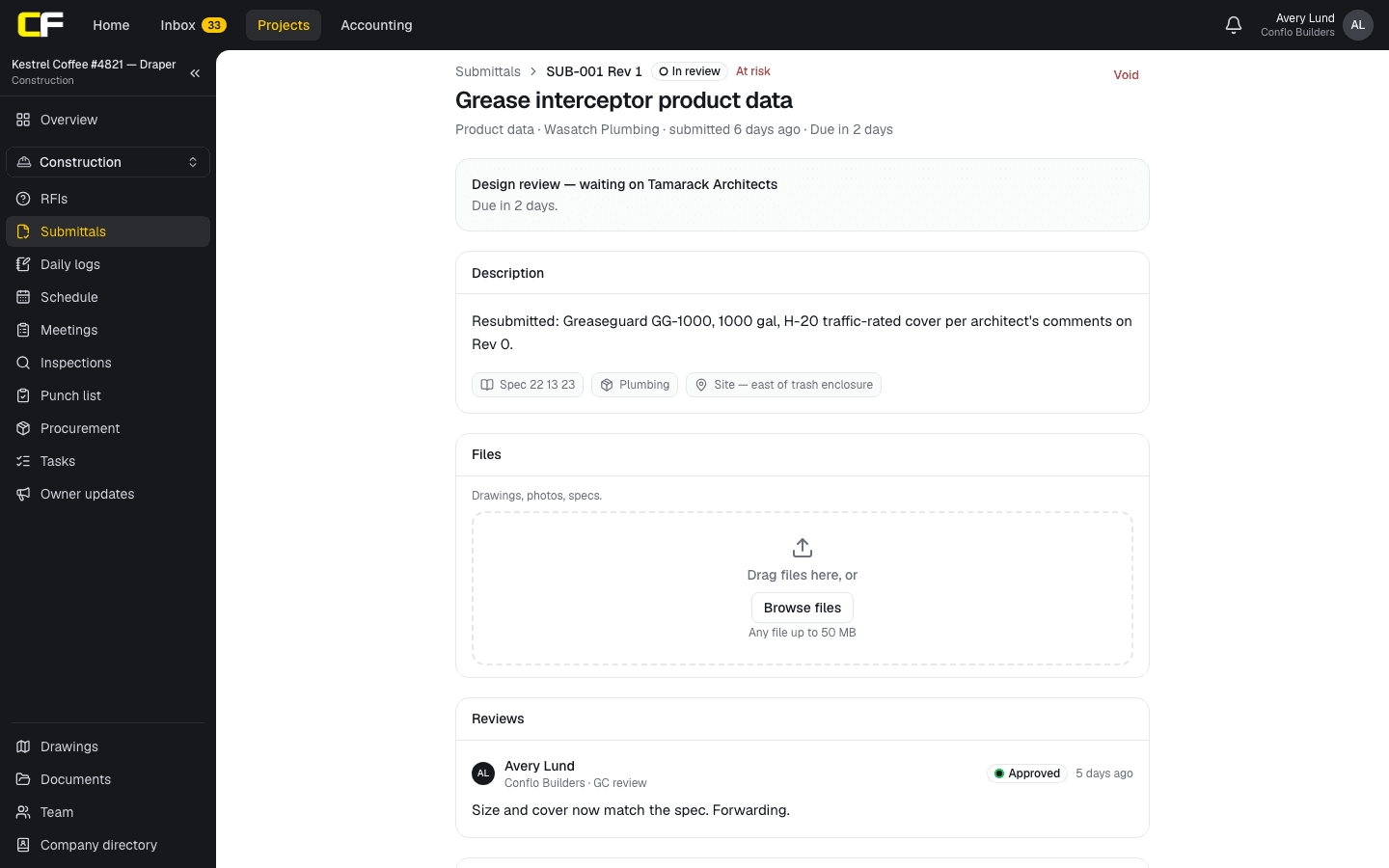
In Conflo the design team works on the same project as the GC. RFIs routed to you wait in your court with a due date, and you answer on the record (RFIs). Submittals reach the architect after the GC's review step, if the GC sets one, and the architect's consultants after the architect; each reviewer returns approved, approved as noted, revise and resubmit, or rejected (Submittals). You issue sets, ASIs and bulletins in Drawings, where each reissued sheet supersedes its old revision.
Conflo does not certify pay applications for the architect or prepare a certificate of substantial completion today; those stay on your own forms.
The bottom line
Construction administration is answering in writing, on time, within the authority the contract gives you: RFIs, submittals, minor changes, pay certifications and the closeout inspections, without ever taking over the contractor's means and methods.
If your RFIs and submittals arrive by email from five GCs, join the Conflo waitlist as a design team.
Sources
- Summary: A201–2017, General Conditions of the Contract for Construction — AIA Contract Documents. Read October 17, 2026.
- 0600 Construction Administrator's Procedure Manual — State of Connecticut Department of Administrative Services. Read October 16, 2026.
- Instructions: G710–2017, Architect's Supplemental Instructions — AIA Contract Documents. Read October 16, 2026.
Questions
What is the construction administration phase?
The last phase of an architect's basic services, from the start of construction to final payment: site visits, RFIs, submittal review, supplemental instructions, pay application certification, change orders and the completion inspections. The owner-architect agreement defines its scope.
Does the architect supervise the contractor?
No. Under AIA A201–2017 §4.2.2 the architect visits the site to become generally familiar with the work and guard the owner against defects, but has no control over the contractor's means, methods, sequences or safety, and isn't required to inspect exhaustively.
How long does an architect have to certify a pay application?
Under A201–2017 §9.4.1, seven days after receiving the contractor's application, to certify it in full, certify part with reasons, or withhold certification with reasons. Your contract may set a different period.
Who decides substantial completion?
Under A201–2017 the architect inspects after the contractor submits its list, and issues the certificate of substantial completion once the work is complete enough for the owner to occupy or use it for its intended purpose (§9.8).
Related
Construction
How Should an Architect Respond to an RFI?
How the design team answers an RFI: check it against the documents, answer the question asked, cite the sheet and spec, and say if it changes the work.
· 8 min read
Construction
How Do Architects and Engineers Review a Submittal?
How the design team reviews a submittal: what the review covers and what it doesn't, choosing the review code, writing comments, and returning it on time.
· 8 min read
Money
How Does an Architect Certify a Pay Application?
Review the draft, compare it with what you observed on site, then certify the full amount or a lower one with the changed figures initialed and explained.
· 5 min read
Closeout
How Does an Architect Decide Substantial Completion?
How the architect inspects for substantial completion: the contractor's list, who walks, what blocks use and what is a punch item, and the certificate.
· 8 min read
Pillar
The Construction Project Lifecycle: Bid to Closeout
The phases of a construction project, from planning and design to bidding, building and closeout, and what the owner, architect, GC and subs do in each.
· 7 min read