
How Does an Architect Write an ASI?
By Wyatt Cooper · Published · 8 min read
Key takeaways
- An ASI is the architect's written order for a minor change or a clarification that does not change the contract sum or the contract time.
- Under AIA A201–2017 §7.4 the architect may issue it alone, but a contractor who believes it costs money or time must say so before doing the work.
- A good ASI is numbered, names every revised sheet and spec section, says what changed and why, and states plainly that no cost or time change is intended.
- When the contractor answers that the ASI does cost money or time, it stops being a minor change: it becomes a proposal request, a change order or a construction change directive.
To write an ASI, number it in the project's ASI sequence, describe the change or clarification in a few plain sentences, list every revised sheet and spec section, attach the revised drawings or sketches, and state that the instruction is not intended to change the contract sum or time. Issue it in writing to the contractor. If the contractor says it does cost money or time, it does not proceed, and the change goes through a change order instead.
What an ASI is for
An architect's supplemental instruction (ASI) is the written order the architect uses during construction to clarify the documents or make a minor change in the work. Under the AIA general conditions, A201–2017, changes happen three ways: a change order, a construction change directive, or "an order for a minor change in the Work", which "may be issued by the Architect alone" (§7.1.2).
The limit is in §7.4: minor changes must be "consistent with the intent of the Contract Documents and do not involve an adjustment in the Contract Sum or an extension of the Contract Time." The AIA's form for this order is G710, and its instructions say the same: G710 "should not be used to change the contract sum or contract time." Your contract may use different names (bulletin, field order, supplemental instruction) and different rules, so read yours.
An ASI often answers an RFI: A201 §4.2.14 says the architect will issue supplemental drawings and specifications in response to RFIs where appropriate. For the line between the two documents, see ASI vs RFI.
| Document | Who signs | Cost or time | Use it for |
|---|---|---|---|
| ASI (order for a minor change, G710) | The architect alone (§7.1.2) | None (§7.4) | Clarifications and minor changes within the design intent |
| Change order | Owner, contractor and architect (§7.1.2) | Adjusts the sum, the time or both | Agreed changes in scope, price or time |
| Construction change directive | Owner and architect; the contractor may or may not agree (§7.1.2) | Adjusted later, by the method the directive sets | A change that must start before the price is agreed |
| RFI response | The architect answers (§4.2.14) | None by itself | Answering the contractor's question about the documents |
The parts of a good ASI
- A number in one sequence for the job (ASI-01, ASI-02…), never reused, and the date issued.
- A short subject: the element and the change, such as "Relocate storefront door 3 ft north".
- The reason: the RFI it answers, the owner's request, a code reviewer's comment or a coordination error.
- The instruction itself, in a few sentences the superintendent can build from.
- Every revised sheet and spec section, each sheet carrying its revision mark and the ASI number in its revision block.
- Attachments: revised sheets, sketches or spec pages. G710's instructions say attached sheets should be "clearly identified, numbered and dated".
- A sentence that the instruction is not intended to change the contract sum or time, and that the contractor must say so before proceeding if it believes otherwise.
Send it to the contractor through the contract's channel. Under A201 §4.2.4, communications with subcontractors go through the contractor, so the GC distributes the ASI to the trades it touches and replaces the superseded sheets in the field set.
A worked example: ASI-03
A fictional job, the Wren Creek Branch Library. The contractor's RFI 014 points out that the book-drop opening on A-201 sits behind a downspout on the civil plan. The architect moves the opening one bay and issues an ASI.
ASI-03 — Relocate exterior book-drop opening from bay 2 to bay 3
- Project
- Wren Creek Branch Library (fictional)
- Date issued
- April 8
- From
- Architect of record
- To
- General contractor
- Reason
- Response to RFI 014: the book-drop opening conflicts with downspout DS-4
- Instruction
- Move the book-drop opening from bay 2 to bay 3 on the east elevation, same size and head height. Move blocking and the interior bin location to match. No change to the downspout.
- Revised sheets
- A-201 (east elevation), rev 2; A-501 (detail 4), rev 1; A-101 (floor plan), rev 2
- Spec sections
- None revised
- Contract sum and time
- This instruction is not intended to change the contract sum or the contract time. If you believe it does, notify the architect and do not proceed.
- Attachments
- Revised A-101, A-201 and A-501, each marked ASI-03 in the revision block
Notice what it does: it names the RFI it answers, lists every sheet that changed, and says the change is free. If the masonry is already laid in bay 3, the contractor answers that the move costs money, and the architect turns it into a proposal request instead.
When an ASI has to become a change order
- 1ArchitectWrites and issues the ASI with revised sheets
- 2General contractorReviews it with the trades for cost and schedule impact
- 3General contractorNo impact: builds it and posts the revised sheets. Impact: notifies the architect and holds the work
- 4Architect and ownerIssue a proposal request, then a change order or a construction change directive
A201 §7.4 is strict both ways. If the contractor believes the change affects the sum or time, it "shall notify the Architect and shall not proceed"; if it does the work without that notice, it "waives any adjustment". Public owners build the same branch into their procedures: in the Minnesota State Colleges and Universities ASI process, an ASI with a cost impact goes back to its initiator, who picks a construction change directive, a proposal request or neither.
Connecticut's construction administration manual adds the owner's side: "no changes will be made without appropriate authorization in writing." Price the follow-on with the change-order method.
Common mistakes
- Using an ASI to add scope the owner wants, because it is faster than a change order. If it costs money, it isn't minor.
- Listing "see attached" instead of every revised sheet, so the field keeps building from a superseded one.
- Reusing a number, or numbering ASIs per discipline, so the job has two ASI-03s.
- Leaving out the reason, so nobody can trace the change back to the RFI or decision behind it.
- Issuing revised sheets without revision marks, so nobody can see what moved.
How it works in Conflo
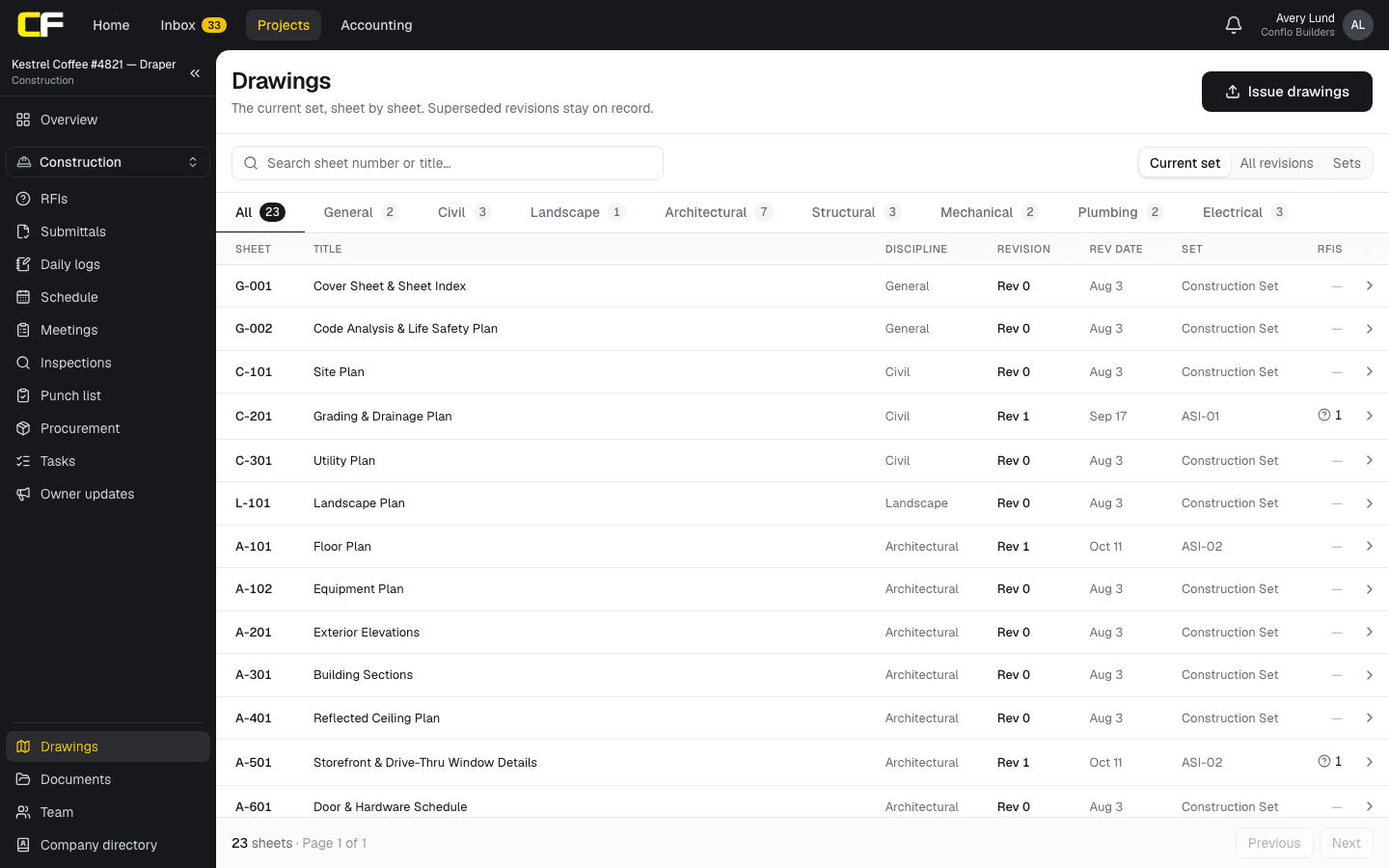
In Conflo's Drawings, the architect or the GC issues an ASI as a named set (ASI-03) with an issue date and a note on what changed. Each sheet number that already exists moves to its next revision and the old revision is kept, marked superseded, so the field sees the current set by default. Filter by set to see exactly which sheets one ASI contained, and each sheet shows the RFIs that reference it.
Conflo has no separate ASI form: the instruction lives in the set's note and the revised sheets. If the contractor says an ASI costs money or time, that goes through a change order, which can be started from the RFI behind it.
The bottom line
An ASI is a numbered, written order for a minor change or clarification that changes neither price nor time. Name the reason and every revised sheet, attach the sheets, and say plainly that no cost or time is intended.
If the contractor answers that it does cost money or time, stop and run it as a change. To issue ASIs and answer RFIs in the same place as the GC, join the Conflo waitlist.
Sources
- Summary: A201–2017, General Conditions of the Contract for Construction — AIA Contract Documents. Read October 17, 2026.
- Instructions: G710–2017, Architect's Supplemental Instructions — AIA Contract Documents. Read October 16, 2026.
- Architect's Supplemental Instructions (ASI2) process — Minnesota State Colleges and Universities, System Office. Read October 16, 2026.
- 0600 Construction Administrator's Procedure Manual — State of Connecticut Department of Administrative Services. Read October 16, 2026.
Questions
What does ASI stand for in construction?
Architect's supplemental instruction: the architect's written order for a clarification or a minor change in the work that does not change the contract sum or time. The AIA's form for it is G710; some contracts call the same thing a bulletin or field order.
Can an ASI change the contract price?
Not under AIA A201–2017. Section 7.4 limits minor changes to ones that involve no adjustment in the contract sum or time. If an ASI turns out to cost money or time, the contractor notifies the architect before proceeding and the change goes through a change order or construction change directive.
Who signs an ASI?
Under A201–2017 §7.1.2, an order for a minor change may be issued by the architect alone; the owner and contractor do not need to sign it. Many contractors still acknowledge receipt, and some owners require their own sign-off, so check your contract.
What happens if the contractor builds an ASI without objecting?
Under A201–2017 §7.4, a contractor that performs the minor change without first telling the architect that it affects the sum or time waives any adjustment. That is why the contractor should review each ASI for cost and schedule before the work starts.
How should ASIs be numbered?
In one sequence for the whole project, starting at ASI-01, never reused, with each revised sheet marked with the ASI number in its revision block. One sequence lets anyone trace a sheet revision back to the instruction that caused it.
Related
Definition
ASI vs RFI: What Is the Difference?
ASI vs RFI: an RFI is the contractor's question about the documents; an ASI is the architect's written instruction or minor change, with no cost or time.
· 4 min read
Construction
How to Write an RFI in Construction (With an Example)
How to write an RFI in construction: the parts of a good request for information, a filled-in example, common mistakes, and how the RFI log works.
· 9 min read
Money
How Do You Price a Change Order?
Price a change order from direct cost (burdened labor, materials, equipment, sub quotes), then the markups and time your contract allows. Worked example.
· 9 min read
Role hub
The Architect's Guide to Construction Administration
The construction administration phase from the architect's seat: site visits, RFIs, ASIs, submittals, pay certification, changes and closeout.
· 8 min read