
How Do Architects and Engineers Review a Submittal?
By Wyatt Cooper · Published · 8 min read
Key takeaways
- Under AIA A201–2017 §4.2.7, the architect reviews submittals only for conformance with the information given and the design concept, not for dimensions, quantities or means and methods.
- Before reviewing the content, check the package: it is a required submittal, it carries the contractor's review stamp, and any deviation is listed in writing.
- Pick the code by what the contractor may do next: approved, approved as noted, revise and resubmit, or rejected, and write every comment against a spec paragraph or drawing.
- A review comment that changes the design is a change to the contract, not a correction; handle it as one.
To review a submittal, first check that it is required, complete, and stamped by the contractor, and that deviations are listed. Then compare it with the specification section and drawings for conformance with the design concept, collect the consultants' comments, and return one marked-up copy with a single review code: approved, approved as noted, revise and resubmit, or rejected. Do it within the time the submittal schedule or specifications allow, and keep each comment tied to a contract requirement.
What the review covers, and what it doesn't
Under the AIA's general conditions, A201–2017 §4.2.7, the architect reviews and approves, or takes other action on, shop drawings, product data and samples "only for the limited purpose of checking for conformance with information given and the design concept expressed in the Contract Documents". The same section lists what the review isn't: a check of "dimensions and quantities", of installation instructions or equipment performance, or of safety and construction means and methods. And approving an item "shall not indicate approval of an assembly of which the item is a component".
That limit is in the contract for a reason: the contractor keeps responsibility for what it submits (§3.12.8), and it prepares the package to the specs before you see it. A review that drifts into checking every dimension takes time the schedule doesn't have and blurs who is responsible for what. Your owner-architect agreement and the project's specifications may change this scope, so read both.
| The reviewer checks | Stays with the contractor |
|---|---|
| The product or system is the one specified, or an acceptable deviation | Field dimensions and quantities |
| Performance, ratings and listings match the spec | Fit and coordination with other trades |
| Finishes, colors and appearance match the design intent | Fabrication and installation methods |
| Required certificates, tests and calculations are there | Safety and means and methods |
| The contractor's listed deviations, one by one | Errors in the submittal, even after approval |
Check the package before the content
Spend five minutes before the real review. Three checks decide whether a submittal is ready for one.
- Is it required? A201–2017 §3.12.4 lets the architect return submittals the contract doesn't require "without action", and informational submittals marked as such in the documents need no responsive action.
- Has the contractor reviewed it? The federal clause FAR 52.236-21 lets the government return shop drawings without the contractor's approval for resubmission, and UFGS 01 33 00 marks them "not reviewed" with the reason.
- Are the deviations listed? Under §3.12.8 the contractor must point out a deviation when it submits; read that list first, because those are the decisions you are being asked to make.
If it fails one of these, return it quickly with the reason. A quick "not reviewed, contractor's stamp missing" costs the job a few days; a full review of an incomplete package costs the whole review period and then a second one.
Review it, step by step
- Open the spec section and paragraph on the cover sheet, and the drawings and schedules the item appears on.
- Route it to the consultant whose work it is (the structural or MEP engineer) with the date you need their comments back.
- Check each requirement in the spec against the submittal: model, rating, size, material, finish, listings and the certificates the section asks for.
- Decide each listed deviation: accept it, accept it with a condition, or refuse it. Say which in writing.
- Write comments that cite the requirement: "Spec 26 24 16 2.2.C requires copper bus; submitted aluminum. Provide copper." Not "see spec".
- Combine your comments and the consultants' into one marked-up copy and choose one code for the submittal.
- Return it to the contractor and log the date on the submittal log. The clock on the job's review time stops when you return it.
The City of Los Angeles Bureau of Engineering's shop drawing procedure puts two rules plainly. Comments "must be clear and based upon the contract documents" and "should not require anything that is not in the specifications". And a second round shouldn't be needed because the reviewer failed "to clearly identify the deficiency". If the comments are clear enough to get an acceptable product, the procedure gives the submittal its approved-with-corrections rating rather than sending it around again.
Choose the review code
Your specifications name the codes, often in Division 01. The words differ (the Los Angeles procedure uses no exceptions taken, make corrections noted, rejected / resubmit, and received and filed), but they come down to what the contractor may do next.
| Code | Use it when | The contractor may |
|---|---|---|
| Approved (no exceptions taken) | It meets the contract documents as submitted | Proceed |
| Approved as noted (make corrections noted) | It is acceptable once your corrections are made, and the corrections are clear | Proceed, making the corrections |
| Revise and resubmit | It is incomplete or a correction is too big to accept on faith | Not proceed until the resubmittal is approved |
| Rejected (not approved) | The product or system doesn't meet the contract documents | Not proceed; submit something that complies |
| Received for information (receipt acknowledged) | It is an information-only submittal | File it; it is not an approval |
Watch for comments that change the design. If a correction asks for something the documents don't require, the contractor may treat it as a change: UFGS 01 33 00 §1.13 tells the contractor to give notice under the changes clause when a correction "constitute[s] a change". If the design has to change, say so and issue it as a change, through a change order or the contract's minor-change procedure, not as a note on a shop drawing.
A worked example: panelboard shop drawings
On a made-up job, the Mill Creek Clinic, the electrical sub's panelboard shop drawings come to the architect through the GC. The MEP engineer reviews them and the architect returns them.
Submittal 003, Rev 0 — Panelboards, shop drawings: review
- Spec section
- 26 24 16 Panelboards
- Received
- November 23
- Package check
- Required (26 24 16 paragraph 1.3); contractor's stamp present; one deviation listed
- Deviation
- Bolt-on breakers proposed in place of plug-on in LP-2. Accepted as a minor change in the Work, no change in price or time: bolt-on meets or exceeds the spec.
- Comment 1
- Panel LP-1: spec 2.2.C requires copper bus; submitted aluminum. Provide copper.
- Comment 2
- Panel LP-1: schedule on E-601 shows a 225 A main breaker; submitted main lugs only. Provide the main breaker.
- Not reviewed
- Dimensions and fit in electrical room 112 (contractor's responsibility)
- Code
- Approved as noted
- Returned
- December 4, within the 14-day review in Division 01
Approved as noted fits here: both corrections are specific and the sub can order with them made. Had the bus material been unclear, or the sub proposed a different manufacturer, revise and resubmit would protect everyone. The deviation is accepted in writing, on its own line, as a minor change, so the approval covers it; a deviation that changes price or time needs a change order or directive instead.
How it works in Conflo
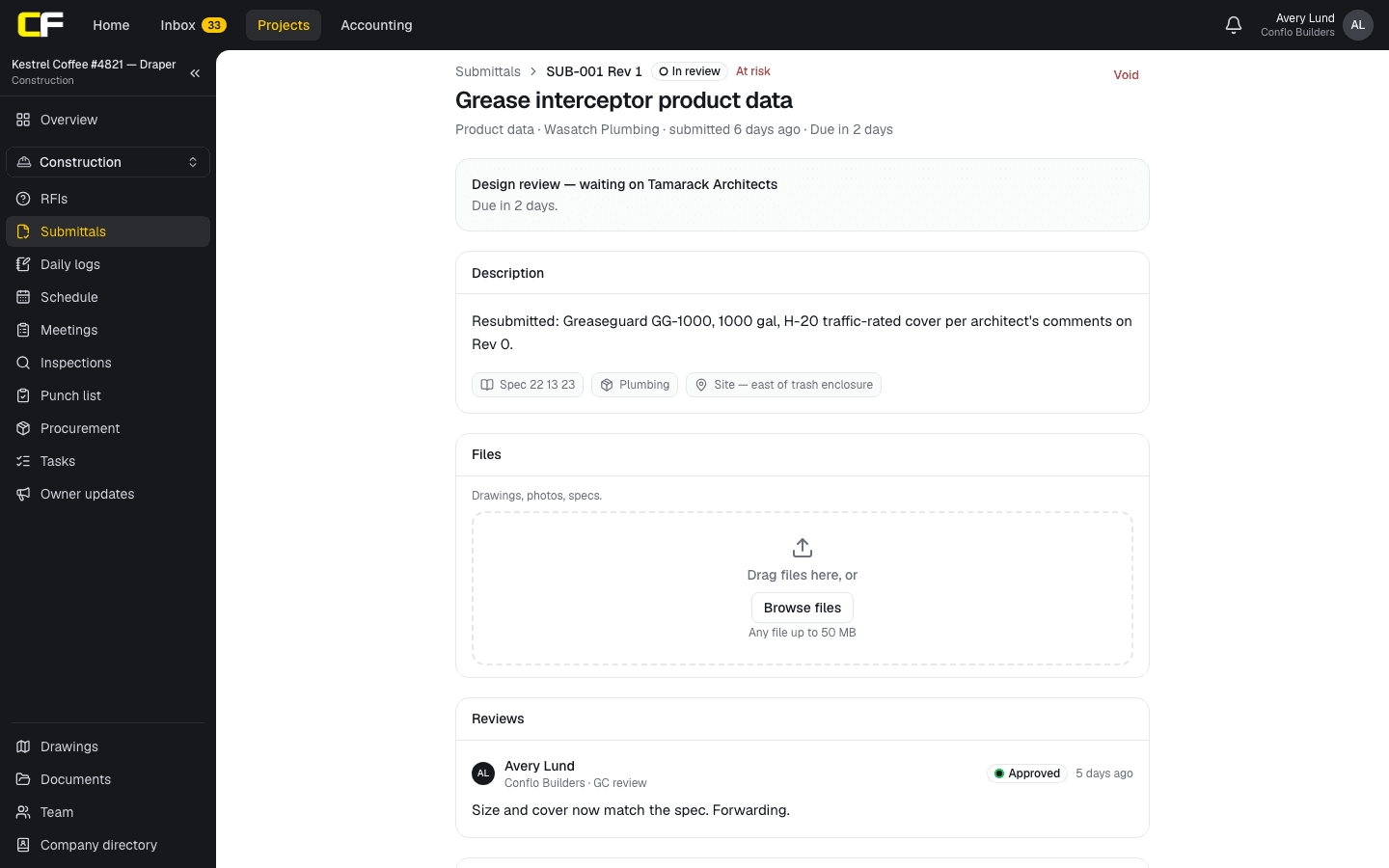
In Conflo's Submittals tool, each submittal names its design-team reviewers when it is set up. Review runs in order: GC review, then design review, then an optional consultant review, and the next step opens only when every required reviewer on the current one has responded. When it reaches you, you see the spec section, the files and the GC's review, and when your review is due.
You answer with one of four codes: approved, approved as noted, revise and resubmit, or rejected. Anything other than approved needs a note saying what to change. The GC returns it to the sub, and the deciding review is marked as the official response on the record. A revise and resubmit comes back as the next revision under the same number, so the history stays in one place.
The bottom line
Review the package before the content, the content against the specs and the design concept, and every listed deviation on its own line. Write comments that cite the requirement, choose the code by what the contractor may do next, and return it inside the review time.
Leave dimensions and means and methods with the contractor, and send design changes through the change process, not a stamp.
Sources
- Summary: A201–2017, General Conditions of the Contract for Construction — AIA Contract Documents. Read October 17, 2026.
- UFGS 01 33 00 Submittal Procedures (August 2026), §1.12–1.13 — Whole Building Design Guide, USACE / NAVFAC / AFCEC. Read October 16, 2026.
- FAR 52.236-21, Specifications and Drawings for Construction — Acquisition.gov, U.S. General Services Administration. Read October 16, 2026.
- Project Delivery Manual, 16.1 Shop Drawings — City of Los Angeles, Bureau of Engineering. Read October 16, 2026.
Questions
What does an architect check when reviewing a submittal?
Under AIA A201–2017, conformance with the information given and the design concept in the contract documents: the specified product, ratings, materials, finishes and required certificates. The review doesn't check dimensions, quantities, installation, safety or means and methods; those stay with the contractor.
Does approving a submittal make the architect responsible for it?
Not under A201–2017's terms. The contractor stays responsible for errors in its submittals and for deviations it didn't point out, even after approval. Your owner-architect agreement and state law also bear on liability, so check both.
How long does an architect have to review a submittal?
The time in the approved submittal schedule or the specifications; otherwise, under A201–2017, reasonable promptness while allowing enough time for adequate review. Division 01 often states a number of calendar or working days per review, and each resubmittal usually gets a full new period.
What is the difference between approved as noted and revise and resubmit?
Approved as noted lets the contractor proceed once it makes your corrections, so use it when the corrections are clear and small. Revise and resubmit stops the work on that item until a corrected submittal is approved, so use it when the package is incomplete or the fix needs a second look.
Related
Construction
How Does a Subcontractor Prepare a Submittal?
How a subcontractor prepares a submittal the GC and architect can approve the first time: what to include, how to mark it up, deviations, and resubmittals.
· 9 min read
Construction
How Should an Architect Respond to an RFI?
How the design team answers an RFI: check it against the documents, answer the question asked, cite the sheet and spec, and say if it changes the work.
· 8 min read
Definition
RFI vs Submittal: What Is the Difference?
An RFI asks the design team what the documents mean; a submittal shows how the contractor will meet them. The difference, side by side, with an example.
· 3 min read
Construction
How Does an Architect Write an ASI?
How an architect writes an ASI: what it may change, the parts of a good one, a filled-in example, and when it must become a change order.
· 8 min read
Role hub
The Architect's Guide to Construction Administration
The construction administration phase from the architect's seat: site visits, RFIs, ASIs, submittals, pay certification, changes and closeout.
· 8 min read