
ASI vs RFI: What Is the Difference?
By Wyatt Cooper · Published · 4 min read
Key takeaways
- An RFI is a question, from the contractor to the architect, about what the contract documents mean or how they fit together.
- An ASI is an order, from the architect to the contractor, clarifying the documents or making a minor change with no change in contract sum or time.
- An RFI's answer often arrives as an ASI, and an ASI that turns out to cost money or time becomes a change order.
An RFI (request for information) is the contractor's written question about the contract documents. An ASI (architect's supplemental instruction) is the architect's written order that clarifies the documents or makes a minor change without changing the contract sum or time. The RFI asks; the ASI instructs. Many ASIs exist because an RFI asked something.
Who sends each, and what it can do
Under the AIA general conditions, A201–2017, the architect "will review and respond to requests for information about the Contract Documents" and, "if appropriate", will "prepare and issue supplemental Drawings and Specifications in response" (§4.2.14). The ASI is the architect's own instrument: an order for a minor change "may be issued by the Architect alone" (§7.1.2), and §7.4 limits it to changes that do not adjust the contract sum or time. The AIA's G710 instructions put it the same way. Your contract may differ, so read it.
| RFI | ASI | |
|---|---|---|
| Sent by | The contractor (a sub's question goes through the GC) | The architect |
| Sent to | The architect | The contractor |
| What it is | A question | An instruction or a minor change |
| Changes cost or time? | No, by itself | No; if it would, it becomes a change order |
| Attachments | Marked-up sheets, photos, a proposed answer | Revised sheets, sketches or spec pages |
| Numbered | RFI 001, 002… on the RFI log | ASI-01, 02… in the sheet revision blocks |
An example with both
On a fictional clinic, the GC's RFI 021 asks whether the 36-inch door shown on A-101 or the 42-inch door in the door schedule on A-601 is right for room 112. The architect answers that 42 inches is right, and issues ASI-05 revising A-101 (rev 2) to match, stating no change in sum or time. The door supplier had already priced 42-inch frames from the schedule, so the GC accepts the ASI and both close. Had the frames already been bought at 36 inches, the GC would notify the architect before proceeding, and the fix would become a change order.
How each one differs from a change order
A change order is signed by the owner, contractor and architect and changes scope, price or time (A201 §7.1.2). Neither an RFI answer nor an ASI does that. When either one adds cost, give the notice your contract requires and price it as a change order. To write each document well, see how to write an RFI and how to write an ASI.
How it works in Conflo
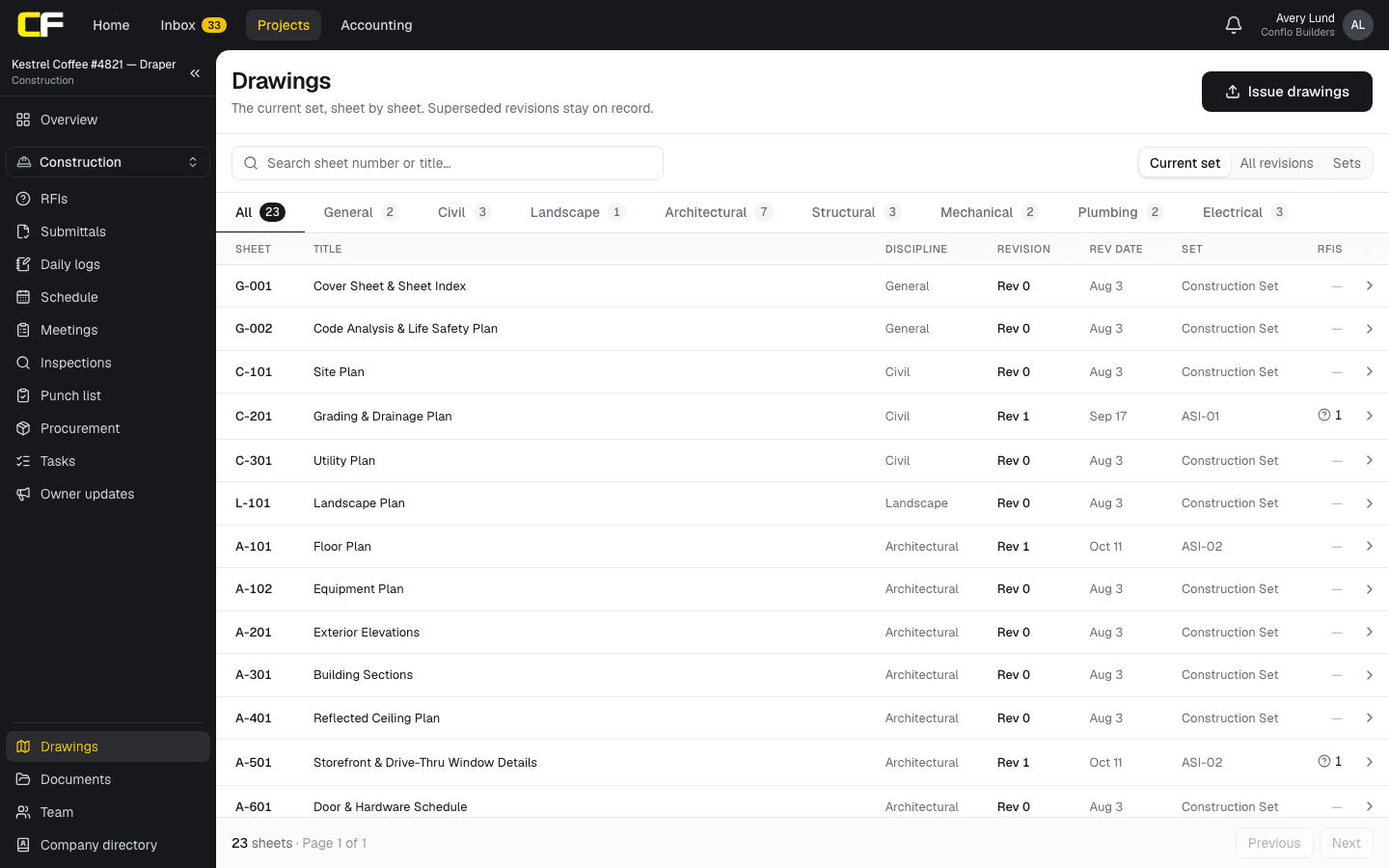
In Conflo, an RFI is a numbered record in the RFI tool: the question, the sheet and spec section, who it waits on, and the answers on the record, with the GC's project manager closing it and marking the official answer. An ASI is issued in Drawings as a named set (ASI-05) whose sheets supersede the old revisions, and each sheet lists the RFIs that reference it.
The bottom line
The RFI is the contractor's question; the ASI is the architect's instruction. An ASI changes neither price nor time, and when one would, it becomes a change order.
Design teams can keep RFIs and ASIs in the same place as the GC: join the Conflo waitlist.
Sources
- Summary: A201–2017, General Conditions of the Contract for Construction — AIA Contract Documents. Read October 17, 2026.
- Instructions: G710–2017, Architect's Supplemental Instructions — AIA Contract Documents. Read October 16, 2026.
Questions
Is an ASI the answer to an RFI?
Often, but not always. Under A201–2017 §4.2.14 the architect may issue supplemental drawings and specifications in response to an RFI, and many ASIs cite the RFI they answer. Architects also issue ASIs for their own corrections or the owner's minor requests.
Can a contractor issue an ASI?
No. An ASI is the architect's instruction. A contractor with a question about the documents sends an RFI; a contractor proposing a change sends a change order request or a substitution request, as the contract provides.
What if an ASI costs money?
Then it is not a minor change. Under A201–2017 §7.4 the contractor notifies the architect and does not proceed; the change then goes through a change order or construction change directive. Proceeding without notice waives the adjustment.
Related
Construction
How Does an Architect Write an ASI?
How an architect writes an ASI: what it may change, the parts of a good one, a filled-in example, and when it must become a change order.
· 8 min read
Construction
How to Write an RFI in Construction (With an Example)
How to write an RFI in construction: the parts of a good request for information, a filled-in example, common mistakes, and how the RFI log works.
· 9 min read
Money
How Do You Price a Change Order?
Price a change order from direct cost (burdened labor, materials, equipment, sub quotes), then the markups and time your contract allows. Worked example.
· 9 min read
Role hub
The Architect's Guide to Construction Administration
The construction administration phase from the architect's seat: site visits, RFIs, ASIs, submittals, pay certification, changes and closeout.
· 8 min read