
How Should an Architect Respond to an RFI?
By Wyatt Cooper · Published · 8 min read
Key takeaways
- Under AIA A201–2017 §4.2.14, the architect responds to RFIs in writing, within any agreed time limits or otherwise with reasonable promptness, and issues supplemental drawings and specifications when needed.
- A good response answers the one question asked, cites the sheet, detail and spec paragraph it relies on, and can be built from without a phone call.
- When the documents already answer the question, say where; when the answer changes the design, say that it does and send it through the change process.
- The architect's answer interprets the documents; it doesn't change the contract price or time by itself, and the contractor gives notice if it believes it does.
To respond to an RFI, read the question against the sheets and spec sections it cites, check whether the documents already answer it, and route it to the consultant whose work it concerns. Then answer the one question asked, in writing, citing the sheet, detail and paragraph you rely on, and attach a sketch or revised sheet if the answer needs one. Say plainly if the answer changes the design, and return it by the date in the contract or the RFI.
What the contract asks of the design team
Under the AIA's general conditions, A201–2017 §4.2.14, "the Architect will review and respond to requests for information about the Contract Documents". The response is "in writing within any time limits agreed upon or otherwise with reasonable promptness", and "if appropriate, the Architect will prepare and issue supplemental Drawings and Specifications in response". The contractor sends an RFI when it finds an error, inconsistency or omission (§3.2.2), "in such form as the Architect may require", so the architect can set the form.
Answers are interpretations, and §4.2.12 sets their standard: consistent with the intent of the documents and "reasonably inferable" from them, in writing or drawings, without partiality to the owner or the contractor. Your owner-architect agreement may set a response time or a fee for excess RFIs; read it with the general conditions.
Respond to it, step by step
- Read the question with the cited sheets, details and spec sections open. Check the contractor's proposed solution first: often the fastest answer is yes.
- Check whether the documents already answer it. If they do, say where (sheet, detail, paragraph) and close it.
- Route it to the consultant whose sheets it concerns, with the date you need their answer, early enough to meet the RFI's needed-by date.
- Answer the question that was asked, once, in a sentence or two the field can build from. Cite what you rely on.
- If the answer needs a drawing, attach a sketch or issue a revised sheet or supplemental instruction, and name it in the answer.
- If the answer changes the work, say so in the answer, so cost and time are dealt with now and not argued about later.
- Return it through the contract's chain, usually to the GC, and log the date.
If the question isn't clear, ask rather than guess. The City of Los Angeles Bureau of Engineering's RFI procedure tells the reviewer to contact the contractor "for clarification" or ask it "to resubmit a revised RFI", and when an RFI "will lead to a change order", to note on the RFI "that a change order will be forthcoming".
What a strong answer looks like
| The RFI | Weak answer | Strong answer | Why |
|---|---|---|---|
| Can FD-3 move 18 inches east, clear of the footing? | Coordinate in field. | Yes. Relocate FD-3 to 2'-6" east of grid B as proposed; keep floor slope to the drain per A-101. | It answers the question and names the dimension and sheet |
| Door 104 hardware set is missing from the schedule. | See specs. | Use hardware set 7, spec 08 71 00 paragraph 3.5. Revised door schedule A-601 attached. | It cites the paragraph and fixes the document |
| Beam B-12 conflicts with the duct on M-201. Which moves? | Contractor to resolve. | The duct moves. Offset per attached sketch SK-M-04; beam unchanged. | It makes the design decision that is the designer's to make |
| Can we substitute a different roof membrane? | Approved. | This is a substitution request. Submit it under the substitution procedure in Division 01. | It sends it to the right procedure |
Three things weaken answers on most jobs. "Coordinate in field" hands a design decision back to the people who asked for one. "See specs" without a paragraph number sends someone to look again. And answering a submittal or a means-and-methods question as an RFI puts a decision in the wrong record: see RFI vs submittal.
When the answer may cost money or time
An RFI answer interprets the documents; it doesn't change the contract by itself. The New Jersey DOT's RFI form says so on its face: the response "does not entitle the Contractor to any additional Time or increase in Price" and is "only a technical response". Under A201–2017, a contractor that believes an answer adds cost or time makes a claim under Article 15 (§3.2.4), and a change in the work is made by change order or construction change directive, which the architect prepares (§4.2.8).
So say what you know. If the answer adds work, write "this changes the work; a change will follow" rather than leaving the contractor to argue it later. If it doesn't, say "no change to the contract sum or time is intended". Some owners charge for design checks of contractor proposals: Louisiana DOTD's instruction sheet warns that modifications needing detail checks "may result in a cost to the Contractor". When the answer does change the work, the GC prices it as a change order.
A worked example: answering RFI 007
On a made-up job, the Alder Street Medical Office, the GC sent RFI 007 on March 3: floor drain FD-3 lands on the footing at grid B/2 (P-101 against detail 3/S-501), and the plumber proposes moving it 18 inches east. The answer is needed by March 10 for the underground inspection on March 12. The RFI itself is written up in our how-to.
RFI 007 — Response
- Received
- March 3; routed the same day to the structural and MEP engineers
- Checked
- P-101, S-101, detail 3/S-501, A-101 floor slopes, spec 22 13 19
- Answer
- Yes. Relocate FD-3 to 2'-6" east of grid B as proposed. Maintain floor slope to the drain per A-101. Footing on grid B is unchanged.
- Consultants
- Structural engineer: no conflict at the new location. MEP engineer: pipe sizes and slope unchanged.
- Attachments
- None; the RFI's marked-up P-101 shows the location
- Change
- No change to the contract sum or time is intended
- Answered by
- Project architect, architect of record (fictional)
- Returned
- March 6, four days ahead of the needed-by date
The answer is one sentence the plumber can lay out from, the engineers' checks are on the record, and the cost question is answered rather than left open. If the structural engineer had found the new location clashing with a grade beam, the right answer would have been a sketch and a note that the change may affect cost.
How it works in Conflo
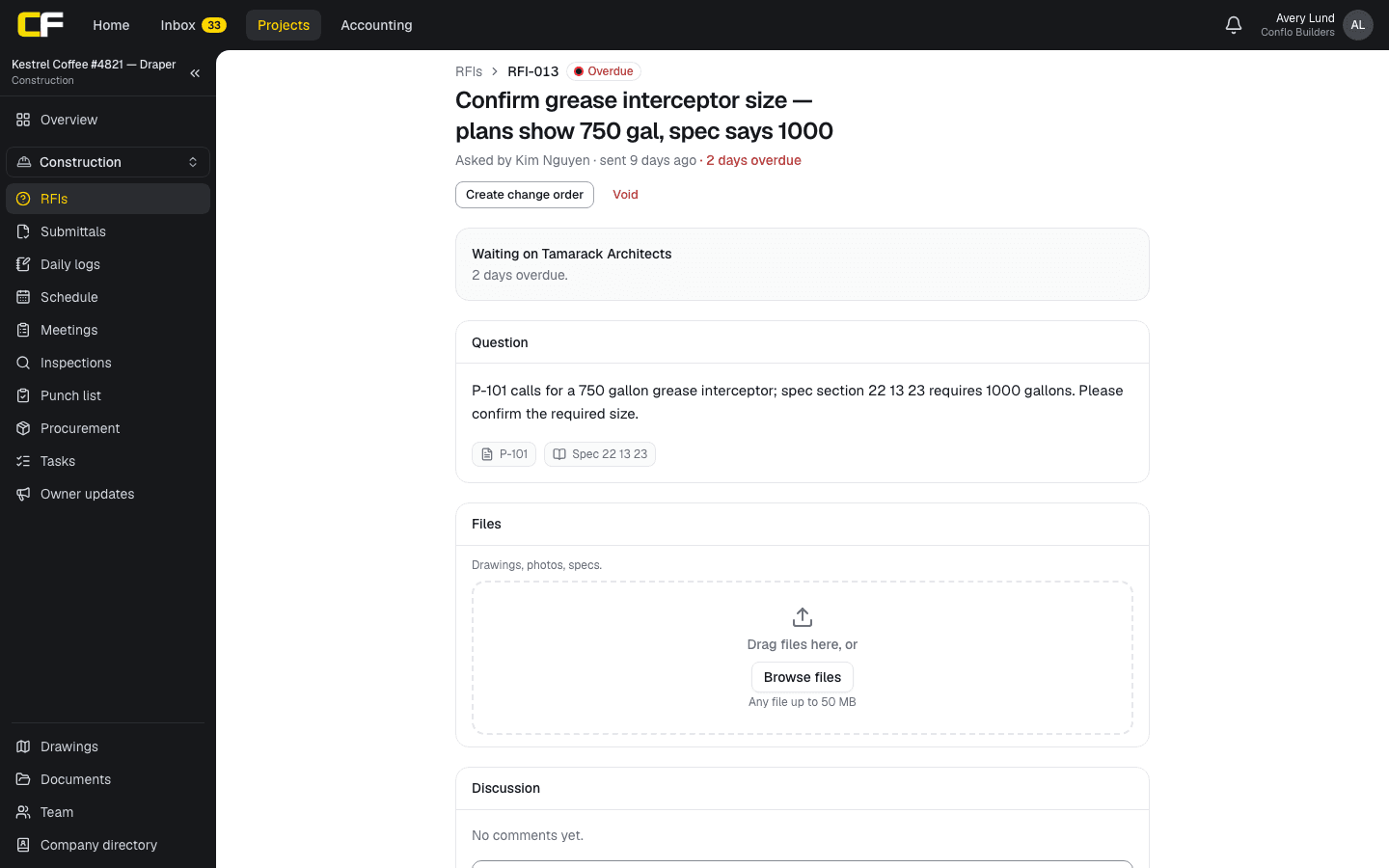
In Conflo's RFI tool, the RFIs waiting on you are on their own tab. Each one shows the question, the location, drawing and spec section it is about, whether the asker marked a cost or schedule impact, the due date and the attached files. You write your answer on the RFI, and comments keep the back-and-forth on the record instead of in email.
When the answers are in, the GC's RFI manager closes it and marks the official answer, or reopens it for another round. Conflo doesn't decide whether your answer changes the contract: added cost or time goes through a change order.
The bottom line
Answer the question that was asked, in writing, from the documents, citing the sheet and paragraph. Issue a sketch or revised sheet when words won't do, and say plainly whether the answer changes the work.
Return it before the needed-by date, through the contract's chain, and keep every answer where the whole team can find it.
Sources
- Summary: A201–2017, General Conditions of the Contract for Construction — AIA Contract Documents. Read October 17, 2026.
- Project Delivery Manual, 16.2 Request for Information — City of Los Angeles, Bureau of Engineering. Read October 16, 2026.
- Request for Information, form DC-162 — New Jersey Department of Transportation. Read October 16, 2026.
- RFI-Proposals Instruction Sheet — Louisiana Department of Transportation and Development. Read October 16, 2026.
Questions
How long does an architect have to respond to an RFI?
Whatever time limit the contract sets; under AIA A201–2017, absent one, with reasonable promptness. Many specifications set a number of days in Division 01, and the RFI should carry a needed-by date tied to the work it holds up. Check your contract and your owner-architect agreement.
Who should answer an RFI, the architect or the engineer?
Under A201–2017 the architect responds, often after routing the question to the consultant engineer whose drawings it concerns. The engineer's answer usually goes back through the architect so the design team gives one answer. Other contracts name a construction manager or owner's representative.
Can an RFI response change the contract?
Not by itself. An RFI response interprets the documents. If it adds work, the change is made by change order or construction change directive, and a contractor who believes an answer adds cost or time gives notice under the contract's claims provisions.
What should an architect do with an RFI the documents already answer?
Answer it with the reference: the sheet, detail or spec paragraph that already covers it. That closes the question quickly and shows the contractor where to look next time.
What if an RFI is really a substitution request or a submittal?
Say so in the answer and point the contractor to the right procedure in Division 01. Approving a product inside an RFI answer bypasses the submittal or substitution review the contract requires.
Related
Construction
How to Write an RFI in Construction (With an Example)
How to write an RFI in construction: the parts of a good request for information, a filled-in example, common mistakes, and how the RFI log works.
· 9 min read
Definition
RFI vs Submittal: What Is the Difference?
An RFI asks the design team what the documents mean; a submittal shows how the contractor will meet them. The difference, side by side, with an example.
· 3 min read
Template
Free RFI Template With a Filled-In Example
A free RFI template in Word, no email needed: every field a good request for information needs, a response section, and a filled-in example on page two.
· 4 min read
Construction
How Do Architects and Engineers Review a Submittal?
How the design team reviews a submittal: what the review covers and what it doesn't, choosing the review code, writing comments, and returning it on time.
· 8 min read
Role hub
The Architect's Guide to Construction Administration
The construction administration phase from the architect's seat: site visits, RFIs, ASIs, submittals, pay certification, changes and closeout.
· 8 min read