
How to Write a Construction Daily Log (With Example)
By Wyatt Cooper · Published · 6 min read
Key takeaways
- A daily log records, for one job and one day, the weather, who was on site and for how long, what work was done and where, equipment, deliveries, inspections, visitors, delays and safety events.
- Write facts with numbers and locations, name work the way the schedule names it, and log every day, including days with no work.
- Agency manuals treat the daily record as the evidence in a dispute and one basis for payment, so write it the same day.
- A delay entry needs its cause, its start and end, the hours lost and who was affected; an instruction needs who gave it, to whom and when.
To write a construction daily log, record for that day: the weather, each company on site with its workers and hours, the work done with locations and quantities, equipment, deliveries, inspections and their results, visitors, delays with cause and hours lost, safety events, and instructions given or received. Use the schedule's activity names, write facts rather than opinions, finish it the same day, and log every calendar day, even when no work happened.
What a daily log is for
The daily log (daily report, superintendent's diary) is the job's record of what happened each day. Months later it is what settles whether rain or a late answer stopped the work, how many people the electrician really had on site, and when the inspector passed the slab.
Public owners say so in their manuals. Wisconsin DOT's Construction and Materials Manual says that in a dispute the diary records "are the legal documents with which the matter may be resolved" and one basis for paying the contractor. Federal guide specification UFGS 01 45 00 requires a production report and a quality-control report for each day work is performed and asks contractors to "account for each calendar day" of the contract.
What to record every day
| Section | What to write | Common mistake |
|---|---|---|
| Weather | Conditions and temperatures through the day; rain or wind that stopped work, and when | "Nice day" with no times |
| Manpower | Each company, trade, workers, hours each, and where they worked | One headcount for the whole site |
| Work performed | What was done, where, how much, in the schedule's activity names | "Continued framing" |
| Equipment | Each piece, hours operating and idle, and where | Leaving out idle or broken-down equipment |
| Deliveries | Time, supplier, what arrived, bill of lading number, any damage | No time or ticket number |
| Inspections and tests | Type, agency, inspector, location and result | Writing "passed" for a partial |
| Delays | Cause, start and end, hours lost, the work and companies affected | "Delay due to weather" with no hours |
| Safety | Accidents, near misses, violations, what was done | Leaving it out because it seemed minor |
| Visitors, calls and instructions | Who, when, and what was said or directed | Verbal directions nobody wrote down |
UFGS 01 45 00 lists the same core: who was working and their area of responsibility, equipment with hours worked, idle or down, work performed by location and schedule activity, materials received, tests, instructions given and received, and conflicts in the drawings. A conflict you log today is often an RFI you send tomorrow.
A filled-in daily log
A made-up job, the Harbor Lane Clinic, on the day the under-slab work is inspected. The superintendent writes it at the end of the day.
Daily log: Harbor Lane Clinic, Thursday, November 12
- Weather
- 7:00 AM cloudy, 41°F; 1:30 PM light rain to 3:00 PM; 52°F high. No work lost to rain.
- Manpower
- GC: 2 laborers × 8 h = 16 h. Ridgeline Concrete: 6 × 8 h = 48 h, area A. Copper Ridge Plumbing: 2 × 4 h = 8 h, area A. Total 10 workers, 72 man-hours.
- Work performed
- 3.3 Slab rebar for area A grids 1–4 received, sorted and staged with the vapor retarder rolls, ready to start tomorrow after the inspection. 3.2 Plumbing: test caps checked for the inspection.
- Equipment
- Skid steer: 6 h operating, 2 h idle. Laser level: on site, no hours kept.
- Deliveries
- 9:40 AM, rebar for area A slab, bill of lading 448120, checked against the shop drawing, no damage.
- Inspections
- 10:00 AM under-slab plumbing, city inspector, area A: passed. 10:30 AM under-slab electrical: partial; two conduit stubs to be re-supported before the pour.
- Delays
- Rebar crew waited 8:00–9:40 AM for the delivery: 6 workers × 1 h 40 min = 10 man-hours lost. Cause: supplier truck late. Pour date unchanged.
- Safety
- No accidents. Toolbox talk on rebar cap use, 7:00 AM, 10 attended.
- Instructions
- Architect's field rep (site visit 1:00–2:00 PM) asked for 6-inch laps at vapor retarder seams per spec; told Ridgeline's foreman 2:05 PM.
Read it as a stranger would in a year. The rebar delay has times, people and a cause. The partial electrical inspection says what must be fixed. The verbal instruction has who, to whom and when. Totals: 16 + 48 + 8 = 72 man-hours, and the 10 workers are 2 + 6 + 2.
Habits that make a log hold up
- Write it the same day. UFGS 01 45 00 wants the reports in by 10:00 AM the next working day.
- Log every day. On a day with no work, a one-line entry with the reason (weather, holiday, suspension) closes the gap.
- Use the schedule's activity names, so a day's work can be tied to the activity it advanced.
- Facts, not blame: "waited 8:00–9:40 for rebar, supplier truck late", not "supplier messed up again".
- Photos with the date and location back up the words; attach them to the day.
- Don't rewrite history. If a log has to change, keep the earlier version and who changed it.
How it works in Conflo
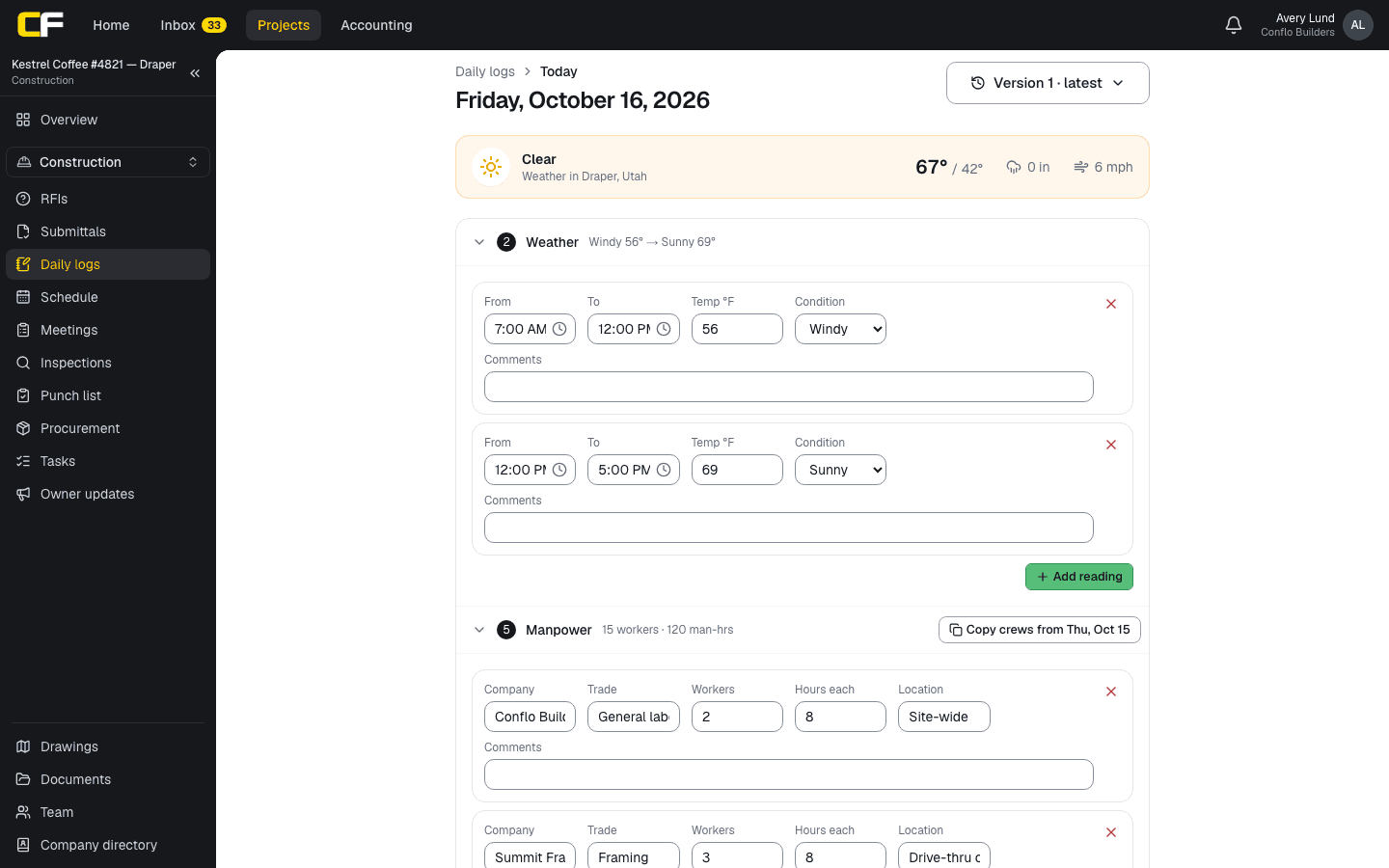
In Conflo's daily logs, each project has one log per day, kept by the GC's team. The day's weather fills in from the job's address, and sections cover weather readings, manpower, scheduled work and no-shows, equipment, deliveries, visitors, inspections, delays with cause and hours lost, accidents, safety violations, phone calls, waste, dumpsters, restrooms and photos. You can copy the crews from the last logged day and adjust them; man-hours add up as you type.
The log saves as you go and can be edited later, and it keeps numbered versions showing who edited it and when, so earlier versions can still be read. Workdays with no log show up in the list, a log can't be written for a future day, and each day's log is also kept as a PDF in the project's documents. There is no submit-and-approve step today.
The bottom line
A good daily log is facts with numbers, times and locations, written the same day, for every day of the job. It is the record you will reach for when a delay, a payment or an inspection is disputed.
If your logs are in notebooks and texts, keep them where the whole project team can read them and nobody can quietly rewrite them.
Sources
- UFGS 01 45 00, Quality Control (August 2023, change 4), §1.12 Documentation — Naval Facilities Engineering Systems Command (Whole Building Design Guide). Read October 16, 2026.
- Construction and Materials Manual, Section 160 Construction Inspection (April 2026) — Wisconsin Department of Transportation. Read October 16, 2026.
Questions
What should a construction daily log include?
The weather, each company on site with workers and hours, work performed with locations and quantities, equipment, deliveries, inspections and results, visitors, delays with cause and hours lost, safety events, and instructions given or received.
Who writes the daily log?
Usually the GC's superintendent. Subcontractors often keep their own daily reports too, and public contracts may require separate quality-control reports signed by the QC manager.
Do you need a daily log on days with no work?
Yes. A short entry saying why no work happened (rain, holiday, a suspension) keeps every calendar day accounted for. Federal guide specifications ask for at least one report for every seven days of no work.
How long should you keep daily logs?
At least as long as claims, warranty and lien periods run on the job, and longer if your contract or company policy says so. Check your contract and your state's law.
Related
Construction
How Do You Build a Three-Week Look-Ahead Schedule?
How to build a three-week look-ahead from the master schedule: crew-sized pieces of work, what must be ready, and how to run it at the weekly meeting.
· 7 min read
Construction
How to Write an RFI in Construction (With an Example)
How to write an RFI in construction: the parts of a good request for information, a filled-in example, common mistakes, and how the RFI log works.
· 9 min read
Closeout
How Do You Build a Punch List?
Build a punch list by walking the job room by room before substantial completion, logging each item with location, trade, photo and due date. With example.
· 9 min read
Construction
How Do You Document a Weather Delay?
How a GC documents a weather delay that wins a time extension: the daily log entry, the critical path, comparing to normal weather, and the notice.
· 8 min read
Construction
How Do You Write a Construction Incident Report?
Write a construction incident report: the first hour, the facts to record, the root cause, and how a filled-in report decides the OSHA 300 log.
· 7 min read
Role hub
The General Contractor's Guide: Bid to Closeout
What a general contractor is responsible for at every phase of a commercial job, from bidding and buyout to RFIs, change orders, pay apps and closeout.
· 8 min read