
What Should a Subcontract Agreement Include?
By Wyatt Cooper · Published · 8 min read
Key takeaways
- A subcontract wraps the scope of work in the commercial and legal terms: price, time, payment, changes, insurance, bonds, default and disputes.
- Most terms should flow down from the prime contract, so the sub owes you what you owe the owner, on the same notice periods.
- The subcontract sum is the awarded leveled number plus accepted alternates, split into a schedule of values the sub will bill against.
- Write payment terms precisely: when the pay application is due, the retainage percentage, when payment is made and what can be withheld.
A subcontract agreement should name the parties and the prime contract it flows down from, attach the scope of work and list the documents it covers, and state the subcontract sum, the schedule, how the sub is paid (schedule of values, pay application date, retainage, payment timing and withholding), how changes are priced and approved, insurance and bonds, warranty, safety and cleanup, default and termination, and how disputes are resolved. Each term should match or flow down from the prime contract.
The agreement around the scope
The scope of work says what the sub builds. The subcontract agreement says everything else: what you pay, when, on what conditions, what happens when the work changes, and what happens when either side fails. It is signed during buyout, after you have leveled the bids and selected a sub, and before the sub mobilizes.
Most general contractors start from a standard form or their own. The AIA's A401–2017 is one widely used standard form of agreement between contractor and subcontractor; AIA's instructions describe it as written to parallel the A201–2017 general conditions, which it incorporates by reference, and walk through the parts you fill in: the scope of work including work excluded, the commencement date and subcontract time, the subcontract sum and alternates, progress payments and retainage, insurance and bonds, and the choice of binding dispute resolution (AIA Contract Documents). Whatever form you use, the same topics need an answer.
Clause by clause
| Clause | What it says | What to check |
|---|---|---|
| Parties and prime contract | Who contracts, and that the prime contract's terms bind the sub for its work | The sub has seen the prime contract sections that flow down |
| Contract documents | The drawings, specifications and addenda by date and number, plus the exhibits | The same set and addenda the sub bid |
| Scope | The scope exhibit: inclusions, exclusions, and boundary items | Every item from leveling is either in or named as excluded |
| Subcontract sum | The price, accepted alternates, and any unit prices or allowances | It equals the awarded number, not the original base bid |
| Schedule | Start, duration or milestones, coordination with the project schedule | Liquidated damages in the prime contract are passed through only for delay the sub causes |
| Payment | Schedule of values, pay application date, retainage, payment timing, what may be withheld | Dates line up with the owner's payment cycle |
| Changes | Changes only in writing, how they are priced, notice periods for claims | Notice periods shorter than the prime contract's, so you can pass a claim up in time |
| Insurance | Required coverages and limits, additional insured status, waiver of subrogation | Limits match the owner's requirements for this trade |
| Bonds | Performance and payment bonds, if required, and who pays for them | Required where the prime contract or the risk calls for it |
| Submittals, warranty and closeout | Submittal timing, warranty period and start, closeout documents | Warranty starts when the prime contract's does |
| Safety and cleanup | Safety program, site rules, daily cleanup and backcharges | Backcharge notice before the work is done by others |
| Default and termination | Notice to cure, termination for default and for convenience | A cure period, and what is paid on termination for convenience |
| Disputes | Negotiation, then mediation, arbitration or litigation | Consistent with the prime contract, so one dispute is not heard in two forums |
Flow down the prime contract
The safest subcontract gives the sub the same obligations toward you that you have toward the owner for the sub's work: the same quality standards, the same warranties, and notice periods short enough that you can pass a claim up the chain in time. Where the prime contract requires something of subcontracts, the subcontract must carry it.
Federal work shows how specific those requirements are. A prime contractor under the federal prompt payment clause must put a payment clause in each subcontract obligating it to pay the subcontractor for satisfactory performance "not later than 7 days from receipt of payment out of such amounts as are paid to the Contractor under this contract", plus an interest penalty clause for late payment, and each subcontractor must put similar clauses in its own lower-tier subcontracts (FAR 52.232-27). The same clause sets out how a prime may withhold from a sub for deficient performance, with written notice. On federal construction contracts over $150,000, performance and payment bonds are required of the prime (FAR 28.102-1); whether you require them of a sub is your decision, and belongs in the subcontract.
A worked example: the subcontract sum and its schedule of values
Subcontract SC-004: Electrical, Coyle Avenue Office
- Parties
- Fairbank Builders (contractor) and Voltline Electric (subcontractor)
- Documents
- Drawings and specifications dated for bid, Addenda 1 to 3, Exhibit A (scope), Exhibit B (insurance)
- Subcontract sum
- $1,284,600: the leveled bid of $1,262,100 plus Alternate 1 (generator transfer switch), accepted, $22,500
- Schedule
- Mobilize February 2; complete electrical rough-in by June 26; substantial completion with the project
- Payment
- Pay application due on the 25th for work through month end; 5% retainage on each payment until substantial completion; payment within 7 days after the contractor receives the owner's payment for the sub's work
- Changes
- Only by written change order; written notice of a claim within 7 days of the event
- Bonds
- Performance and payment bonds required, cost included in the sum
| Cost code | Line | Scheduled value |
|---|---|---|
| 26 05 00 | Common work, mobilization and temporary power | $96,000 |
| 26 24 00 | Switchboards and panelboards | $214,500 |
| 26 05 19 | Conductors and cables | $388,200 |
| 26 27 26 | Wiring devices | $121,400 |
| 26 51 00 | Lighting | $286,000 |
| 28 31 00 | Fire alarm | $156,000 |
| 26 36 00 | Transfer switch (Alternate 1) | $22,500 |
| Total | $1,284,600 |
The lines add up: $96,000 + $214,500 + $388,200 + $121,400 + $286,000 + $156,000 = $1,262,100, the leveled bid, and + $22,500 = $1,284,600. If Voltline's first pay application bills $142,000 of work, 5% retainage is $7,100 and the payment due is $134,900. The schedule of values is what the sub's pay applications bill against, so agree it before the subcontract is signed, not with the first pay application.
Mistakes that come back later
- Writing the base bid as the subcontract sum when the award was made on a leveled number with added scope.
- Attaching the sub's proposal as the scope, with its exclusions and qualifications inside the contract.
- Claim notice periods in the subcontract longer than the prime contract's.
- Retainage and payment dates that do not match the owner's cycle.
- Letting the sub mobilize before the subcontract is signed and its compliance documents are in.
How it works in Conflo
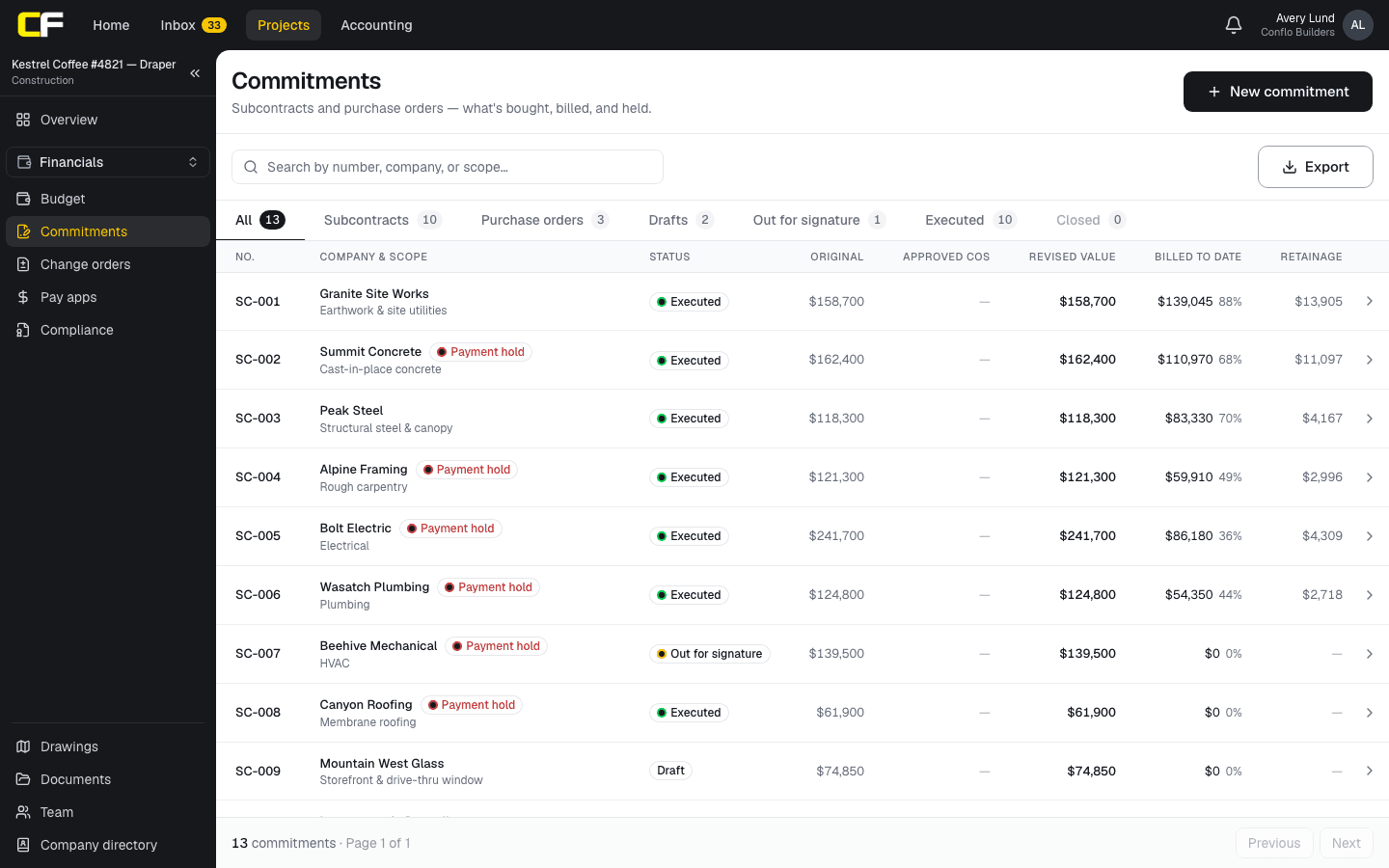
In Conflo, a subcontract is a commitment. You write its scope (the form's hint: what is included and excluded; the sub signs against it), set the retainage percentage, and build the schedule of values in lines, each with a budget cost code, a description and an amount. Save it as a draft or send it for signature. The sub's authorized signer signs in Conflo by typing their full name as it appears on their profile, or declines with a reason; a contract signed on paper or elsewhere can be marked executed by an approver on your team. If the sub has missing or expired compliance documents, signing shows a warning that needs a reason to go ahead.
From a trade bid you have awarded, Buyout issues the subcontract to the winner at the leveled amount. After that, each commitment shows its original value, approved and pending change orders, revised value, billed to date, retainage held and balance. Conflo holds the commercial terms; the legal clauses stay in your own subcontract form.
The bottom line
A subcontract agreement is the scope plus the terms that make it enforceable: the sum, the schedule, payment, changes, insurance and bonds, warranty, default and disputes, each flowing down from the prime contract.
Get the sum and the schedule of values right before signing, keep notice periods shorter than your own, and have counsel in the project's state review the form.
Sources
- Instructions: A401–2017, Standard Form of Agreement Between Contractor and Subcontractor — AIA Contract Documents. Read October 22, 2026.
- FAR 52.232-27, Prompt Payment for Construction Contracts — Acquisition.gov, U.S. General Services Administration. Read October 22, 2026.
- FAR 28.102-1, General (bonds for construction contracts) — Acquisition.gov, U.S. General Services Administration. Read October 22, 2026.
Questions
What should a subcontract agreement include?
The parties and the prime contract, the contract documents, the scope exhibit, the subcontract sum, the schedule, payment terms and retainage, the changes process, insurance and bonds, submittals and warranty, safety and cleanup, default and termination, and dispute resolution.
What is a flow-down clause?
A clause that binds the subcontractor, for its work, to the prime contract's terms toward the contractor, so the sub owes the general contractor what the general contractor owes the owner. Some prime contracts, such as federal ones, also require specific clauses in every subcontract.
Is the subcontract sum the sub's bid?
It is the price the award was made on: usually the leveled bid with any scope added during leveling, plus accepted alternates. Check that it matches the number you carried, not only the original base bid.
Who writes the subcontract, the GC or the sub?
Usually the general contractor, on its own form or a standard one such as AIA A401. The sub reviews it and may negotiate changes before signing.
Related
Preconstruction
How Do You Buy Out a Construction Job?
Construction buyout step by step: scope review, leveling, award, the subcontract and its exhibits, compliance documents, and savings against budget.
· 7 min read
Bidding
How to Write a Scope of Work for a Subcontractor
Write a subcontractor scope of work from the drawings and specs: a summary, numbered inclusions, named exclusions, alternates and the documents behind it.
· 7 min read
Preconstruction
What Paperwork Does a GC Require From a Sub?
The documents a GC asks a subcontractor for before work and payment: W-9, insurance certificate and endorsements, license, safety program, waivers.
· 6 min read
Money
How Does a Subcontractor Fill Out a Pay Application?
A subcontractor's pay app bills percent complete and stored materials per schedule-of-values line, less retainage and prior payments, with a lien waiver.
· 9 min read
Role hub
The General Contractor's Guide: Bid to Closeout
What a general contractor is responsible for at every phase of a commercial job, from bidding and buyout to RFIs, change orders, pay apps and closeout.
· 8 min read