
How Do You Buy Out a Construction Job?
By Wyatt Cooper · Published · 7 min read
Key takeaways
- Buyout is the stretch after the prime contract is signed when the GC turns every estimated trade into a signed subcontract or purchase order.
- Compare each award to the estimate's budget for that trade on the leveled number, not the base bid, or missing scope shows up later as a change order.
- In the example below, three signed trades come in $27,800 under budget; plumbing, awarded but not yet signed, is $8,300 over and stays out of the reported savings.
- A trade is not bought out until the subcontract is signed and the insurance certificate, W-9 and any required bond are in.
To buy out a construction job, take each trade in the estimate, confirm its scope with the low bidders, level the bids so they cover the same work, and award on the leveled number. Then issue the subcontract with its scope, schedule, schedule of values and insurance requirements, collect the certificate of insurance, W-9 and any bond, and record the signed amount against the estimate's budget. Buyout is done when every trade is under a signed contract and the savings or overrun is known.
What buyout is and when it happens
Buyout is the general contractor's work of buying the job it just sold: turning each line of the estimate into a subcontract or purchase order. It starts when the prime contract is awarded and runs through preconstruction, trade by trade, with the long-lead trades (structural steel, elevators, switchgear, mechanical equipment) first.
Two numbers matter for each trade. The budget is what the estimate carried for it. The award is the signed subcontract amount. The difference is buyout savings (award under budget) or a buyout overrun. Whether savings stay with the GC depends on the prime contract: on a lump-sum job they usually do, while a cost-plus or guaranteed-maximum-price contract often returns them to the owner or shares them. Check your contract.
The buyout process, trade by trade
- 1EstimatorHands over the trade's budget, the bids and the scope sheet it was bid against
- 2Project managerHolds a scope review with the low two or three bidders and writes down every clarification
- 3Project managerLevels the bids on the same scope and recommends the award
- 4GC approverApproves the award, with the variance to budget
- 5SubcontractorReceives the subcontract with its exhibits and signs it, or declines
- 6SubcontractorSends the insurance certificate, W-9, license and any bond the subcontract requires
- 7Project managerMarks the trade executed and records the committed cost against the budget
The scope review is where buyout savings are kept or lost. Walk the bidder through the drawings and specification sections, the exclusions on its proposal, the schedule, and who provides what at the trade's edges (temporary power, firestopping, equipment pads, cutting and patching). Every clarification goes into the subcontract's scope exhibit, not just into meeting notes. For the leveling step itself, see how to level subcontractor bids.
What goes into the subcontract
| Exhibit | What it holds | Why it matters later |
|---|---|---|
| Scope of work | Inclusions, exclusions and clarifications from the scope review, by drawing and spec section | It is what a change order is measured against |
| Schedule | Mobilization, durations, milestones and long-lead release dates | Delay claims and back-charges start here |
| Schedule of values | The contract amount broken into billable lines | Every pay app bills against it |
| Insurance requirements | Coverages, limits, additional insured and waiver of subrogation | The certificate is checked against it |
| Bonds | Performance and payment bonds where the GC or the prime contract requires them | Protects the GC if the sub fails or does not pay its suppliers |
| Payment terms | Retainage, pay-app cutoff, lien waiver requirements | Sets when and how the sub is paid |
On federal construction contracts over $150,000 (the statute's $100,000, adjusted for inflation in FAR 28.102-1), the prime must furnish performance and payment bonds before the contract is awarded (40 U.S.C. § 3131); whether you bond your subs is a business decision and, on some jobs, a contract requirement. And each federal progress-payment request carries the contractor's certification that subcontractors and suppliers have been paid from earlier payments (FAR 52.232-5), which is one reason the subcontract's payment terms must line up with the prime's.
Collect the paperwork before the sub mobilizes
A signed subcontract is not the end of buyout. Before the sub starts work, collect its certificate of insurance, checked against the insurance exhibit, and the additional-insured endorsement, since a certificate alone does not change coverage (ACORD certificates FAQ). Add a Form W-9 (IRS), its contractor license where the state requires one, and any bond. What each document is and why it matters is in what paperwork a GC requires from a sub.
Worked example: buyout savings on four trades
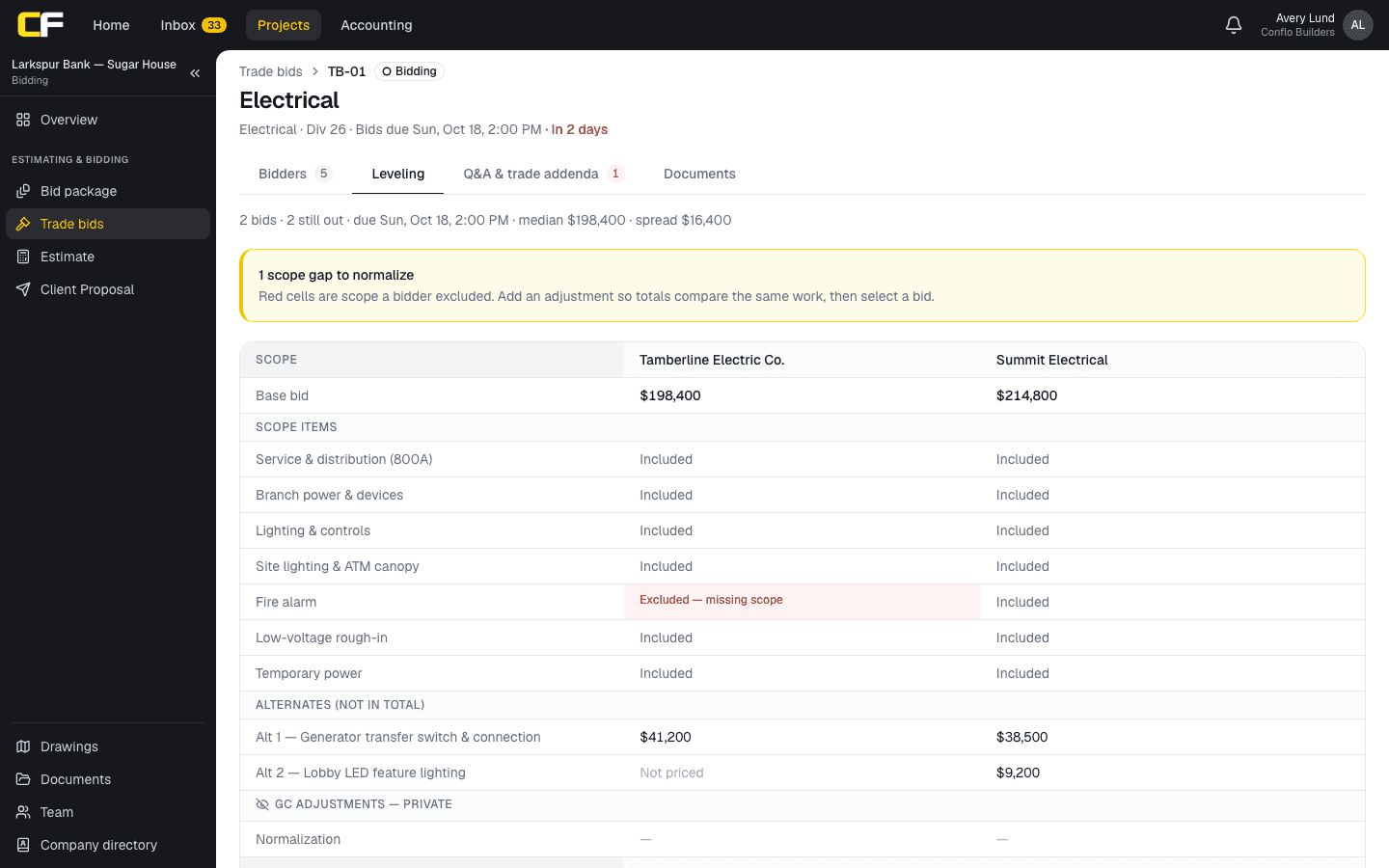
A fictional GC is buying out the fictional "Corbett Street Clinic". Four trades are awarded and three are signed; plumbing's subcontract is issued but not signed, and drywall is still out to bid. Electrical's low base bid was $271,200 but excluded fire alarm, which the GC priced at $8,750 in leveling, so the award is the leveled $279,950.
| Trade | Budget (estimate) | Award | Savings (overrun) | Status |
|---|---|---|---|---|
| Concrete | $412,000 | $398,500 | $13,500 | Signed |
| Electrical | $286,400 | $279,950 | $6,450 | Signed |
| HVAC | $341,750 | $333,900 | $7,850 | Signed |
| Signed trades (savings to report) | $1,040,150 | $1,012,350 | $27,800 | 3 signed |
| Plumbing | $198,000 | $206,300 (awarded) | ($8,300) | Issued, not signed |
| All four awarded trades, if plumbing signs | $1,238,150 | $1,218,650 | $19,500 | Forecast |
| Drywall | $154,200 | — | — | Not started |
Check: $13,500 + $6,450 + $7,850 = $27,800, and $1,040,150 − $1,012,350 = $27,800. Plumbing stays out of the reported savings until its subcontract is signed; if it signs at $206,300, its $8,300 overrun brings the total to $19,500 ($27,800 − $8,300, or $1,238,150 − $1,218,650). Drywall stays out of the totals until it is awarded; carrying its budget as if it were bought out would overstate the savings. Had the GC awarded electrical on the $271,200 base bid, its savings would have looked like $15,200 and the $8,750 of fire alarm would have come back later as a change.
Mistakes that turn buyout savings into overruns
- Awarding on the base bid without leveling exclusions.
- Skipping the scope review on a low bid that looks too good.
- Leaving the clarifications out of the subcontract's scope exhibit.
- Letting a sub mobilize before its certificate and endorsement are in.
- Releasing long-lead equipment late because the subcontract was not signed.
- Reporting savings on trades that are awarded but not yet signed.
When a sub declines the subcontract, go back to the leveled bids, not the base bids, and re-check the next bidder's exclusions before you issue again. Later changes to a signed subcontract are priced as in how to price a change order.
How it works in Conflo
Conflo's Buyout lists every trade with its budget from the estimate and the awarded subcontractor and leveled amount from Bid leveling, with the savings or overrun per trade and in total. Estimated divisions with no trade bid yet appear as not started. Each trade moves from To issue to Issued to Signed: the GC issues the subcontract to the awarded bidder, and the sub signs it or declines with a reason in Conflo. If the sub declines, Conflo offers the next-lowest eligible leveled bid. A new subcontract takes the project's retainage terms, or 10% when none are set, and an executed one opens the sub's billing.
Insurance certificates, W-9s and licenses are requested and reviewed in Compliance. Not built today: bond tracking, and a scope-review meeting record tied to the trade.
The bottom line
Buyout is where the estimate meets real contracts. Award on the leveled number, put every clarification in the subcontract, and do not call a trade bought out until it is signed and its paperwork is in.
Keep a buyout log with budget, award and status for every trade, and report savings only on signed trades.
Sources
- 40 U.S.C. § 3131, Bonds of contractors of public buildings or works — U.S. Government Publishing Office (GovInfo). Read October 17, 2026.
- FAR 28.102-1, General (bonds for construction contracts) — Acquisition.gov, U.S. General Services Administration. Read October 17, 2026.
- FAR 52.232-5, Payments under Fixed-Price Construction Contracts — Acquisition.gov, U.S. General Services Administration. Read October 16, 2026.
- Certificates of Insurance: Frequently Asked Questions — ACORD. Read October 16, 2026.
- About Form W-9, Request for Taxpayer Identification Number and Certification — Internal Revenue Service. Read October 16, 2026.
Questions
What is buyout in construction?
Buyout is the GC's process of turning each trade in the estimate into a signed subcontract or purchase order after the prime contract is awarded, and tracking each award against the trade's budget.
What are buyout savings?
The difference between a trade's budget in the estimate and its signed subcontract amount, when the award comes in lower. Who keeps them depends on the prime contract: on lump-sum work usually the GC, on cost-plus or GMP work often the owner, in whole or in part.
When is a trade bought out?
When its subcontract or purchase order is signed. Many GCs also wait for the insurance certificate, W-9 and any bond before calling it complete.
Should you award on the base bid or the leveled bid?
The leveled bid. A low base bid that excludes scope will cost the excluded work later, usually as a change order at a worse price.
Which trades should be bought out first?
The ones with long lead times or early schedule dates: typically sitework and concrete, structural steel, elevators, switchgear and major mechanical equipment.
Related
Bidding
How Do You Level Subcontractor Bids?
Level subcontractor bids by pricing every scope gap, exclusion and missing addendum so each bid covers the same work, then compare the leveled totals.
· 9 min read
Preconstruction
What Paperwork Does a GC Require From a Sub?
The documents a GC asks a subcontractor for before work and payment: W-9, insurance certificate and endorsements, license, safety program, waivers.
· 6 min read
Money
How Do You Price a Change Order?
Price a change order from direct cost (burdened labor, materials, equipment, sub quotes), then the markups and time your contract allows. Worked example.
· 9 min read
Money
How Do You Track a Budget Against Commitments?
Track a construction budget against committed cost by cost code: revised budget, signed commitments, buyout variance and exposure, with a worked table.
· 7 min read
Role hub
The General Contractor's Guide: Bid to Closeout
What a general contractor is responsible for at every phase of a commercial job, from bidding and buyout to RFIs, change orders, pay apps and closeout.
· 8 min read