
How Do You Write a Purchase Order for Materials?
By Wyatt Cooper · Published · 7 min read
Key takeaways
- A purchase order turns a supplier's quote into a commitment on your terms: what, how many, at what price, delivered where and when.
- Name each item by its spec section and approved submittal, and release fabrication only once the submittal is approved.
- Write delivery terms out: delivered to the jobsite, freight included, who unloads, the delivery window and when risk of loss passes.
- If you will bill materials before they are installed, write the stored-materials conditions (title, storage, insurance) into the PO.
Write a materials purchase order with the supplier, the project and ship-to address, each item with its spec section, approved submittal or model, quantity, unit and unit price, the delivery date and terms (who pays freight, who unloads, when risk passes), sales tax, the cost code it charges and the payment terms. Tie release for fabrication to an approved submittal, and say how stored materials are documented if you will bill them before they are installed.
A purchase order is a commitment, not a quote
A supplier's quote sets out its terms: valid for 30 days, freight extra, delivery "to be confirmed". A purchase order (PO) is your offer on your terms, and once the supplier accepts it, it is the contract. On a construction job the PO is how you buy material that a supplier delivers and someone else installs: doors and frames, hardware, lighting packages, owner-specified equipment. Work that is furnished and installed by the same company is a subcontract instead; see what a subcontract agreement includes.
Issue POs during buyout, as soon as lead times allow, and charge each one to the cost code it was carried under so the budget shows the commitment.
What goes on a construction purchase order
| Field | What to write | Why |
|---|---|---|
| PO number and date | Your number, the date, and the supplier's quote number it replaces | One reference for invoices, deliveries and disputes |
| Supplier | Legal name, address, a contact for orders and one for deliveries | Who you are contracting with |
| Project and ship-to | Project name, delivery address, gate or dock, site contact and phone | Trucks arrive at the right gate with someone to call |
| Items | Each line: description, spec section, model or approved submittal, quantity, unit, unit price, extension | The supplier ships what was approved, in the right count |
| Price and tax | Subtotal, sales tax as your state requires, total | No surprises on the invoice |
| Delivery | Required date or window, notice before delivery, site hours, phased releases | Material arrives when the crew needs it, not before |
| Freight and unloading | Delivered to the jobsite, freight included; who unloads and with what equipment | A frequent source of invoice disputes |
| Submittals and release | Submittals due by a date; release for fabrication only on approved submittals | Nothing is built before it is approved |
| Stored materials | If billed before installation: bill of sale, insurance, separate labeled storage | Lets you bill it and protects your title |
| Payment terms | When invoices are due and paid; any retainage; lien waiver with each invoice if required | Matches your cash flow to the owner's payments |
| Changes and returns | Changes only by written PO revision; restocking terms | A changed quantity is a priced change |
| Cost code | The budget cost code the PO charges | Committed cost lands on the right budget line |
Write the delivery terms out
Shipping shorthand gets read differently by every supplier, so define it on the PO. The federal clause for "F.o.b. destination" is a good model of a complete definition: free of expense to the Government, on board the carrier's conveyance, at a specified delivery point, with the contractor paying all charges to that point and remaining responsible for loss or damage until the consignee receives the goods (FAR 52.247-34). On a jobsite PO, write the same in plain words: delivered to the address and gate above, freight included, risk of loss stays with the supplier until our site contact signs the delivery ticket.
Then add what the clause does not cover. Who unloads, and with what: a liftgate truck, the supplier's forklift, or your crew. The delivery window and notice: 48 hours' call ahead, deliveries between 7:00 AM and 2:00 PM. And what happens to a delivery that arrives early, late or short.
Release only what is approved
Many materials need an approved submittal before they are fabricated: door and frame schedules, hardware sets, light fixtures. The federal guide specification for submittals is explicit: a submittal marked "approved" authorizes proceeding with the work covered, and one marked revise and resubmit means "Do not proceed with work for this item until the resubmittal is approved" (UFGS 01 33 00, §1.12.1). Put the same rule in the PO: the supplier prepares submittals by a date, and fabrication is released in writing on the approved submittal only. A PO that releases fabrication on signature buys material nobody has approved.
Plan for stored materials
If material will arrive well before it is installed, you may want to bill it as stored materials. Owners set conditions for that. On federal fixed-price construction, material delivered on the site may be taken into consideration in progress payments, and material delivered elsewhere only if the contract specifically authorizes it and the contractor shows it has title and that the material will be used to perform the contract (FAR 52.232-5). Private contracts vary. Whatever your prime contract asks for, require it of the supplier in the PO: a bill of sale or invoice showing title passed to you, storage that is separate and labeled for the project, and insurance while it is stored.
A worked example: doors and frames
PO-007: Hollow metal doors and frames, Alder Court Clinic
- Supplier
- Corbel Door Supply (fictional), replacing quote 4471
- Ship to
- Alder Court Clinic site, north gate; site contact: the superintendent
- Line 1
- Hollow metal door, 3 ft × 7 ft, per Section 08 11 13 and approved submittal 08 11 13-001: 46 each × $412 = $18,952
- Line 2
- Hollow metal frame, knock-down, per the same submittal: 46 each × $236 = $10,856
- Line 3
- Hollow metal door pair, 6 ft × 7 ft: 4 pairs × $1,048 = $4,192
- Subtotal
- $34,000
- Sales tax
- 7.25% (fictional rate; apply your state's rule) = $2,465
- Total
- $36,465
- Delivery
- Frames by March 15, doors by April 26; 48 hours' notice; 7:00 AM to 2:00 PM
- Freight
- Delivered to the north gate, freight included; supplier's truck has a liftgate; our crew unloads
- Release
- Fabrication released only on the approved submittal; no material ships before written release
- Stored materials
- If invoiced before delivery: bill of sale to Fairbank Builders, separate labeled storage, insurance certificate
- Cost code
- 08 11 13 Hollow metal doors and frames
- Payment
- Net 30 from receipt of a correct invoice for delivered material
The arithmetic: 46 × $412 = $18,952; 46 × $236 = $10,856; 4 × $1,048 = $4,192. Those add to $34,000. Tax at the fictional 7.25 percent is $34,000 × 0.0725 = $2,465, for a total of $36,465. Frames come first because they are set with the walls; doors follow with finishes.
How it works in Conflo
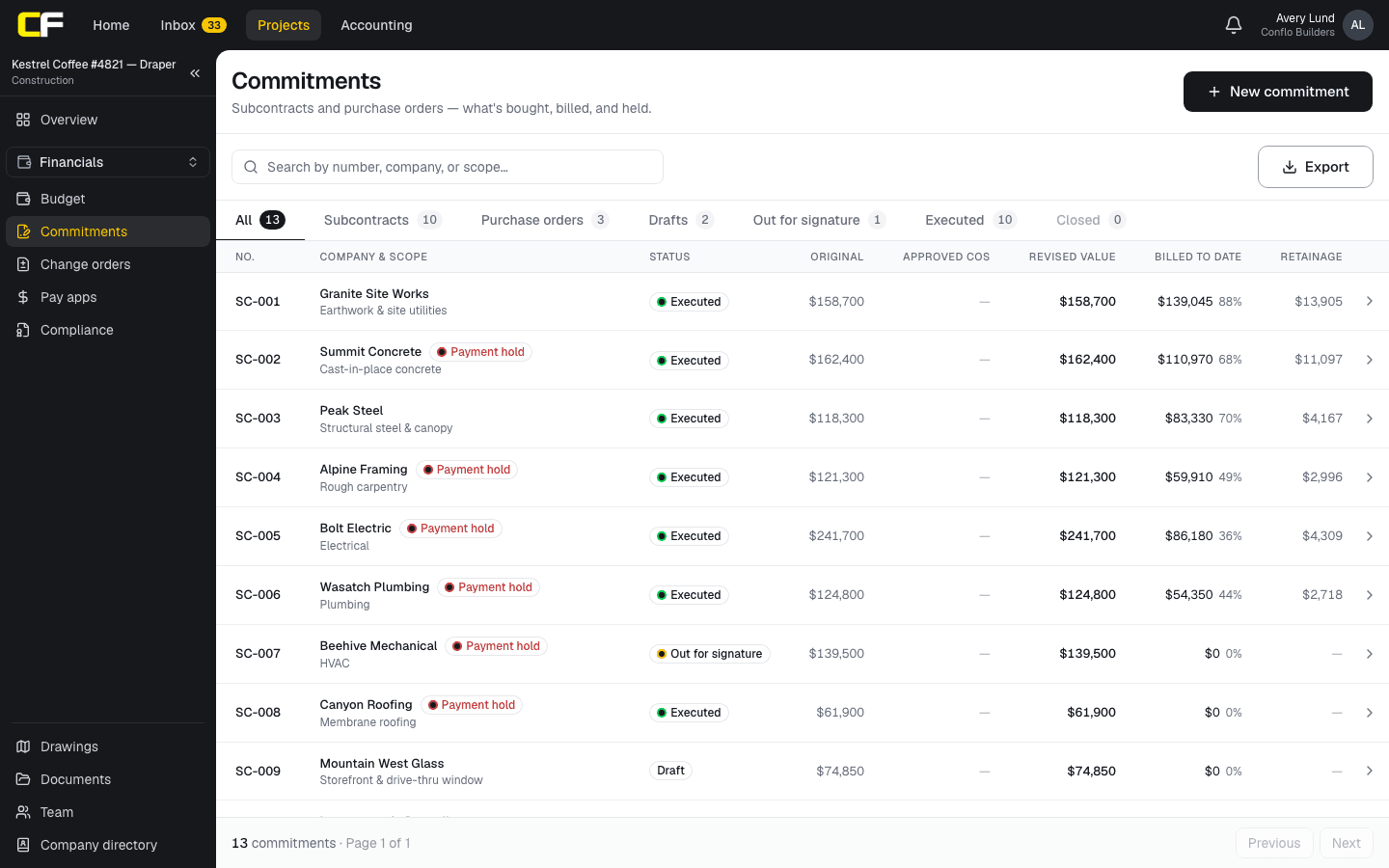
In Conflo, a purchase order is a commitment, numbered on its own sequence (PO-001, PO-002) apart from subcontracts. You pick the vendor from the project's suppliers, give it a title and scope, set the delivery date, tax rate and ship-to address, and enter line items, each with a budget cost code, a description and an amount, so committed cost rolls into the budget. Save it as a draft or send it for signature, the same way as a subcontract.
Two limits worth knowing: line items are amounts by cost code, so the quantity and unit price go in the line's description, and Conflo records the tax rate on the PO rather than adding tax to the lines. Write the release and stored-materials terms into the scope.
The bottom line
A materials PO is short but specific: items by spec section and approved submittal, quantities and prices that add up, delivery and freight written out, release on approval only, stored-material conditions and the cost code.
Write those once in your PO form, and every supplier invoice, delivery and stored-materials billing has something to check against.
Sources
- FAR 52.247-34, F.o.b. Destination — Acquisition.gov, U.S. General Services Administration. Read October 22, 2026.
- FAR 52.232-5, Payments under Fixed-Price Construction Contracts — Acquisition.gov, U.S. General Services Administration. Read October 22, 2026.
- UFGS 01 33 00 Submittal Procedures (August 2026), §1.12.1 — Whole Building Design Guide, USACE / NAVFAC / AFCEC. Read October 22, 2026.
Questions
What is a purchase order in construction?
A general contractor's written order to a supplier for materials or equipment, with the items, quantities, prices, delivery terms and payment terms. Once the supplier accepts it, it is the contract for that material.
What is the difference between a purchase order and a subcontract?
A purchase order buys material that a supplier delivers; someone else installs it. A subcontract buys work performed on site, usually labor and material together, with its own scope, insurance and payment terms.
What does FOB jobsite mean on a purchase order?
Usually that the supplier pays freight to the jobsite and carries the risk of loss until delivery. Because suppliers read it differently, write it out on the PO: freight included, delivered to which gate, risk passes when your site contact signs the delivery ticket, and who unloads.
Should you issue a purchase order before the submittal is approved?
Yes, if lead times require it, but release fabrication only once the submittal is approved, and say so on the PO. Otherwise the supplier may build material that is later rejected.
Related
Preconstruction
How Do You Buy Out a Construction Job?
Construction buyout step by step: scope review, leveling, award, the subcontract and its exhibits, compliance documents, and savings against budget.
· 7 min read
Preconstruction
What Should a Subcontract Agreement Include?
The clauses a construction subcontract agreement needs, what to check in each, how terms flow down from the prime contract, and a worked example.
· 8 min read
Construction
How Does a Subcontractor Prepare a Submittal?
How a subcontractor prepares a submittal the GC and architect can approve the first time: what to include, how to mark it up, deviations, and resubmittals.
· 9 min read
Construction
How Do Architects and Engineers Review a Submittal?
How the design team reviews a submittal: what the review covers and what it doesn't, choosing the review code, writing comments, and returning it on time.
· 8 min read
Role hub
The General Contractor's Guide: Bid to Closeout
What a general contractor is responsible for at every phase of a commercial job, from bidding and buyout to RFIs, change orders, pay apps and closeout.
· 8 min read