
How Do You Forecast Cost to Complete on a Job?
By Wyatt Cooper · Published · 6 min read
Key takeaways
- Cost to complete is what you still expect to spend on a line; projected final cost is actual cost to date plus cost to complete.
- Forecast each line by how it is bought: subcontracted lines from the unbilled commitment plus pending changes, self-performed lines from the production rate so far, and time-based lines from the current schedule.
- Never forecast by subtracting actual cost from the budget: that assumes the rest of the line will go exactly to plan.
- In the worked example, five lines with $1,285,300 spent and $706,000 to go project $1,991,300 against a $1,963,000 budget: $28,300 over.
To forecast cost to complete, take each cost code and estimate what is still to be spent, not what is left in the budget. For subcontracted work, that is the unbilled part of the commitment plus pending changes. For your own crews, divide cost to date by percent complete. For time-based costs like supervision, multiply the weekly cost by the weeks left on the current schedule. Actual cost plus cost to complete is the projected final.
Budget remaining is not cost to complete
The easy number is budget minus actual cost: what is left to spend. It tells you nothing about whether the rest of the work fits in it. Cost to complete is a forecast: what the remaining work will really cost, given what you know today about contracts, productivity and the schedule.
Federal cost guidance puts it the same way: to project future performance you need "the actual costs spent on completed work, and the expected cost of remaining work", and the estimate at completion "should take into account performance to date" (GAO-20-195G). Its bottom-up estimate at completion also asks you to "assess commitment values for material needed to complete remaining work": on a construction job, that is your signed subcontracts and purchase orders. Committed cost per line is covered in tracking a budget against commitments.
Forecast each line by how it is bought
| Kind of line | Cost to complete | Watch for |
|---|---|---|
| Subcontracted, signed | Commitment − billed to date + pending change orders you expect to approve | Scope the sub excluded that someone still has to do |
| Not bought out yet | Your best current number: the leveled low bid, else the budget | Plugs never tested by a bid |
| Self-performed labor | Cost to date ÷ percent complete − cost to date | Percent complete measured in quantities installed, not hours spent |
| Time-based (supervision, trailer, rentals) | Weekly or monthly rate × time left on the current schedule | A schedule slip adds cost even when no work changes |
| Material bought direct | Open purchase orders + the quantities still to buy at today's price | Price escalation on the part not yet ordered |
The monthly forecast, step by step
- 1Project accountantCloses the month's actual cost by cost code: sub billings, invoices and payroll
- 2SuperintendentReports percent complete on self-performed work from installed quantities
- 3Project managerUpdates the schedule's finish date and the open and pending change orders
- 4Project managerForecasts cost to complete on each line by the rule for its kind
- 5Project executiveReviews projected final against the budget and the lines that moved since last month
A worked example: week 18 on a fictional medical office
The job is fictional: the same "Juniper Street Medical Office" as the commitments example, 18 weeks into construction. Concrete is finished. The steel sub has a pending $4,800 change the PM expects to approve. The GC's carpenters are 60% complete by installed quantity. The schedule, planned at 30 weeks, now forecasts 33, and the GC's site staff cost $9,600 a week.
| Cost code | Revised budget | Actual to date | Cost to complete | Projected final | Variance |
|---|---|---|---|---|---|
| 01 31 00 Site staff (time-based) | $288,000 | $172,800 | $144,000 (15 weeks × $9,600) | $316,800 | −$28,800 |
| 03 30 00 Concrete (sub, complete) | $412,000 | $398,500 | $0 | $398,500 | +$13,500 |
| 05 12 00 Steel (sub) | $655,000 | $503,400 | $172,600 ($671,200 − $503,400 + $4,800) | $676,000 | −$21,000 |
| 06 10 00 Rough carpentry (own crews) | $96,000 | $61,200 | $40,800 ($61,200 ÷ 0.60 − $61,200) | $102,000 | −$6,000 |
| 26 00 00 Electrical (sub) | $512,000 | $149,400 | $348,600 ($498,000 − $149,400) | $498,000 | +$14,000 |
| Total | $1,963,000 | $1,285,300 | $706,000 | $1,991,300 | −$28,300 |
Site staff ran 18 weeks at $9,600 ($172,800); 15 weeks remain on the 33-week forecast, so $144,000 is still to come, and the three-week slip alone is the $28,800 overrun. Carpentry spent $61,200 for 60% of the work, so the whole line runs $102,000 at the same rate. Totals check both ways: $1,285,300 + $706,000 = $1,991,300, and $1,963,000 − $1,991,300 = −$28,300, the same as +$13,500 − $21,000 − $6,000 − $28,800 + $14,000.
Budget minus actual would have said $677,700 was left ($1,963,000 − $1,285,300) and the job was fine. The forecast says the remaining work needs $706,000, and two of the three problems, the schedule and the crew's production rate, show up nowhere in the contracts.
Mistakes that make a forecast look better than it is
- Forecasting time-based lines on the baseline schedule after the finish date has moved.
- Measuring percent complete by hours spent instead of quantities installed, which hides a slow crew.
- Leaving pending change orders out until they are signed, then finding them all at once.
- Netting a savings on one line against an overrun on another and reporting only the total.
- Not escalating material still to be bought. GSA's estimating policy describes escalation as "a contingency to address future cost increases due to: Market inflation and cost increases".
The GSA quote is from its P-120 cost and schedule policy. For an earned-value version of the same forecast on one trade, see how to use earned value on a construction job; the general conditions behind the site-staff line are priced in how to price general conditions. More for GCs is in the general contractor's guide.
How it works in Conflo
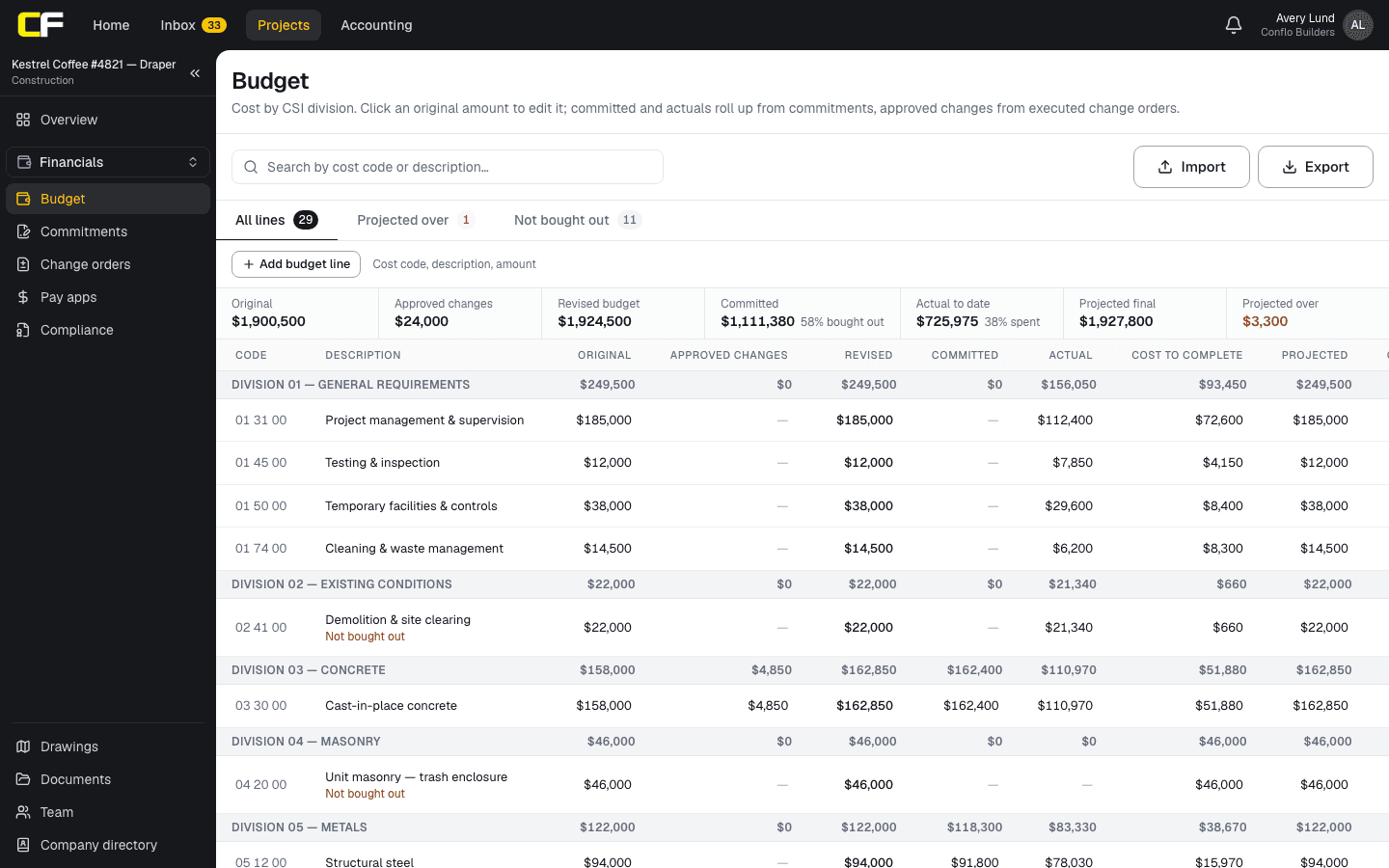
Conflo's Budget shows actual to date, cost to complete and projected cost on every cost code, division and the whole job. Actual cost is the GC's direct costs plus sub billings from executed commitments. Projected cost is the highest of the revised budget, committed cost and actual cost, and cost to complete is projected minus actual, so a line never looks cheaper than what is already signed or spent.
That projected number is a floor, not the forecast above: Conflo does not know your crew's production rate or a schedule slip, so the PM's adjustments for those are still the PM's. The summary strip shows actual cost with percent spent, projected final, and the amount projected over budget; a Projected over tab lists the lines that are over.
The bottom line
Cost to complete is a forecast of the remaining work, line by line, by how each line is bought: commitments for subs, production rates for your crews, and the current schedule for time-based costs.
Do it every month, before the owner's pay app goes out. Budget minus actual only tells you what is left; the forecast tells you whether it is enough.
Sources
- GAO-20-195G, Cost Estimating and Assessment Guide (March 2020), Chapter 19: Earned Value Management: Execution — U.S. Government Accountability Office. Read October 22, 2026.
- P-120, Public Buildings Service Cost and Schedule Management Policy Requirements (PBS 1000.6B, November 7, 2022) — U.S. General Services Administration (via WBDG). Read October 22, 2026.
Questions
What is the difference between cost to complete and projected final cost?
Cost to complete is what is still to be spent on a line. Projected final cost, sometimes called estimate at completion, is actual cost to date plus cost to complete.
How do you forecast self-performed work?
Divide cost to date by percent complete measured in installed quantities, then subtract cost to date. $61,200 spent at 60% complete forecasts a $102,000 line, so $40,800 to go.
Does a schedule delay change cost to complete?
Yes, on every time-based line: supervision, the site office, temporary utilities and rented equipment. Multiply each weekly or monthly rate by the time added.
How often should you forecast cost to complete?
Monthly, after actual cost for the month is closed and before the pay app goes out, and whenever a large change or delay comes up.
Related
Money
How Do You Track a Budget Against Commitments?
Track a construction budget against committed cost by cost code: revised budget, signed commitments, buyout variance and exposure, with a worked table.
· 7 min read
Money
How Do You Use Earned Value on a Construction Job?
Earned value on a construction job, worked on one trade: planned value, earned value, actual cost, CPI, SPI and estimate at completion.
· 6 min read
Bidding
How Do You Price General Conditions?
Price general conditions from the schedule: staff by the weeks on site, facilities by the month, fixed items as lump sums, and a weekly delay rate.
· 7 min read
Money
How Should an Owner Read a GC's Cost Report?
Read a GC's monthly cost report on a GMP or cost-plus job: current budget, projected final, contingency drawdown and the questions to ask.
· 7 min read
Role hub
The General Contractor's Guide: Bid to Closeout
What a general contractor is responsible for at every phase of a commercial job, from bidding and buyout to RFIs, change orders, pay apps and closeout.
· 8 min read