
How Do You Price General Conditions?
By Wyatt Cooper · Published · 7 min read
Key takeaways
- Price general conditions from the schedule, not as a percentage: each person and each rental for the weeks or months it is really on the job.
- Split time-based items (staff, trailer, temporary utilities, rentals) from fixed ones (final cleaning, a builder's risk policy), because only the time-based ones grow with a delay.
- Check that nothing is in both general conditions and a subcontractor's scope, such as temporary power or cleanup.
- In the worked example, a 40-week job carries $587,200 of general conditions, $535,700 of it time-based, and a delay at the end costs $10,912.50 a week, not the $14,680 average.
To price general conditions, lay the schedule out week by week and price each item for the time it is on the job: the superintendent for every week on site, the project manager at their share of time, assistants only for the busy stretch, the trailer, toilets and temporary power by the month, and dumpsters by the pull. Price fixed items as lump sums. Total it, then work out what one extra week at the end costs.
Build them up from the schedule
General conditions are the GC's cost of running the job site that no trade's scope covers. The definition is in what general conditions are; this post prices them. GSA's estimating policy lists what field requirements and office overhead and profit include, from "Management, supervision, and field engineering" and "Temporary construction" to "Maintenance and housekeeping", and says they "can be estimated as a percentage allowance or by using detailed cost build-up" (GSA P-120).
A percentage is fine for a budget before the design is done. For a bid, build them up: most general conditions cost is time, so the schedule is the quantity. Two jobs of the same value can carry very different general conditions if one runs 30 weeks and the other 50.
Steps to price them
- Start from the bid schedule: mobilization, the major phases and substantial completion. See how to read a construction schedule.
- Staff the job: for each person, the weeks on site and their share of time. Price at the loaded weekly cost of each person, not the base salary.
- Price temporary facilities by the month: site office, toilets, temporary power and water, fencing, and their removal.
- Price site services by the unit: dumpsters by the pull, progressive cleaning by the week, final cleaning as a lump sum.
- Price equipment the GC provides for everyone (a telehandler, a hoist) by the month it is needed.
- Add insurance, bonds and permits only where the contract puts them on the GC and they are not in your markups.
- Check each item against the subcontract scopes, so temporary power, hoisting or cleanup is not in both places.
- Total it, split time-based from fixed, and work out the weekly cost of the last weeks of the job.
The no-double-counting rule is old. The federal cost principles say no cost may be charged indirectly "if other costs incurred for the same purpose, in like circumstances, have been included as a direct cost" (FAR 31.203(b)). On a bid, the same logic keeps a cost in one place: general conditions, a sub's scope or your overhead, never two.
A worked example: a fictional 40-week office building
The job is fictional: a three-story office with a 40-week schedule. The superintendent is on site from a week before mobilization to a week after substantial completion; the assistant superintendent covers the busy weeks 10 to 34; the project manager spends half their time on the job.
| Category | Item | Quantity × rate | Amount | Time-based? |
|---|---|---|---|---|
| Supervision and staff | Superintendent | 42 weeks × $4,400 | $184,800 | Yes |
| Supervision and staff | Project manager, half time | 20 weeks × $4,200 | $84,000 | Yes |
| Supervision and staff | Project engineer | 36 weeks × $2,600 | $93,600 | Yes |
| Supervision and staff | Assistant superintendent | 25 weeks × $3,000 | $75,000 | Yes |
| Temporary facilities | Site office trailer | 10 months × $1,250 | $12,500 | Yes |
| Temporary facilities | Temporary toilets | 10 months × $600 | $6,000 | Yes |
| Temporary facilities | Temporary power and usage | 9 months × $1,800 | $16,200 | Yes |
| Site services | Progressive cleaning labor | 36 weeks × $900 | $32,400 | Yes |
| Site services | Dumpsters | 30 pulls × $650 | $19,500 | No: by quantity |
| Site services | Final cleaning | Lump sum | $14,000 | No |
| Equipment | Telehandler | 6 months × $5,200 | $31,200 | Yes |
| Insurance and permits | Builder's risk (if the contract puts it on the GC) | Lump sum | $18,000 | No |
| Total | $587,200 | $535,700 time-based |
Staff add up to $184,800 + $84,000 + $93,600 + $75,000 = $437,400; temporary facilities to $12,500 + $6,000 + $16,200 = $34,700; site services to $32,400 + $19,500 + $14,000 = $65,900. With $31,200 of equipment and $18,000 of insurance, the total is $587,200, or $14,680 per week of schedule ($587,200 ÷ 40). The time-based part is $587,200 − $19,500 − $14,000 − $18,000 = $535,700.
Weekly extension rate: two weeks added at the end
- Superintendent
- 2 weeks × $4,400 = $8,800
- Project manager, half time
- 2 weeks × 0.5 × $4,200 = $4,200
- Project engineer
- 2 weeks × $2,600 = $5,200
- Assistant superintendent
- Already off the job: $0
- Trailer, toilets and power
- Half a month × ($1,250 + $600 + $1,800) = $1,825
- Progressive cleaning
- 2 weeks × $900 = $1,800
- Telehandler
- Already off-rented: $0
- Two weeks
- $8,800 + $4,200 + $5,200 + $1,825 + $1,800 = $21,825
- Per week
- $21,825 ÷ 2 = $10,912.50
That is the number to use when a delay is priced, not the $14,680 average: the end of a job is leaner than its middle. A delay in the middle, with the assistant superintendent and the telehandler still on site, costs more per week than either.
Mistakes that leave money out
- Staffing every person for the full schedule, or only for the construction weeks and not preconstruction and closeout.
- Pricing staff at base salary instead of their loaded cost (taxes, insurance, benefits and a vehicle).
- Forgetting the removal of temporary facilities and the last month's rent.
- Carrying temporary power or cleanup that the electrical or a finish sub already carries.
- Using an average weekly rate to price a delay that happens at a different stage of the job.
Home-office overhead and profit come after general conditions; see how much overhead and profit a GC should carry. How general conditions fit into the whole bid is in how to build an estimate from sub bids, and the rest of the GC's path in the general contractor's guide.
How it works in Conflo
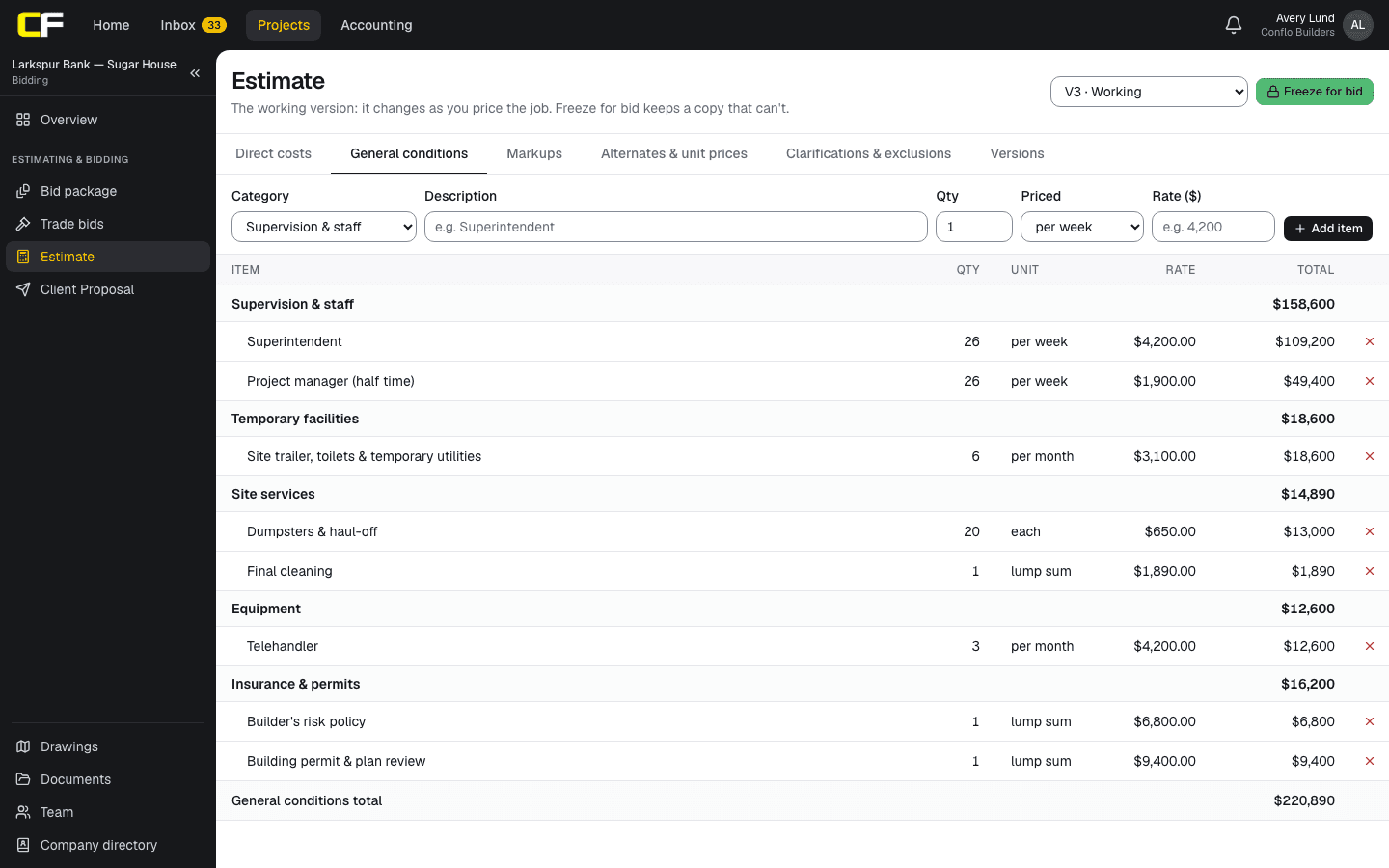
In Conflo's Estimate, general conditions have their own tab. Each row is a category, description, quantity, unit and rate, priced per week, per month, each or as a lump sum, and grouped into supervision and staff, temporary facilities, site services, equipment, insurance and permits, and other, with a subtotal for each group and a general conditions total.
The markups then show direct cost, general conditions and their sum as cost, before contingency, fee and the rest are applied in the order you set. The estimate is visible only to the general contractor.
The bottom line
General conditions are mostly the cost of time. Price each person and each rental for the weeks or months it is on the job, keep fixed items apart, and check nothing is also in a sub's scope.
Then work out the weekly cost at the end of the job. When the schedule moves, that is the number you will need.
Sources
- P-120, Public Buildings Service Cost and Schedule Management Policy Requirements (PBS 1000.6B, November 7, 2022), 3.5 GSA Cost Estimate Elements — U.S. General Services Administration (via WBDG). Read October 22, 2026.
- FAR 31.203, Indirect costs — Acquisition.gov, U.S. General Services Administration. Read October 22, 2026.
Questions
Should general conditions be priced as a percentage?
For an early budget, a percentage from your own past jobs is acceptable. For a bid, build them up from the schedule, because they depend on time more than on the value of the work.
What is the difference between general conditions and overhead?
General conditions are the cost of running this job's site: its staff, facilities and services. Home-office overhead is the cost of running the company, spread across all jobs and carried in the markup.
How do you price general conditions for a delay?
Price the items still on the job at the time of the delay, for the time added. At the end of a job that is usually fewer people and rentals than the average week.
Are insurance and bonds part of general conditions?
Sometimes. Many GCs carry them as markups on the total price instead, because the premium depends on the contract value. Put each in one place only, as your contract defines it.
Related
Definition
What Are General Conditions in a Construction Bid?
General conditions in a bid are the contractor's cost of running the job: supervision, temporary facilities, site services. Not the A201 contract document.
· 4 min read
Bidding
How Much Overhead and Profit Should a GC Carry?
Work out a GC's overhead and profit from its own books: home-office overhead over annual volume, plus target profit, turned into the markup a bid needs.
· 6 min read
Bidding
How Do You Build an Estimate From Sub Bids?
Build a GC estimate from sub bids: plug each division, carry the leveled bid in place of the plug, add your own work and general conditions, then markups.
· 7 min read
Money
How Do You Forecast Cost to Complete on a Job?
Forecast cost to complete line by line: remaining commitments, self-performed work at its real production rate, and time-based costs against the schedule.
· 6 min read
Role hub
The General Contractor's Guide: Bid to Closeout
What a general contractor is responsible for at every phase of a commercial job, from bidding and buyout to RFIs, change orders, pay apps and closeout.
· 8 min read