
How Does a GC Review a Subcontractor's Pay App?
By Wyatt Cooper · Published · 7 min read
Key takeaways
- Review a sub's pay app line by line against what is in place in the field, not against the sub's percentages or the calendar.
- Stored materials need backup (invoices, photos, insurance or title documents as the subcontract asks), and only approved change orders belong on the bill.
- In the example below, three corrections take a $72,270.00 request down to $28,080.00 due, and every dollar of the difference is explained line by line.
- Collect the lien waivers the subcontract requires before you pay, and know your payment deadline: federal prompt-payment rules and many states give you days, not weeks, after you are paid.
To review a subcontractor's pay app, compare each schedule-of-values line's percent complete with what is actually installed, check stored materials against invoices and the subcontract's storage rules, and remove any change order that isn't approved. Then check the math: retainage at the subcontract's rate, previous payments matching what you paid, and nothing over 100%. Confirm the required lien waivers and compliance documents, approve or send back the lines that are wrong with a reason, and roll the approved amount into your owner billing.
Know what you are certifying before you start
When you put a sub's billing into your own pay application, you vouch for it to the owner. On federal jobs that is literal: with each payment request, the prime contractor certifies that "the amounts requested are only for performance in accordance with the specifications, terms, and conditions of the contract", that subs have been paid from earlier payments, and that the request doesn't include amounts it intends to withhold or retain from a sub (FAR 52.232-5). Private contracts say something similar in the GC's certification on the application.
So a sub's pay app is not a bill to pass along. It is a claim you check, line by line, before your name goes on it.
The review checklist, line by line
| Check | Compare against | Common problem |
|---|---|---|
| Percent complete per line | A site walk, the daily logs, the superintendent's own estimate | Billing ahead of the work, especially on rough-in lines |
| Stored materials | Invoices, delivery tickets, photos, insurance or title documents the subcontract requires | Material billed that isn't on site or has no backup |
| Change orders | Executed change orders only | Pending or verbal changes billed as if approved |
| Schedule of values | The approved schedule of values | Lines renamed, merged or revalued |
| Previous billing | Your last approved version of their pay app | "From previous" not matching what you approved last month |
| Retainage | The subcontract's rate and any reduction you approved | Wrong rate, or retainage left off stored materials |
| Lien waivers | The waivers the subcontract requires | No conditional waiver for this period, no unconditional for the last payment |
| Compliance | Insurance certificates, licenses and payroll reports the job requires | Expired insurance holding up payment |
Owners often ask the same of you: one university's payment specification wants waivers from subcontractors and suppliers with each application for the previous period, net of retainage, and paid invoices behind stored materials (University of Houston, Section 01 29 00). If your owner will ask, ask your subs first.
A worked review: an electrical pay app
A fictional electrical subcontractor, "Brightwire Electric", submits pay app 4 on a $310,000.00 subcontract with 10% retainage. Its previous payments are correct. This period it bills four items:
| Item | Requested this period | After review | Why |
|---|---|---|---|
| Branch rough-in ($96,000.00 line; 40% billed before) | $33,600.00 (to 75%) | $19,200.00 (to 60%) | Site walk: second floor not started |
| Switchgear stored on site | $28,500.00 | $0.00 | No invoice or delivery ticket yet |
| Lighting fixture installation | $12,000.00 | $12,000.00 | Matches the field |
| CO-03, added receptacles | $6,200.00 | $0.00 | Change order still pending |
| Total this period | $80,300.00 | $31,200.00 | |
| Less 10% retainage | −$8,030.00 | −$3,120.00 | |
| Due this period | $72,270.00 | $28,080.00 |
The arithmetic: 75% of $96,000.00 is $72,000.00, less $38,400.00 billed before, is $33,600.00; 60% is $57,600.00, less $38,400.00, is $19,200.00. Requested: $33,600.00 + $28,500.00 + $12,000.00 + $6,200.00 = $80,300.00, less $8,030.00 retainage, is $72,270.00. After review: $19,200.00 + $12,000.00 = $31,200.00, less $3,120.00, is $28,080.00. The difference, $44,190.00, is 90% of the $49,100.00 removed ($14,400.00 + $28,500.00 + $6,200.00).
- 1SubcontractorSubmits pay app 4 with a conditional lien waiver
- 2GC project managerSends back the rough-in, switchgear and CO-03 lines with a note on each
- 3SubcontractorRevises to 60%, attaches the switchgear invoice next month, resubmits
- 4GCApproves and carries the approved amount into the owner pay application
- 5OwnerPays the GC; the GC pays the sub's share by the contract's or statute's deadline
Write the reason on each line you change. It saves a phone call, and it is the record if the sub disputes it later.
Pay on time, and say in writing what you hold back
Your review has a deadline at the other end. On federal construction, subcontracts must require the prime to pay subs for satisfactory performance "within 7 days out of such amounts as are paid to the prime contractor", and a prime that withholds for deficient performance must give written notice saying how much and why (31 U.S.C. § 3905). On private work in Texas, a contractor paid by the owner must pay each sub its share no later than the seventh day after receiving the payment (Texas Property Code § 28.002); other states set their own periods.
Hold back only what the subcontract lets you hold, for the reason it lets you hold it, and tell the sub in writing. For the sub's side of the same pay app, see how a subcontractor fills out a pay application; for the arithmetic of the retainage line, how to calculate retainage.
How it works in Conflo
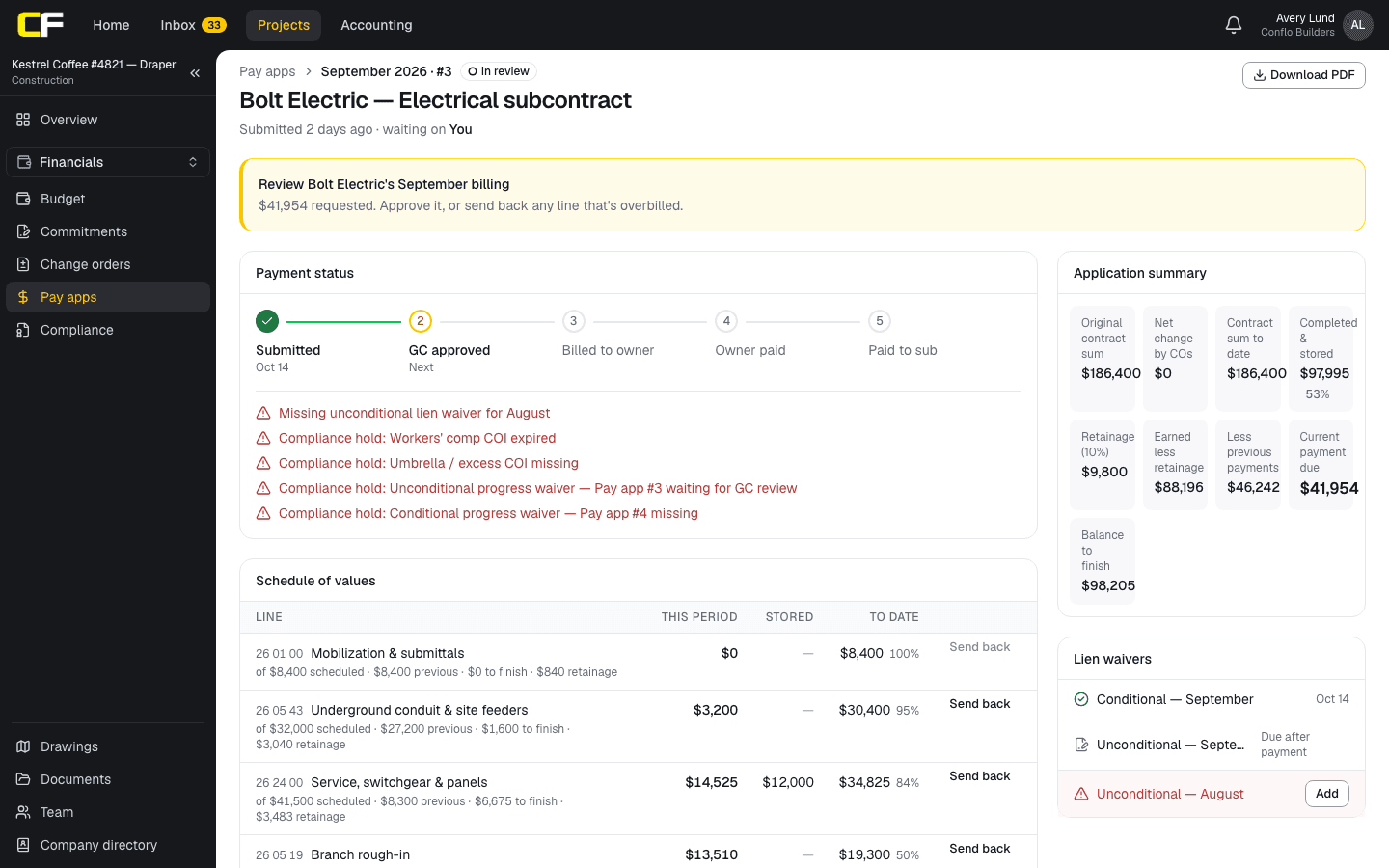
On Conflo's pay apps, a sub's pay app comes to the GC for review with the summary, the schedule of values line by line and the payment steps from submitted to paid to the sub. The GC approves it, or sends back only the lines that are wrong, each with a note on what to fix; the sub revises and resubmits. Missing lien waivers and compliance holds are listed on the pay app by name, and releasing payment needs the conditional waiver for this period and the unconditional waiver for the last payment. Approved sub pay apps roll into the matching lines of the GC's owner pay app.
What it doesn't do: the GC can't edit a sub's figures directly (it sends lines back), and stored materials are an amount per line: invoices and photos go in the pay app's files, not against the line.
The bottom line
A good review is quick because it is routine: walk the work, check the backup, strike what isn't approved, check the math and the waivers, and write down why. The sub gets a clear answer, and your owner billing holds up.
Set the routine before the first billing: tell every sub what backup you need, which waivers, and the day of the month their pay app is due.
Sources
- FAR 52.232-5, Payments under Fixed-Price Construction Contracts — Acquisition.gov, U.S. General Services Administration. Read October 16, 2026.
- 31 U.S.C. § 3905, Payment provisions relating to construction contracts — U.S. Government Publishing Office (govinfo), United States Code, 2023 edition. Read October 17, 2026.
- Texas Property Code Chapter 28, Prompt Payment to Contractors and Subcontractors — Texas Legislature. Read October 16, 2026.
- Section 01 29 00, Payment Procedures (master construction specification) — University of Houston, Facilities Planning and Construction. Read October 16, 2026.
Questions
What should a GC check on a subcontractor pay application?
Each line's percent complete against the field, stored materials against backup, change orders against what is executed, previous billing against last month's approved figures, retainage at the subcontract's rate, and the lien waivers and compliance documents the subcontract requires.
Can a GC reduce a subcontractor's pay app?
Usually, for work not in place, unsupported stored materials, unapproved changes or other reasons the subcontract allows. Explain each change in writing. Federal subcontracts require written notice of any withholding for deficient performance.
How fast must a GC pay a subcontractor?
It depends on the job. Federal construction requires payment within 7 days of the prime being paid. Texas private work also says 7 days after the contractor receives the owner's payment. Other states and subcontracts set their own periods.
Should stored materials be paid on a sub's pay app?
If the subcontract allows it and the backup is there: invoices, delivery proof, and any insurance, title or storage conditions the contract sets. Without backup, many GCs leave the line for next month.
Related
Money
How Does a Subcontractor Fill Out a Pay Application?
A subcontractor's pay app bills percent complete and stored materials per schedule-of-values line, less retainage and prior payments, with a lien waiver.
· 9 min read
Money
How Should an Owner Review a GC's Pay Application?
An owner's checklist for a contractor's pay application: work in place, stored materials, change orders, retainage, waivers and the math. With an example.
· 6 min read
Money
How Do You Calculate Retainage on a Pay App?
Retainage is a percentage of work completed and stored to date, held back each pay period. How to calculate it, reduce it, release it, with an example.
· 9 min read
Definition
What Is a Pay Application in Construction?
A pay application is a contractor's monthly request for payment against the schedule of values, less retainage and earlier payments. With an example.
· 3 min read
Role hub
The General Contractor's Guide: Bid to Closeout
What a general contractor is responsible for at every phase of a commercial job, from bidding and buyout to RFIs, change orders, pay apps and closeout.
· 8 min read