
How Do You Send an Invitation to Bid to Subs?
By Wyatt Cooper · Published · 7 min read
Key takeaways
- An invitation to bid (ITB) tells a subcontractor what to price, from which documents, by when, and in what form, so every bid that comes back can be compared line by line.
- Send it to subs who perform that trade, early enough to price it, with the scope items, alternates, bid form, bond and insurance requirements and the questions deadline in the invitation itself.
- Answer every question for all bidders at once, and issue anything that changes the price as a numbered addendum to everyone invited.
- Federal rules are a useful checklist even on private work: construction invitations are expected to state the project's size, the period of performance, site visit and pre-bid conference details and any special qualifications.
To send an invitation to bid, write one per trade package with the project, the scope and its numbered items, the drawings, specifications and addenda it covers, alternates to price, the bid due date and time, the questions deadline, site visit details, bond and insurance requirements and the bid form you want back. Send it to subcontractors who perform that trade, track who views, declines and submits, answer questions for all bidders, and issue changes as numbered addenda.
An invitation to bid asks every sub the same question
An invitation to bid (ITB), sometimes called a request for bid, is the general contractor's ask to subcontractors: price this package, from these documents, by this time, in this form. Its job is to make the bids comparable, so it carries the package's scope of work and goes out once you have split the job into bid packages. If two subs read different drawings, price different alternates or leave out different items, you spend the days after bid day guessing instead of leveling.
Public owners have formal versions. Federal sealed bids follow a uniform format, with sections for the description and specifications, deliveries or performance, special contract requirements, and instructions, conditions and notices to bidders (FAR 14.201-1). A GC's invitation to a sub is much shorter, but it needs the same core: what, from which documents, by when, and how to answer.
What to put in an invitation to bid
| Part | What to write | Why |
|---|---|---|
| Project and package | Project name and address, owner, the trade package and its number | The sub decides in seconds whether to look further |
| Bid due | Date, time and time zone; how bids are submitted | A deadline without a time zone invites a late bid argument |
| Scope | A short summary and the numbered scope items | The items become the rows you level against |
| Documents | Drawing set and date, specification sections, addenda issued so far | Every bidder prices the same documents |
| Alternates and unit prices | Each described well enough to price; add or deduct | Alternates come back priced the same way |
| Bid form | Base bid, breakouts wanted, alternates, exclusions, qualifications, addenda acknowledged | A bid in your format is faster to compare |
| Bonds and insurance | Bid bond, performance and payment bond, insurance limits required | A missing bond is a cost you otherwise have to plug |
| Site and meetings | Site visit arrangements and any pre-bid meeting | Bidders price conditions they have seen |
| Schedule | Expected start, duration, phasing and working hours | Time is part of the price |
| Questions | Where to ask and the last day to ask | Answers go to everyone, in time to price |
| Special requirements | Prevailing wage, licensing, prequalification or participation goals, if they apply | A bidder who cannot meet them should not spend time bidding |
Federal construction invitations are a good cross-check. They are expected to include, when applicable, the magnitude of the project, the period of performance, arrangements for bidders to inspect the site, information about the pre-bid conference, special qualification or experience requirements, and special instructions concerning bids, alternate bids and award (FAR 36.213-3).
A worked example: an electrical invitation on a fictional office
Invitation to bid: BP-12 Electrical, Coyle Avenue Office
- From
- Estimator, Fairbank Builders (general contractor)
- Project
- Coyle Avenue Office, a three-story steel-frame office building (fictional)
- Bids due
- Thursday, November 12, 2:00 PM Mountain Time, submitted online or by email to the estimator
- Scope
- Electrical, low-voltage and fire alarm per E-series drawings and Divisions 26, 27 and 28. Items: 1. Service and distribution. 2. Branch power and devices. 3. Lighting and controls. 4. Fire alarm. 5. Low-voltage rough-in. 6. Power to HVAC equipment. 7. Firestopping at own penetrations. 8. Temporary power.
- Not in this package
- Controls wiring (HVAC package); utility company fees (owner).
- Documents
- Drawings dated for bid; specification Divisions 26 to 28; Addendum 1.
- Alternates
- Alternate 1: generator transfer switch and connection (add). Alternate 2: LED feature lighting at the lobby (add).
- Bid form
- Base bid; a breakout for each numbered item if you can give one; alternates; exclusions and qualifications; addenda acknowledged.
- Bonds and insurance
- Performance and payment bond required on awards over $100,000; give the bond cost as a separate add. Insurance per the subcontract exhibit.
- Site visit
- Walk-throughs Tuesday, November 3, 9:00 AM, by appointment with the estimator.
- Questions
- Ask by Thursday, November 5. Answers go to all bidders; the last addendum, if any, goes out by Monday, November 9.
- Schedule
- Mobilize in February; about 30 weeks on site.
The dates leave the bidders time after the site walk and after the last addendum: nine days from the walk-through to bid day, and three days from the last possible addendum. The bond is asked for as a separate add, so a bidder who excludes it can still be leveled at its own price.
After you send it: questions, addenda and coverage
- Track coverage by package: who viewed the invitation, who said they will bid, who declined. A package with one committed bidder a week out needs more invitations now, not on bid day.
- Answer each question once, for everyone, without naming who asked. If the answer changes the price or the scope, it is an addendum, not an email.
- Number every addendum and send it to every invited bidder. Federal rules require amendments to go to everyone furnished the invitation before bid opening, and require the contracting officer to consider extending the bid date when little time remains (FAR 14.208). The same discipline keeps a private bid fair.
- Ask each bidder to acknowledge the latest addendum in its bid. A bid that does not has priced older documents.
- Remind the bidders who have not answered two or three days before the due date.
When the bids are in, level them against the same scope items the invitation listed.
How it works in Conflo
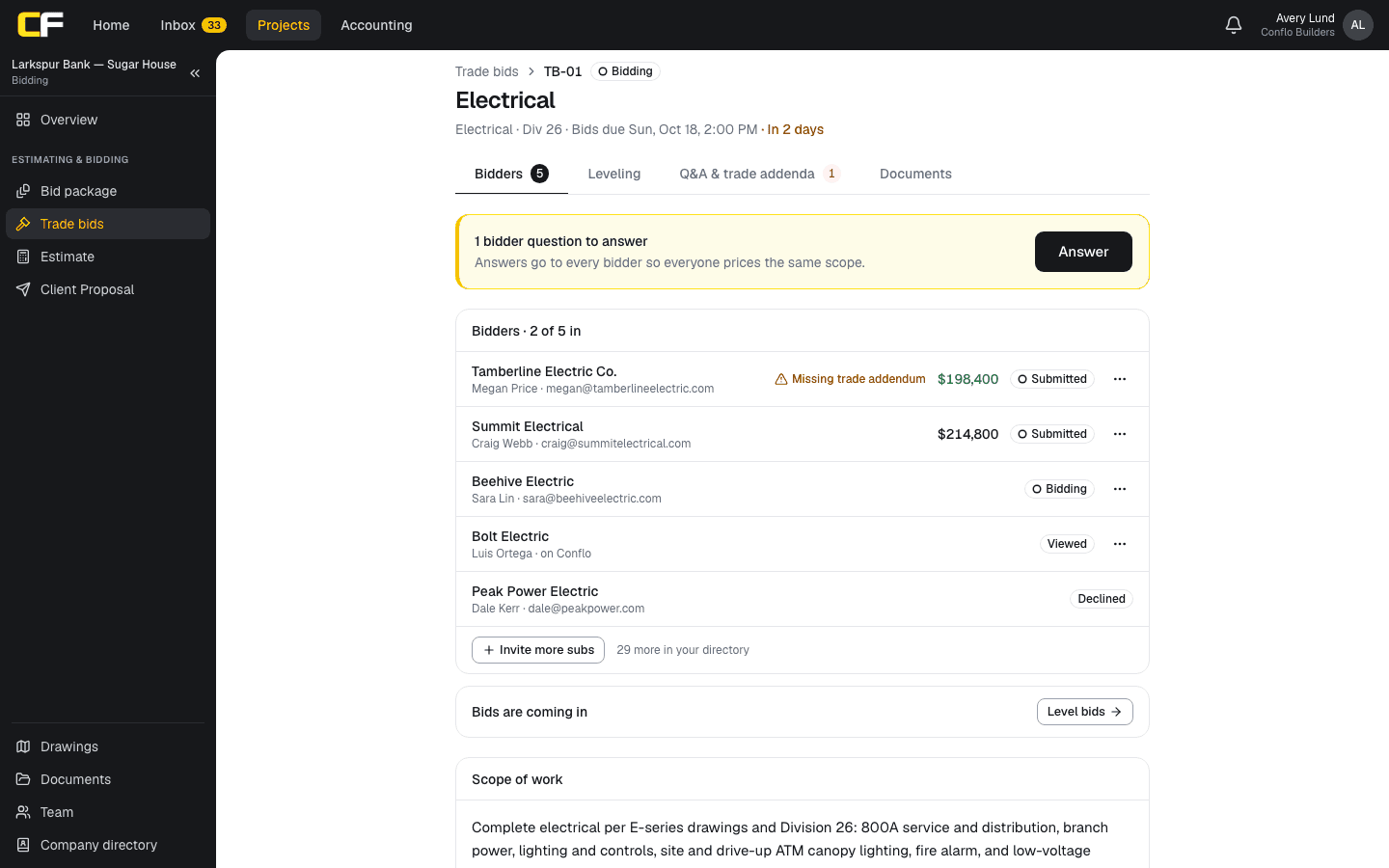
In Conflo, you send the invitation from the trade bid itself: pick bidders from your directory (the subs in that trade are listed first) and send. Each bidder gets an email from you via Conflo whose subject names your company, the trade, the project and the due date, with the scope items and the number of alternates to price, and a link to the invitation. A sub who is not on the project yet gets a one-time link that sets up a free Conflo account; a contact with no email address can still be listed, and you enter their bid for them.
The Bidders tab shows each invitation as invited, viewed, bidding, declined or submitted. Bidders ask questions on the invitation and your answer is shared with every bidder without the asker's name. Trade addenda are numbered, emailed to every bidder, and must be acknowledged before a sub can submit; you can remind those who have not.
The bottom line
A good invitation to bid is mostly specifics: the numbered scope, the exact documents, the due time with its time zone, the bid form and the bond. Every one you leave vague comes back as a difference between bids you have to price yourself.
Send it early to subs who do the work, answer questions for everyone, and number every addendum. Bid day is then a comparison, not a scramble.
Sources
- FAR 36.213-3, Invitations for bids — Acquisition.gov, U.S. General Services Administration. Read October 16, 2026.
- FAR 14.201-1, Uniform contract format — Acquisition.gov, U.S. General Services Administration. Read October 16, 2026.
- FAR 14.208, Amendment of invitation for bids — Acquisition.gov, U.S. General Services Administration. Read October 16, 2026.
Questions
What should an invitation to bid include?
The project and package, the bid due date and time with its time zone, the scope and its numbered items, the drawings, specifications and addenda it covers, alternates, the bid form you want back, bond and insurance requirements, site visit and meeting details, the schedule, the questions deadline and any special requirements such as prevailing wage.
How far ahead should you send an invitation to bid?
Early enough for subs to walk the site, ask their questions, get the answers and price the work after the last addendum, with more time for large or complex packages. Work back from the due date: last addendum, questions deadline, site walk. Federal construction rules call for enough time to give bidders an adequate opportunity to prepare and submit bids.
Is an invitation to bid the same as a request for proposal?
Not quite. An invitation to bid asks for a price on a defined scope, compared mainly on price. A request for proposal usually asks for a price and other information, such as approach, team and schedule, and is evaluated on several factors.
How do you handle questions from bidders?
Take them in one place, answer each once for all bidders without naming who asked, and set a last day for questions. Anything that changes the scope or price goes out as a numbered addendum every bidder must acknowledge.
Related
Bidding
How Do You Break a Job Into Bid Packages?
Split a job into bid packages by trade: start from the CSI divisions, group what one kind of sub performs, and give every boundary item one home.
· 7 min read
Bidding
How to Write a Scope of Work for a Subcontractor
Write a subcontractor scope of work from the drawings and specs: a summary, numbered inclusions, named exclusions, alternates and the documents behind it.
· 7 min read
Bidding
How Do You Bid a GC's Job as a Subcontractor?
How a subcontractor bids commercial work for a GC: choosing jobs, reading the invitation, pricing, writing a bid the GC can level, and what comes after.
· 7 min read
Bidding
How Do You Write a Bid Addendum?
How a GC writes a bid addendum to trade bidders: what goes in it, how to word each change, when to send it, and how to collect acknowledgments.
· 8 min read
Bidding
How Do You Answer Bidder Questions During a Bid?
How a GC handles pre-bid questions from subs: one written channel, a question log, answers to every bidder, and when an answer must become an addendum.
· 7 min read
Role hub
The General Contractor's Guide: Bid to Closeout
What a general contractor is responsible for at every phase of a commercial job, from bidding and buyout to RFIs, change orders, pay apps and closeout.
· 8 min read