
How Do You Write a Bid Addendum?
By Wyatt Cooper · Published · 8 min read
Key takeaways
- An addendum is the only way to change bid documents before bids are due; a change mentioned in a meeting, a call or an email to one bidder is not one.
- Number it, date it, and list each change as its own item: which document, which paragraph or sheet, and exactly what it now says.
- Send it to every invited bidder with time left to price it, and say plainly whether the bid date moves.
- Ask every bidder to acknowledge it on the bid; a bid that does not has priced older documents and must be leveled or confirmed.
Write a bid addendum as a numbered, dated notice to every invited bidder that lists each change to the bid documents as its own item: which document or sheet changes, what it now says, and which revised drawings are attached. Add answers to questions that affect price, state whether the bid date changes, and tell bidders to acknowledge the addendum on their bid. Send it to everyone invited, early enough for them to price it before bids are due.
An addendum changes the documents everyone prices
A bid addendum is a written change to the bid documents issued before bids are due, so every bidder prices the same thing. A general contractor issues two kinds to its trade bidders: it passes on the owner's or architect's addenda to the drawings and specifications, and it writes its own for changes to a package, such as moving a scope item from one trade to another.
The federal rule for sealed bids sets the standard. Changes to quantity, specifications, delivery schedules or opening dates, or corrections to a defective or ambiguous invitation, are made by amendment, and "The fact that a change was mentioned at a pre-bid conference does not relieve the necessity for issuing an amendment." Amendments go, before bid opening, to everyone who received the invitation (FAR 14.208). A private GC is not bound by the FAR, but the same discipline keeps a bid fair and the bids comparable.
What goes in a bid addendum
| Part | What to write |
|---|---|
| Header | Addendum number, date, project, and the package or packages it applies to |
| Purpose | One line: what the addendum does ("revises the plumbing scope and reissues two sheets") |
| Specification changes | Section and paragraph, then Add, Delete or Revise to read, with the new wording in full |
| Drawing changes | Sheet number, title and new revision; reissued sheets attached, changes clouded |
| Package changes | Scope items added to or moved between packages, named on both sides |
| Clarifications | Answers to bidder questions that affect price or scope, written as statements, not as a reply to one bidder |
| Bid date | The bid date and time, changed or unchanged; say "unchanged" in words |
| Acknowledgment | How to acknowledge: on the bid form, by number and date |
| Attachments | Every attached sheet or section, listed, so a bidder can tell whether it has them all |
| Issued by | Name and company of the person issuing it |
Word each change so it can be read only one way
- One change per item, numbered within the addendum (2-1, 2-2, 2-3), so bidders and you can refer to it later.
- Name the exact place: Section 22 13 16, paragraph 2.3.B; sheet P-201. "See plumbing drawings" is not a location.
- Use Add, Delete or Revise to read, and give the full new text. A bidder should not have to infer the result from the old text and a description.
- Reissue changed sheets with a revision number and a cloud around each change. Narrative descriptions of a drawing change get read differently by different bidders.
- When a scope item moves between packages, issue it to both. Moving firestopping to the plumbing package means a deduct for the firestopping bidders and an add for the plumbers.
- Put price-affecting answers in the addendum, not only in a reply. If an answer changes what a bidder would price, it belongs here (see how to answer bidder questions).
A worked example: a plumbing trade addendum
Addendum 2: BP-15 Plumbing, Alder Court Clinic
- Issued
- Monday, February 8, by the senior estimator, Fairbank Builders (general contractor)
- Applies to
- BP-15 Plumbing; item 2-3 also applies to BP-07 Firestopping
- Purpose
- Adds two grease interceptors, clarifies water heater supply, moves plumbing firestopping into BP-15
- Item 2-1 (drawings)
- Sheet P-201, Lower Level Plumbing Plan, reissued as Revision 2 (attached): adds two grease interceptors at the kitchen, with connections, clouded.
- Item 2-2 (clarification)
- Water heaters WH-1 and WH-2 are furnished and installed by BP-15, per Section 22 34 00. The owner does not furnish them.
- Item 2-3 (package change)
- Firestopping at plumbing penetrations moves from BP-07 to BP-15. BP-07 bidders: deduct it. BP-15 bidders: include it, per Section 07 84 00.
- Bid date
- Unchanged: Thursday, February 11, 2:00 PM Mountain Time.
- Acknowledge
- List Addendum 2 and its date on your bid form. Bids that do not acknowledge it will be treated as not including it.
- Attachments
- Sheet P-201, Revision 2 (one sheet)
The dates matter. This addendum goes out three days before bids are due, and item 2-1 adds equipment that needs a supplier quote. The federal rule asks the contracting officer to "consider the period of time remaining until bid opening and the need to extend this period" before amending (FAR 14.208). If bidders tell you three days is not enough to price the interceptors, move the bid date in the addendum itself, or issue a short one that does.
Collect an acknowledgment from every bidder
Federal bidders must acknowledge each amendment: by signing and returning it, by identifying the amendment number and date on the bid form, by letter, or by fax or email where those bids are allowed, and the acknowledgment must be received by the time and at the place set for bids (FAR 52.214-3). A missing acknowledgment can be waived as a minor informality only if the bid clearly shows the bidder received the amendment, or the amendment has no effect or merely a negligible effect on price, quantity, quality or delivery (FAR 14.405).
Private bids work best on the same terms. Ask for each addendum by number on the bid form. When a bid comes in without the latest one, it priced older documents: ask the bidder to confirm in writing, or price the difference as a plug when you level the bids. Never assume an unacknowledged addendum is included.
Addenda are usually the last step after the invitation to bid and the package's scope of work. Once the subcontract is signed, changes are no longer addenda; they go through a change order.
How it works in Conflo
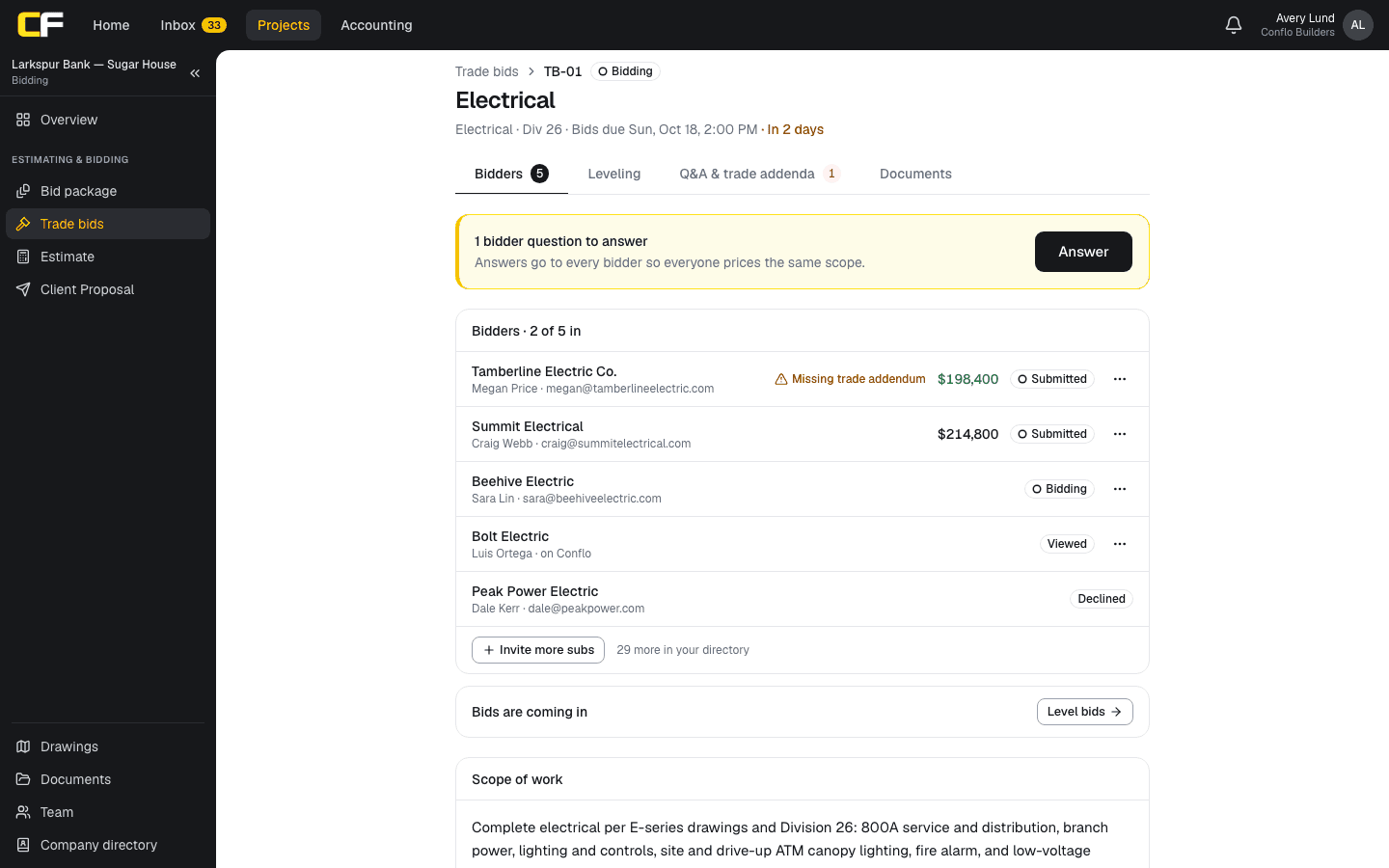
In Conflo, you issue a trade addendum from the Q&A and addenda tab of a trade bid, with a title and a description of what changed; Conflo numbers trade addenda in order on each trade bid. Once the trade bid is out, every bidder who has not declined and has an email address gets a short heads-up with the addendum number and title and a link, and acknowledges the addendum in Conflo. A bidder must acknowledge the latest trade addendum before submitting or updating a bid; one whose bid is already in is told the bid must cover it, and can still revise after the due date for that purpose only.
Under each addendum you see how many bidders have acknowledged it and who has not, with a Remind button for one bidder or all of them (at most one email per bidder per addendum a day). If a bidder confirms by phone or email instead, an approver on your team can mark it acknowledged manually with a note, which is kept on the record. Bids missing a trade addendum are flagged on the Bidders tab, and selecting one in leveling brings up a warning that an approver can override with a reason. Trade addenda can be issued until the package is awarded.
The bottom line
A good addendum is specific and complete: numbered, dated, one change per item at an exact location, revised sheets attached, the bid date stated, and an instruction to acknowledge it.
Send it to every invited bidder in time to price it, and check every bid for the acknowledgment. The bids that come back then price the same documents.
Sources
- FAR 14.208, Amendment of invitation for bids — Acquisition.gov, U.S. General Services Administration. Read October 22, 2026.
- FAR 52.214-3, Amendments to Invitations for Bids — Acquisition.gov, U.S. General Services Administration. Read October 22, 2026.
- FAR 14.405, Minor informalities or irregularities in bids — Acquisition.gov, U.S. General Services Administration. Read October 22, 2026.
Questions
What is a bid addendum?
A written change to the bid documents, issued to every bidder before bids are due: revised drawings or specifications, a changed scope, answers that affect price, or a new bid date. Bidders acknowledge each addendum on their bids.
How late can you issue a bid addendum?
Any time before bids are due, but late addenda need time to price. If an addendum adds work close to the deadline, move the bid date in the addendum. Federal rules ask the contracting officer to consider the time left and the need to extend it.
What happens if a bidder does not acknowledge an addendum?
Its bid priced older documents. Ask it to confirm in writing whether the addendum is included, or price the difference as a plug when leveling. On federal sealed bids, a missing acknowledgment is waivable only in narrow cases, such as a negligible effect on price.
What is the difference between an addendum and a change order?
An addendum changes the documents before bids are due and the contract is signed. A change order changes the contract after it is signed, with its own price and time.
Related
Bidding
How Do You Send an Invitation to Bid to Subs?
What an invitation to bid to subs includes, how to send it, and how to run questions and addenda so every bid prices the same scope, with an example.
· 7 min read
Bidding
How Do You Answer Bidder Questions During a Bid?
How a GC handles pre-bid questions from subs: one written channel, a question log, answers to every bidder, and when an answer must become an addendum.
· 7 min read
Bidding
How Do You Level Subcontractor Bids?
Level subcontractor bids by pricing every scope gap, exclusion and missing addendum so each bid covers the same work, then compare the leveled totals.
· 9 min read
Bidding
How to Write a Scope of Work for a Subcontractor
Write a subcontractor scope of work from the drawings and specs: a summary, numbered inclusions, named exclusions, alternates and the documents behind it.
· 7 min read
Role hub
The General Contractor's Guide: Bid to Closeout
What a general contractor is responsible for at every phase of a commercial job, from bidding and buyout to RFIs, change orders, pay apps and closeout.
· 8 min read