
How Do You Answer Bidder Questions During a Bid?
By Wyatt Cooper · Published · 7 min read
Key takeaways
- Take bidder questions in writing, in one place, with a last day to ask that leaves time to answer and price.
- Answer each question once, to every bidder, without naming who asked.
- An answer that only explains the documents can be posted; an answer that changes scope, quantities, price or the bid date must be issued as a numbered addendum.
- Keep a question log with the reference, who answered and whether an addendum carried it, so the answer is still findable after award.
Take bidder questions in writing in one place, set a last day to ask, and answer each one once, to every bidder, without naming who asked. Log every question with its date, package and the drawing or spec it concerns. If an answer only explains what the documents already say, post it to all bidders; if it changes scope, quantities, price or the bid date, issue it as a numbered addendum. Send design questions to the architect before you answer.
Every answer goes to every bidder
Questions during a bid are a good sign: the sub is reading the documents. They are also the easiest way to make bids incomparable. If one electrician hears on the phone that the lobby fixtures are owner-furnished and the others do not, you get one bid that is low for a reason nobody else knows, and you find out when you level the bids.
Federal sealed bidding writes the rule down. A prospective bidder who wants an explanation of the solicitation, drawings or specifications "must request it in writing soon enough to allow a reply to reach all prospective bidders before the submission of their bids", and oral explanations given before award are not binding (FAR 52.214-6). The government may give general information that would not be prejudicial to other bidders, such as an explanation of a clause, but may not give one bidder information that affords an advantage over others; more specific information is furnished by amending the solicitation (FAR 14.211). And information given to one prospective bidder is furnished promptly to all the others as an amendment if it is necessary to submit bids or if the lack of it would be prejudicial to uninformed bidders (FAR 14.208).
Keep a question log
Log each question as it arrives, rewritten neutrally so the asker cannot be identified. The log is how you make sure nothing is answered twice in two ways, and it is the record you go back to when a scope argument starts after award.
| No. | Received | Question (as logged) | Reference | Routed to | Answer | How answered |
|---|---|---|---|---|---|---|
| 1 | Day −12 | Is the site walk on the 3rd open to all bidders? | Invitation | GC | Yes, 9:00 AM at the main gate, by appointment | Posted to all |
| 2 | Day −11 | Are lobby feature fixtures F7 furnished by the owner? | E-501 schedule; Section 26 51 00 | Architect | No: furnished and installed by the electrical bidder | Addendum 1, item 1-2 |
| 3 | Day −10 | Which package carries power wiring to the HVAC units? | M-301; scope item 6 | GC | Electrical, as scope item 6 says; controls wiring is in the HVAC package | Posted to all |
| 4 | Day −9 | Sheet E-201 shows a panel that E-601 does not schedule. Which governs? | E-201, E-601 | Engineer | Panel LP-2A is added; reissued E-601 attached | Addendum 1, item 1-3 |
| 5 | Day −7 | Can the generator alternate be priced with a different transfer switch? | Alternate 1 | GC | Price the specified switch; a voluntary alternate may be listed separately | Posted to all |
Questions 2 and 4 change what a bidder prices, so they went into an addendum. Questions 1, 3 and 5 explain what the documents and the invitation already say, so a posted answer is enough. Question 4 is also a design conflict: the GC does not decide which sheet governs; the engineer does, the same way a request for information would be answered during construction.
The answered-by-addendum rule
One test sorts every answer: would a careful bidder price differently after reading it? If yes, the answer is a change to the bid documents, and it goes out as a numbered addendum that bidders acknowledge. If no, it is a clarification, and a posted answer to all bidders will do.
- Addendum: a quantity, product, responsibility or package boundary changes; a drawing conflict is resolved; the bid date or time moves; a requirement is added or dropped.
- Posted answer: logistics (site walk, where to submit), pointing to where the documents already answer it, explaining a term in the invitation.
- When in doubt, use the addendum. A clarification issued as an addendum costs nothing; a price-changing answer posted as a note costs a dispute.
Set the dates so answers can be priced
- 1GCDay −14: the invitation goes out with the last day to ask (Day −7)
- 2BiddersAsk in writing, in one channel, by Day −7
- 3GC and design teamAnswer within two working days; route design questions to the architect or engineer
- 4GCDay −4: the last addendum, carrying every price-affecting answer
- 5BiddersDay 0: bids due, each acknowledging every addendum
A question that arrives after the cutoff still gets read. If it reveals a real conflict, answer it by addendum and move the bid date if bidders need time; if it does not, reply that questions have closed and the documents govern. The invitation itself should carry the cutoff; see how to send an invitation to bid.
Write the answer
- Restate the question neutrally, with no company name or anything that identifies the asker.
- Answer from the documents and cite them: sheet, section, paragraph, scope item.
- Answer the question asked; do not guess at intent or add opinions about means and methods.
- Never mention another bidder's price, approach or questions.
- If you do not know yet, say when the answer will come, and make sure it comes before the cutoff for the last addendum.
Subs sit on the other side of the same process; how to bid a GC's job as a subcontractor covers asking well.
How it works in Conflo
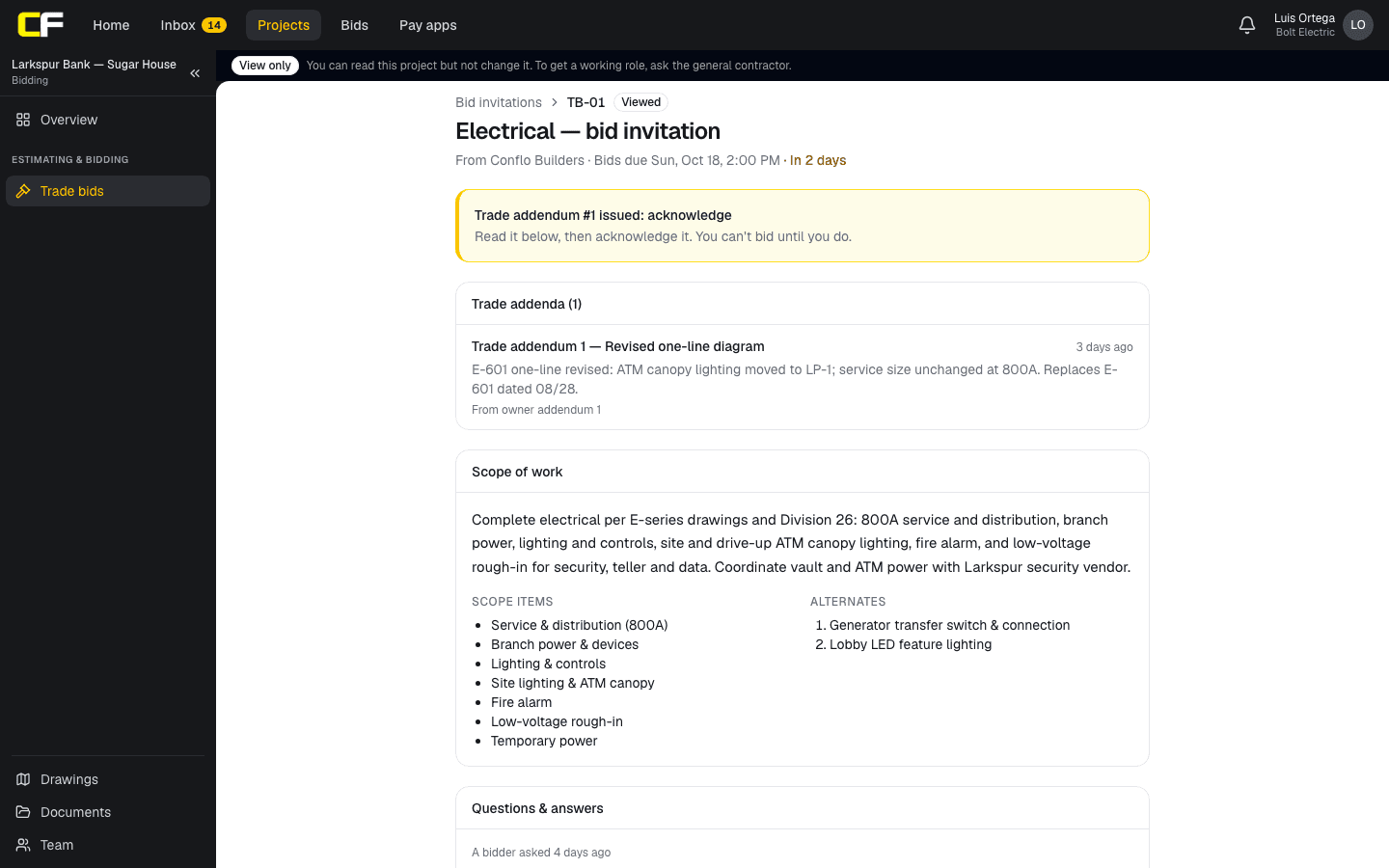
In Conflo, bidders ask questions on their invitation to a trade bid. Each question waits on the trade bid's Q&A and addenda tab, which shows how many are still to answer. You answer once, and the answer appears on every bidder's invitation page without the asker's name. A bidder sees every answered question and its own open ones, never another bidder's unanswered question. You can also post a note to all bidders with Ask all bidders, which needs no answer.
Answers and notes do not send an email of their own; bidders see them on the invitation. That fits the rule above: anything that changes the price belongs in a trade addendum, which is emailed to every bidder and must be acknowledged before a bid can be submitted.
The bottom line
Answering bidder questions well is mostly process: one written channel, a cutoff, a log, an answer to everyone without the asker's name, and an addendum whenever the answer changes the price.
Run it that way and the bids that come back price the same documents, which is the whole point of the questions period.
Sources
- FAR 52.214-6, Explanation to Prospective Bidders — Acquisition.gov, U.S. General Services Administration. Read October 22, 2026.
- FAR 14.211, Release of acquisition information — Acquisition.gov, U.S. General Services Administration. Read October 22, 2026.
- FAR 14.208, Amendment of invitation for bids — Acquisition.gov, U.S. General Services Administration. Read October 22, 2026.
Questions
What is a pre-bid RFI?
A question a bidder asks about the bid documents before bids are due. Unlike an RFI during construction, the answer goes to every bidder, and if it changes what they would price, it is issued as an addendum.
Should you tell other bidders who asked a question?
No. Restate the question neutrally and share the answer with every bidder without naming the asker or anything that identifies them.
When does an answer to a bidder question need an addendum?
When a careful bidder would price differently after reading it: a changed quantity, product, responsibility or package boundary, a resolved drawing conflict, or a new bid date. Explanations of what the documents already say can be posted as answers.
What is a reasonable deadline for bidder questions?
Early enough to answer, issue a last addendum, and leave bidders time to price it before bid day. In the example above, questions close seven days out and the last addendum goes four days out; set your own dates in the invitation.
Can you answer a bidder's question by phone?
Only to point them to the written channel. A phone answer reaches one bidder, cannot be checked later, and on federal bids an oral explanation is not binding.
Related
Bidding
How Do You Write a Bid Addendum?
How a GC writes a bid addendum to trade bidders: what goes in it, how to word each change, when to send it, and how to collect acknowledgments.
· 8 min read
Bidding
How Do You Send an Invitation to Bid to Subs?
What an invitation to bid to subs includes, how to send it, and how to run questions and addenda so every bid prices the same scope, with an example.
· 7 min read
Bidding
How Do You Level Subcontractor Bids?
Level subcontractor bids by pricing every scope gap, exclusion and missing addendum so each bid covers the same work, then compare the leveled totals.
· 9 min read
Bidding
How Do You Bid a GC's Job as a Subcontractor?
How a subcontractor bids commercial work for a GC: choosing jobs, reading the invitation, pricing, writing a bid the GC can level, and what comes after.
· 7 min read
Role hub
The General Contractor's Guide: Bid to Closeout
What a general contractor is responsible for at every phase of a commercial job, from bidding and buyout to RFIs, change orders, pay apps and closeout.
· 8 min read