
How Do You Spot a Sub Bid That Is Too Low?
By Wyatt Cooper · Published · 8 min read
Key takeaways
- A bid is suspiciously low when, after leveling, it sits well below both the other bids and your own estimate; the base bid alone cannot tell you.
- Trace the gap to a cause: missing scope, a short quantity, a unit or arithmetic slip, an unpriced addendum, or a qualification that quietly narrows the work.
- Ask the low bidder in writing to verify its price, naming the items you suspect but never the other bidders' numbers.
- A bidder who shows a real mistake should be allowed to correct or withdraw it; awarding on a number the sub cannot perform moves the loss to the middle of your job.
A sub bid is probably too low when, after leveling, it sits well below the other bids and your own estimate, and the gap traces to a cause: missing scope, a short quantity, an arithmetic or unit slip, an addendum it did not price, or a narrowing qualification. Level every bid first, compare each with the median and your estimate, then ask the low bidder in writing to verify its scope and price, calling attention to the items you suspect, before you award.
Low is a signal, not a verdict
Some low bids are simply good prices: a sub with crews coming free, a better supplier deal, a more efficient means and method. Others are mistakes, and a mistake found after award becomes a change order fight, a default, or a sub who stops showing up. The job on bid day is to tell the two apart before you commit. Do it on leveled numbers: a base bid that excludes a scope item is low for an obvious reason, and leveling has already priced it with a plug.
Public owners have a written habit worth copying. After bids are opened, federal contracting officers "shall examine all bids for mistakes", and where they have reason to believe a mistake may have been made, "shall request from the bidder a verification of the bid, calling attention to the suspected mistake", before award (FAR 14.407-1). The Federal Highway Administration's bid review guidelines list factors such as the comparison of the bids against the engineer's estimate, the number of bids submitted and the distribution or range of bids received (FHWA). Neither binds a private GC, but both describe the right sequence: compare, suspect, ask, then decide.
The checks to run on a low bid
| Check | What to look at | What it can find |
|---|---|---|
| Distance from the median | The leveled bid as a percent above or below the median of all leveled bids | A bid far from the pack, worth a closer look |
| Distance from your estimate | The leveled bid against your own estimate or budget for the trade | Whether the whole field is low, or one bidder |
| Breakouts | Each scope item's price against the same item from other bidders | The one item where the gap actually sits |
| Quantities and units | Its stated quantities against your takeoff; square feet versus linear feet, each versus pair | A floor or a run left out, or a unit misread |
| Arithmetic | Whether its breakouts add up to its base bid | A transposed or dropped figure |
| Addenda | Which addenda the bid acknowledges | Work added after it priced |
| Qualifications | Every line of its qualifications and assumptions | "Per manufacturer's standard", "one mobilization", "by others": scope quietly narrowed |
A single percent cutoff is a prompt, not a rule. A bid 10 percent under the median on a trade where bids usually cluster tightly may deserve more attention than one 20 percent under on a trade where they always scatter. Read the breakouts before you read anything into the percentage.
A worked example: five plumbing bids on a fictional clinic
Five bidders priced the plumbing package on a fictional two-level clinic. The GC's estimate for the trade is $640,000. After leveling for excluded scope, the totals are below.
| Bidder | Leveled total | Versus median | Versus estimate | Sanitary and storm piping breakout |
|---|---|---|---|---|
| Pinecrest Plumbing | $497,000 | −23% | −$143,000 | $96,000 |
| Keystone Mechanical | $612,000 | −6% | −$28,000 | $184,000 |
| Larch Plumbing | $648,500 | Median | +$8,500 | $190,500 |
| Orchard Pipe | $661,000 | +2% | +$21,000 | $197,000 |
| Sandbar Plumbing | $689,000 | +6% | +$49,000 | $204,000 |
With five bids the median is the third: $648,500. Pinecrest is $151,500 under it ($151,500 ÷ $648,500 = 23 percent) and $115,000 under the next bidder. The other four sit within 6 percent of the median, so the field is not low; one bidder is. The breakouts point at sanitary and storm piping: $96,000 against $184,000 to $204,000 from everyone else. Pinecrest's quantity sheet lists 1,150 linear feet of underground piping; the drawings show about 2,300, both levels. It priced one level.
Its bid also acknowledges Addendum 1 but not Addendum 2, which added two grease interceptors. The four bidders who priced Addendum 2 carried $14,500 to $16,000 for them. Corrected on the GC's figures, Pinecrest would be $497,000 + $96,000 (the second level at the same price) + $15,500 (the addendum) = $608,500: still the lowest, by $3,500 under Keystone's $612,000. That is why the next step is to ask, not to throw the bid out.
Request to verify bid: BP-15 Plumbing, Alder Court Clinic
- To
- Estimator, Pinecrest Plumbing
- From
- Senior estimator, Fairbank Builders (general contractor)
- Your bid
- Base bid of $497,000 submitted for BP-15 Plumbing
- Please verify
- 1. Underground sanitary and storm piping: your quantity sheet shows 1,150 linear feet; please confirm your price covers both levels on sheets P-101 and P-102. 2. Addendum 2 (two grease interceptors) is not acknowledged; please confirm whether your price includes it.
- Please reply
- In writing by Wednesday at noon: confirm your bid as submitted, or state the error and the price you intended, with your takeoff or worksheets.
- Note
- This is a request to verify, not an award or a rejection. Other bidders' prices are not shared.
What to do with the answer
- The bidder confirms its price as submitted. Get the confirmation in writing, including the scope you questioned, then weigh the risk: its backlog, its bonding, how it has performed for you. A confirmed low price on fully covered scope is a good price.
- The bidder shows a mistake and the price it intended. Federal rules allow correction when "clear and convincing evidence establishes both the existence of the mistake and the bid actually intended" (FAR 14.407-3). The same test is a fair one privately: a corrected bid backed by worksheets, compared with the others on the same basis.
- The bidder shows a mistake but cannot show what it intended, or asks to withdraw. Let it withdraw. The federal rule allows withdrawal on evidence that is clear as to the mistake even when it is not clear as to the intended bid. A sub forced to perform at a price it knows is wrong is the risk you were trying to avoid.
- The bidder does not answer. Treat its number as unverified, and do not carry it into your estimate or award on it.
Two things not to do. Do not tell the low bidder what the others bid or by how much it is low: that is bid shopping, and it damages your coverage on every future job. And do not plug a low bidder's mistake silently and award at its original number, expecting to argue scope later. Write down what was asked, what came back and why you awarded as you did.
How it works in Conflo
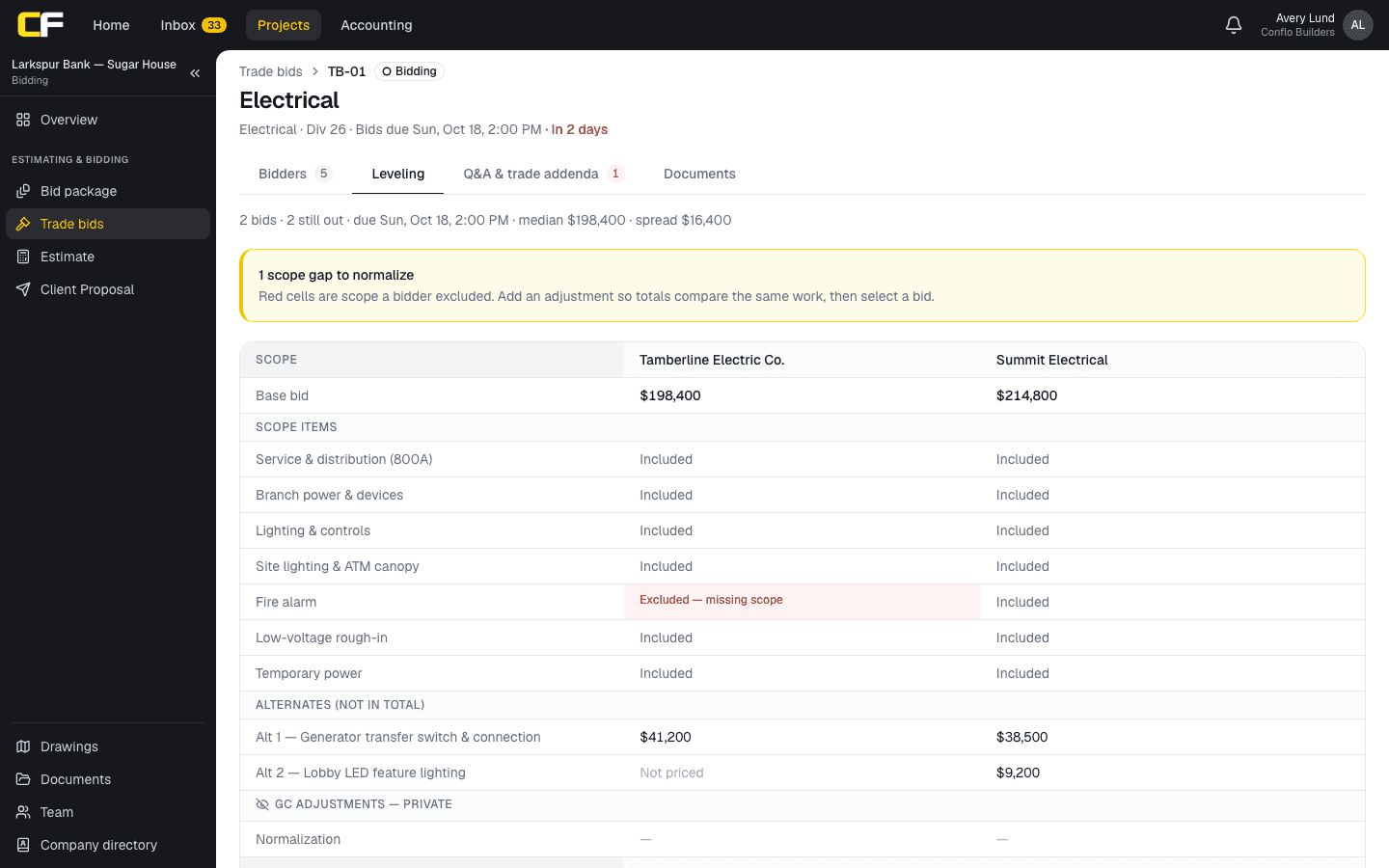
In Conflo, bid leveling is a tab of each trade bid, seen only by the general contractor's team. Each submitted bid is a column and each scope item a row, showing the bidder's breakout amount where it gave one; a scope item a bidder excluded is marked as missing scope until you price it with a private adjustment. Each bid's leveled total is its base bid plus your adjustments, and bids sort from low to high.
Under each leveled total the grid shows how far it sits from the median, as a percent above or below, and the header shows the median and the spread across all bids, so a bid 23 percent under the rest is plain at a glance. Exclusions and qualifications sit on their own rows beside each bid, and a bid missing a trade addendum is flagged on the Bidders tab; selecting it in leveling brings up a warning to confirm past. When a bidder revises its bid, the column shows the revision number.
The bottom line
Spotting a bid that is too low is leveling plus curiosity: compare the leveled totals with the median and your estimate, find the item where the gap sits, check quantities and addenda, and ask the bidder to verify in writing.
The answer decides the award. A confirmed price is a good price; a real mistake is corrected or withdrawn before you commit, not discovered by your superintendent in the third month.
Sources
- FAR 14.407-1, General (Mistakes in bids) — Acquisition.gov, U.S. General Services Administration. Read October 22, 2026.
- FAR 14.407-3, Other mistakes disclosed before award — Acquisition.gov, U.S. General Services Administration. Read October 22, 2026.
- Guidelines on Preparing Engineer's Estimate, Bid Reviews and Evaluation (October 7, 2021), Bid Review Factors — Federal Highway Administration. Read October 22, 2026.
Questions
How do you know if a subcontractor bid is too low?
Level all the bids first, then compare each leveled total with the median of the bids and with your own estimate. A bid well below both, where the gap traces to one item, a short quantity, an arithmetic slip or an unpriced addendum, is likely a mistake rather than a good price.
Should you accept a bid that seems too low?
Not before the bidder verifies it. Ask in writing, naming the items you suspect. If it confirms the price on the full scope, it can be a good award; if it shows a mistake, let it correct or withdraw before you commit.
Can you tell a sub its bid is too low?
You can ask it to verify specific items, such as a quantity or an unacknowledged addendum. Do not tell it what other bidders bid or by how much it is low; that is bid shopping.
What percent below other bids is too low?
There is no standard figure. How tightly bids cluster varies by trade and market, so use the distance from the median as a prompt to read the breakouts, not as a rule.
Related
Bidding
How Do You Level Subcontractor Bids?
Level subcontractor bids by pricing every scope gap, exclusion and missing addendum so each bid covers the same work, then compare the leveled totals.
· 9 min read
Template
Free Bid Leveling Spreadsheet (Excel Template)
A free bid leveling spreadsheet for Excel: five bidders, fifteen scope rows, plugs and deducts, leveled totals, median and alternates. No email needed.
· 4 min read
Preconstruction
How Do You Buy Out a Construction Job?
Construction buyout step by step: scope review, leveling, award, the subcontract and its exhibits, compliance documents, and savings against budget.
· 7 min read
Bidding
How to Write a Scope of Work for a Subcontractor
Write a subcontractor scope of work from the drawings and specs: a summary, numbered inclusions, named exclusions, alternates and the documents behind it.
· 7 min read
Role hub
The General Contractor's Guide: Bid to Closeout
What a general contractor is responsible for at every phase of a commercial job, from bidding and buyout to RFIs, change orders, pay apps and closeout.
· 8 min read