
How Do You Build an Estimate From Sub Bids?
By Wyatt Cooper · Published · 7 min read
Key takeaways
- A general contractor's estimate is mostly subcontractor bids: price each trade yourself first as a plug, then replace the plug with the leveled bid you will carry.
- Carry the leveled number, not the base bid, and replace only the plug: your own self-performed lines in the same division still count.
- Add general conditions and then markups in a stated order; in the worked example below, $482,050 of cost becomes a $521,337.08 bid after 3% contingency and a 5% fee.
- Track the variance between each carried bid and your plug; a division with no bids still carries your plug, and that is where the bid's risk sits.
To build an estimate from sub bids, price every trade yourself first as a plug, so you have a number before bids arrive. When bids come in, level them, then replace each division's plug with the leveled bid you will carry: the awarded or chosen bid, otherwise the lowest leveled one. Keep your own self-performed lines, add general conditions, apply contingency and fee in a stated order, and freeze that version as the bid.
Sub bids are most of a GC's estimate
On a commercial job the general contractor buys most of the work from subcontractors, so most of its estimate is their prices. The estimator's job on bid day is assembly: deciding which number carries for each trade, adding the work the GC performs itself and the cost of running the job, and applying markups.
Do not wait for the bids to start. Price each trade first from your own takeoff and history, as public owners do with their own estimates: federal agencies prepare an independent estimate "in as much detail as though the Government were competing for award" (FAR 36.203), and the Federal Highway Administration calls the engineer's estimate "the benchmark for analyzing bids" (FHWA). Your plug is that benchmark: it tells you whether a bid is high, low or missing scope.
Steps from plugs to a bid
- Plug every division. Write your own number for each trade package from quantities and unit costs or recent bids on similar work. Keep it as its own line, marked as a plug.
- Price your own work separately: self-performed labor, material and equipment, and allowances. These lines always count.
- Level each package's bids against one scope, so each bidder's number covers the same work. See how to level subcontractor bids.
- Choose what carries: the awarded bid if there is one; otherwise the bidder you intend to use; otherwise the lowest leveled bid. With no bids in, the plug carries.
- Replace the plug, not the division. The carried bid takes the plug's place; your own lines in that division stay.
- Add general conditions: supervision, temporary facilities, site services, equipment, insurance and permits that are not in any sub's scope. See what general conditions are.
- Apply markups in a stated order: contingency on cost, then fee on cost plus contingency, plus any bond, insurance or tax your contract requires.
- Save the version you submit and do not change it. If a bid moves after you submit, that is a new version.
Which number carries for each trade
- 1EstimatorCarries the awarded bid, if the package is awarded
- 2EstimatorOtherwise carries the bidder it intends to use, at the leveled total
- 3EstimatorOtherwise carries the lowest leveled bid
- 4EstimatorWith no bids in, keeps the plug and flags the trade as unbid
A worked example: a fictional dental clinic fit-out
The job is fictional: "Bramble Creek Dental", a 6,000-square-foot clinic fit-out. The GC self-performs rough carpentry and buys four trades. Bids are in on three; HVAC bids are not.
| Division | GC's plug | Carried | Why it carries | Bid minus plug |
|---|---|---|---|---|
| 06 Wood (GC self-performs) | None | $18,500 (own lines) | GC's own labor and material | Not applicable |
| 09 Drywall package | $138,000 | $131,400 | Lowest leveled of three bids | −$6,600 |
| 22 Plumbing package | $64,000 | $66,900 | Chosen bidder (the low bidder could not meet the start date) | +$2,900 |
| 23 HVAC package | $92,000 | $92,000 (plug) | No bids in yet | Not applicable |
| 26 Electrical package | $118,000 | $121,250 | Lowest leveled of two bids | +$3,250 |
| Direct cost | $430,050 | −$450 on the three divisions with bids |
| Line | How it is figured | Amount |
|---|---|---|
| Direct cost | $18,500 + $131,400 + $66,900 + $92,000 + $121,250 | $430,050.00 |
| General conditions | Superintendent 10 weeks × $4,000; trailer and toilets 3 months × $1,500; dumpsters 8 × $600; final cleaning $2,700 | $52,000.00 |
| Subtotal | $430,050 + $52,000 | $482,050.00 |
| Contingency 3% | 3% × $482,050.00 | $14,461.50 |
| Subtotal with contingency | $482,050.00 + $14,461.50 | $496,511.50 |
| Fee 5% | 5% × $496,511.50 = $24,825.575, rounded to the cent | $24,825.58 |
| Bid | $496,511.50 + $24,825.58 | $521,337.08 |
| Cost per square foot | $521,337.08 ÷ 6,000 | $86.89 |
General conditions add up as $40,000 + $4,500 + $4,800 + $2,700 = $52,000. Across the three divisions with bids, the bids came in $450 under the plugs (−$6,600 + $2,900 + $3,250). The HVAC plug is the open risk: it is $92,000 of the bid with no sub's price behind it yet, so it is the first thing to chase before the bid goes out.
Mistakes that move the number
- Carrying a base bid instead of the leveled bid, so excluded scope is missing from your estimate.
- Replacing the whole division with the bid, and losing your own self-performed lines in it.
- Keeping the plug and adding the bid, and counting the trade twice.
- Putting general conditions items a sub already carries (temporary power, cleanup) in both places.
- Applying fee before contingency without meaning to, or changing the order between versions.
- Changing a submitted number in place, so nobody can say later what the bid was.
When the job is won, the same carried numbers become the budget each award is measured against, and later the schedule of values each sub bills from.
How it works in Conflo
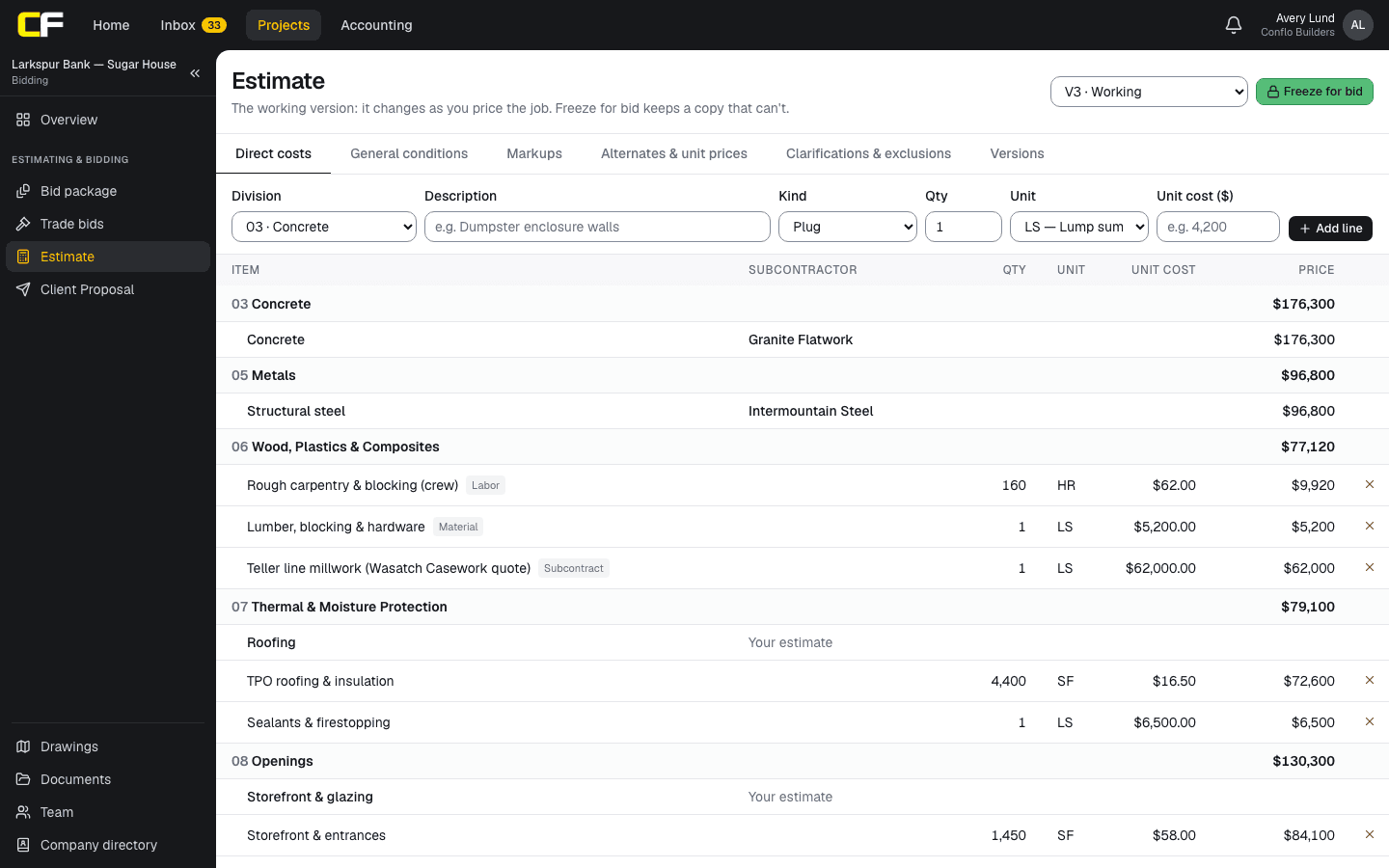
Conflo's Estimate is organized by CSI division. Each line is a plug, labor, material, equipment, subcontract or allowance line with a quantity, unit and unit cost. When a trade bid for a division has a price, it replaces that division's plug lines only: the awarded bid first, then the bid you selected in leveling, then the lowest leveled bid. You can also choose a specific bidder for the estimate or keep your plug. Each division shows the carried bid against your plug.
General conditions have their own tab, as quantity × rate rows grouped by category, and markups such as contingency, insurance, bond, fee and tax are applied in the order you set. Freeze for bid keeps a copy of the version that cannot change, and the Client Proposal reads its numbers from that frozen version. The estimate is visible only to the general contractor.
The bottom line
An estimate built from sub bids is only as good as the plugs under it and the leveling before it. Plug every trade first, carry leveled numbers, replace only the plug, and apply markups the same way every time.
Then freeze what you submit. When the owner asks what the bid was, or a sub's number moves the next morning, you will have the answer.
Sources
- FAR 36.203, Government estimate of construction costs — Acquisition.gov, U.S. General Services Administration. Read October 16, 2026.
- Guidelines on Preparing Engineer's Estimate, Bid Reviews and Evaluation (October 7, 2021), Preparing Engineer's Estimate — Federal Highway Administration. Read October 17, 2026.
Questions
What is a plug in a construction estimate?
Your own number for a trade, from your takeoff or history, carried until subcontractor bids replace it. It is your benchmark for judging the bids, and the number that stays in the estimate when no bid comes in. See what a plug number is.
Which sub bid should go in the estimate?
The leveled bid of the sub you expect to use: the awarded bid if there is one, otherwise your chosen bidder, otherwise the lowest leveled bid. Carry the leveled total, so scope the bidder excluded is still priced.
Is fee calculated before or after contingency?
It depends on your contract and your company's practice, so state the order and keep it. A common order applies contingency to cost and then fee to cost plus contingency, as in the example above. The owner contract may define what fee is charged on.
What do you do if no bids come in for a trade?
Carry your plug, flag it as unbid, and chase more bidders before the due date. If it is still unbid, decide whether to raise the plug for risk or qualify the bid, and say which in your proposal.
Related
Bidding
How Do You Level Subcontractor Bids?
Level subcontractor bids by pricing every scope gap, exclusion and missing addendum so each bid covers the same work, then compare the leveled totals.
· 9 min read
Definition
What Are General Conditions in a Construction Bid?
General conditions in a bid are the contractor's cost of running the job: supervision, temporary facilities, site services. Not the A201 contract document.
· 4 min read
Definition
What Is a Plug Number in a Bid?
A plug number is an estimator's own figure for work with no firm price yet: a placeholder in the estimate, or an add to a bid that excluded scope.
· 4 min read
Bidding
How Do You Break a Job Into Bid Packages?
Split a job into bid packages by trade: start from the CSI divisions, group what one kind of sub performs, and give every boundary item one home.
· 7 min read
Role hub
The General Contractor's Guide: Bid to Closeout
What a general contractor is responsible for at every phase of a commercial job, from bidding and buyout to RFIs, change orders, pay apps and closeout.
· 8 min read