
How Much Overhead and Profit Should a GC Carry?
By Wyatt Cooper · Published · 6 min read
Key takeaways
- There is no right percentage to copy: a GC's overhead and profit comes from its own home-office budget, its expected volume and the profit it wants.
- Overhead rate is next year's home-office overhead divided by next year's revenue; add the profit you want, also as a share of revenue, to get the margin a bid must keep.
- Turn that margin into a markup on cost with margin ÷ (1 − margin): an 8.5% margin needs a 9.29% markup.
- Volume moves the rate: in the worked example, the same $1,320,000 of overhead is 5.5% of $24 million of work but 6.6% of $20 million.
A GC should carry the overhead and profit its own numbers require. Divide next year's home-office overhead by next year's expected revenue to get the overhead rate, add the profit you want as a share of revenue, and that is the margin each bid must keep. Convert it to a markup on cost with margin ÷ (1 − margin). Then adjust job by job for risk, size and how much you want the work.
What overhead and profit covers, and what it does not
Overhead and profit (OH&P, or fee) is what the GC adds on top of the job's cost. GSA's estimating policy separates the parts: field requirements (the job's own site costs), then "The portion of the contractor’s home office costs and corporate overhead allocated to the construction contract", then "Any fee or profit mark-up applied by the prime contractor as compensation for undertaking the work" (GSA P-120).
The job's own site costs belong in general conditions, priced from the schedule; see how to price general conditions. What is left for overhead is the cost of running the company: the office, estimators and executives not assigned to one job, accounting, IT, company insurance and the cost of chasing work you do not win.
| Cost | Where it goes | Why |
|---|---|---|
| Superintendent and project manager on this job | General conditions | Charged to this job, for its duration |
| Site trailer, temporary utilities, dumpsters | General conditions | This job's site |
| Office rent, accounting, estimating, executives | Overhead | Shared by every job the company runs |
| Company vehicles and IT not assigned to a job | Overhead | Shared |
| Return to the owners of the business | Profit | The reason to take the risk |
| Contingency for this job's risks | A separate markup | Specific to this job; spent or returned under the contract's terms |
Steps to work out your number
- Budget next year's home-office overhead from your books: everything not charged to a job.
- Forecast next year's revenue from backlog and the work you expect to win, honestly.
- Overhead rate = overhead ÷ revenue.
- Choose the profit you want as a share of revenue.
- Target margin = overhead rate + profit. This is the share of each bid's price you must keep.
- Markup on cost = margin ÷ (1 − margin). Apply it to the job's cost: direct cost, general conditions and contingency.
- Adjust per job: up for risk, a tight schedule or a difficult owner; down for a large job, a repeat client or work you need to keep crews busy.
- Track it: compare the overhead you really spent and the volume you really billed each quarter, and reset the rate when either moves.
The federal cost principles say the same about any allocation rate: the method "may require revision when there is a significant change in … the volume of sales and production" (FAR 31.203(e)). A rate built on volume you are not going to bill underprices every job.
A worked example: a fictional regional GC
The company is fictional: a regional GC expecting $24,000,000 of revenue next year, with $1,320,000 of home-office overhead, and a target of 3% profit. It is bidding a job whose cost (direct cost, general conditions and contingency) is $5,000,000.
OH&P worksheet: next year
- Home-office overhead
- $1,320,000
- Expected revenue
- $24,000,000
- Overhead rate
- $1,320,000 ÷ $24,000,000 = 5.5%
- Target profit
- 3.0%
- Target margin
- 5.5% + 3.0% = 8.5% of price
- Markup on cost
- 0.085 ÷ 0.915 = 0.0929, a 9.29% markup
- Job cost
- $5,000,000
- Fee
- 9.29% × $5,000,000 = $464,500
- Price
- $5,000,000 + $464,500 = $5,464,500
- Check
- $464,500 ÷ $5,464,500 = 8.50% of price
If revenue comes in at $20,000,000 instead, the same overhead is $1,320,000 ÷ $20,000,000 = 6.6% of revenue. Keeping 3% profit then needs a 9.6% margin, which is a 0.096 ÷ 0.904 = 10.62% markup, or $531,000 on the same $5,000,000 job. Bid at 9.29% in a slow year and the company quietly earns 1.9% instead of 3% (8.5% kept − 6.6% overhead, before any job loses money).
Why divide by price and not cost: overhead and profit are measured against revenue, so the target is a margin, and the markup that delivers it is always larger. The conversion table and more examples are in markup vs margin.
Mistakes that erase profit
- Applying the target margin as a markup: 8.5% on cost keeps only 7.83% of price (0.085 ÷ 1.085).
- Copying a percentage from another company whose overhead and volume are not yours.
- Putting job-site staff in overhead and also in general conditions.
- Building the rate on a revenue forecast that includes work you have not won.
- Cutting fee to win a job without saying which cost you expect to beat.
On a cost-plus or GMP contract, the owner contract defines the fee and what it is charged on; see what a GMP contract is. The whole bid, from sub bids to markups, is in how to build an estimate from sub bids, and the rest of the GC's path in the general contractor's guide.
How it works in Conflo
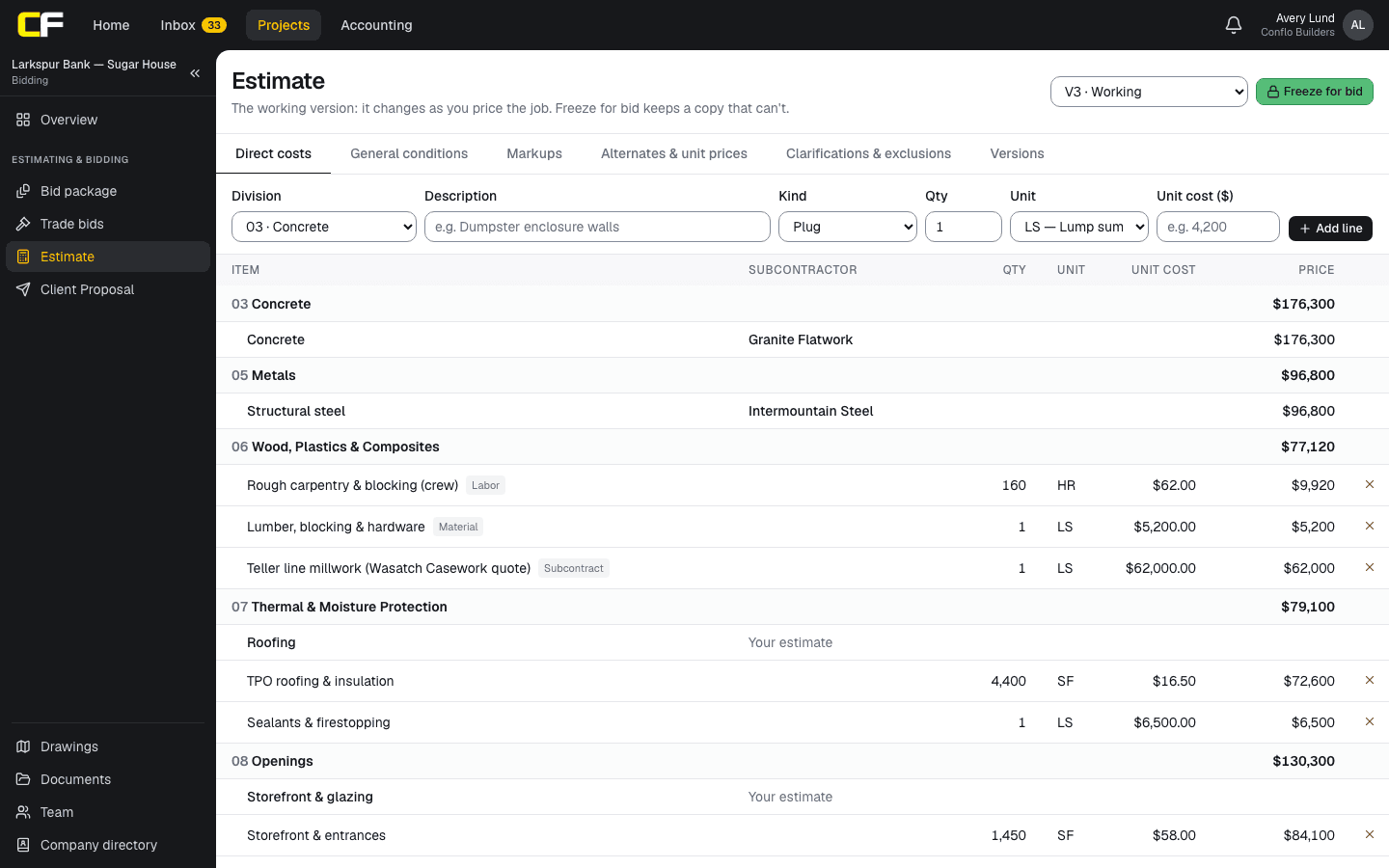
In Conflo's Estimate, markups are a stack applied in the order you set: contingency, insurance, bond, fee, tax, escalation or other. Each is charged on everything above it, on direct cost plus general conditions only, on the material lines only (for sales tax), as a fixed amount, or on the final price including itself (for insurance and bonds).
The fee line shows the fee in dollars and as a percent of the price, against a margin target you set on the fee, and says so when the fee is below target. The estimate is visible only to the general contractor.
The bottom line
Your overhead and profit is a number you calculate, not one you look up: next year's overhead over next year's volume, plus the profit you want, turned into a markup that keeps that margin.
Recheck it every quarter. When volume drops, the same overhead needs a higher markup, and a bid priced on last year's rate quietly gives profit away.
Sources
- P-120, Public Buildings Service Cost and Schedule Management Policy Requirements (PBS 1000.6B, November 7, 2022), General Conditions and Profit — U.S. General Services Administration (via WBDG). Read October 22, 2026.
- FAR 31.203, Indirect costs — Acquisition.gov, U.S. General Services Administration. Read October 22, 2026.
Questions
What is a typical overhead and profit percentage for a GC?
There is no single right one. Work it out from your own overhead budget, expected volume and target profit, then check it against what you have won and lost at.
Is overhead and profit charged on general conditions?
Usually, yes: the fee is applied to the job's cost, and general conditions are part of that cost. On a cost-plus or GMP contract, the owner contract says what the fee is charged on.
Should overhead be a markup or a margin?
Set the target as a margin, because overhead and profit are measured against revenue. Apply it as the markup that delivers that margin: margin ÷ (1 − margin).
Should I cut my fee to win a job?
Only knowingly. A lower fee still has to cover overhead; if it does not, say which cost on the job you expect to beat, or what the work is worth to you otherwise.
Related
Bidding
Markup vs Margin: How Should a Contractor Price Work?
Markup is a percentage of cost; margin is a percentage of price. A 20% markup is a 16.7% margin. Conversion table and a worked remodel example.
· 5 min read
Bidding
How Do You Price General Conditions?
Price general conditions from the schedule: staff by the weeks on site, facilities by the month, fixed items as lump sums, and a weekly delay rate.
· 7 min read
Bidding
How Do You Build an Estimate From Sub Bids?
Build a GC estimate from sub bids: plug each division, carry the leveled bid in place of the plug, add your own work and general conditions, then markups.
· 7 min read
Bidding
How Do You Price a Bid Alternate?
Price add and deduct bid alternates: each trade's alternate price, your own work, the base bid's markups, and what each one includes.
· 6 min read
Role hub
The General Contractor's Guide: Bid to Closeout
What a general contractor is responsible for at every phase of a commercial job, from bidding and buyout to RFIs, change orders, pay apps and closeout.
· 8 min read