
How Do You Price a Bid Alternate?
By Wyatt Cooper · Published · 6 min read
Key takeaways
- A bid alternate is a priced change to the base bid that the owner may accept or not: an add alternate raises the price, a deduct alternate lowers it.
- Price each alternate on its own scope: every affected trade's alternate price plus your own work and any change in general conditions, then the same markups as the base bid.
- A deduct alternate gives back the markup it carried too, or the owner pays fee on work that was removed.
- Public owners often pick the low bidder on the base bid plus the alternates they can afford, so an alternate priced carelessly can lose you the job.
To price a bid alternate, read its description in the bid documents, ask every affected trade for an alternate price, and add your own work and any change in general conditions. Apply the same markups you apply to the base bid, in the same order. A deduct alternate takes off the cost and the markup on it. Show each alternate separately on the bid form, as an add or a deduct, and say what it includes.
What alternates are for
Owners use alternates to keep options open until bids show what the money buys: a better roof, an extra classroom, a canopy that may have to go. Each is priced separately from the base bid, and the owner chooses which to take at award, or sometimes later, within a time the bid documents set.
On public work the alternates can decide who wins. A Department of Veterans Affairs provision makes the low bidder the one offering "the lowest aggregate amount for the first or base line item, plus or minus (in the order stated in the list of priorities in the bid schedule) those additive or deductive line items that provide the most features within the funds determined available" (VAAR 852.236-92). The Department of the Interior's version says award "may be made to the bidder having the lowest total of the base bid and a combination of additive and deductive items" (DIAR 1452.236-71).
How an owner's alternates can change the low bidder
The worked example in VAAR 852.236-92, the same numbers as the bid alternate definition, has $100,000 available: Offeror A bids $85,000 with a $10,000 first additive, Offeror B $80,000 with $16,000. The provision finds A low at $99,000: the base bid plus the first and fourth additives. "The second and third additives were skipped because each of them would cause the aggregate bid to exceed $100,000." Offeror B had the lower base bid by $5,000 and still lost, because its first additive was $6,000 higher. Alternates are priced to win, not filled in last.
Steps to price one
- Read each alternate's description and the drawings and specs it points to; write down what is in and out.
- List every trade it touches. A deleted canopy changes steel, concrete, electrical and roofing flashing, not one trade.
- Put the alternates in your invitation to bid so each sub prices them on the same basis, and level them like base bids.
- Add your own work: self-performed scope, protection, and any extra weeks of supervision the alternate adds.
- Apply the base bid's markups in the same order: contingency, fee, insurance and bond as your bid carries them.
- For a deduct, take off the cost and the markups on it, and check that the base bid really includes the work you are deducting.
- Enter each one on the bid form as an add or a deduct, with any qualification, such as a date the price holds until.
A worked example: three alternates on a fictional library
The job is fictional: a library renovation. The GC's base bid carries 3% contingency on cost and then a 5% fee on cost plus contingency, so each alternate gets the same two markups in the same order (a factor of 1.03 × 1.05 = 1.0815).
| Alternate | Cost | Contingency 3% | Fee 5% | Price on the bid form |
|---|---|---|---|---|
| 1 (add): replace the east wing roof | $92,000.00 (roofing sub $86,400 + protection and supervision $5,600) | $2,760.00 | $4,738.00 (5% × $94,760) | Add $99,498.00 |
| 2 (deduct): delete the north entry canopy | −$30,000.00 (steel −$21,500, concrete −$6,200, electrical −$2,300) | −$900.00 | −$1,545.00 (5% × −$30,900) | Deduct $32,445.00 |
| 3 (add): upgrade the lighting controls | $41,800.00 (electrical sub) | $1,254.00 | $2,152.70 (5% × $43,054) | Add $45,206.70 |
Each price checks against the factor: $92,000 × 1.0815 = $99,498.00, $30,000 × 1.0815 = $32,445.00 and $41,800 × 1.0815 = $45,206.70. Had the canopy deduct been entered at its $30,000 cost, the owner would still pay $2,445 of contingency and fee on work that is gone. Alternate 1 also adds a week of supervision, so its $5,600 includes general conditions; alternate 3 adds none, and the bid form says so.
Bid form: alternates
- Alternate 1, replace the east wing roof
- Add $99,498.00, includes temporary protection and one added week of supervision
- Alternate 2, delete the north entry canopy
- Deduct $32,445.00, includes foundations, steel and lighting at the canopy
- Alternate 3, upgrade the lighting controls
- Add $45,206.70, no change to the schedule
- Prices held until
- 90 days after the bid date
Mistakes that cost money either way
- Pricing an alternate from one trade's number and missing the other trades it touches.
- Leaving markups off a deduct, so you refund less than the work carried.
- Leaving markups off an add, so you do the work at cost.
- Missing the schedule effect: an added scope that extends the job also extends general conditions.
- Deducting work your base bid never included.
- Letting an alternate price stand forever: say how long it holds.
The base bid the alternates sit on is assembled in how to build an estimate from sub bids, and the markups in how much overhead and profit a GC should carry. More for GCs is in the general contractor's guide.
How it works in Conflo
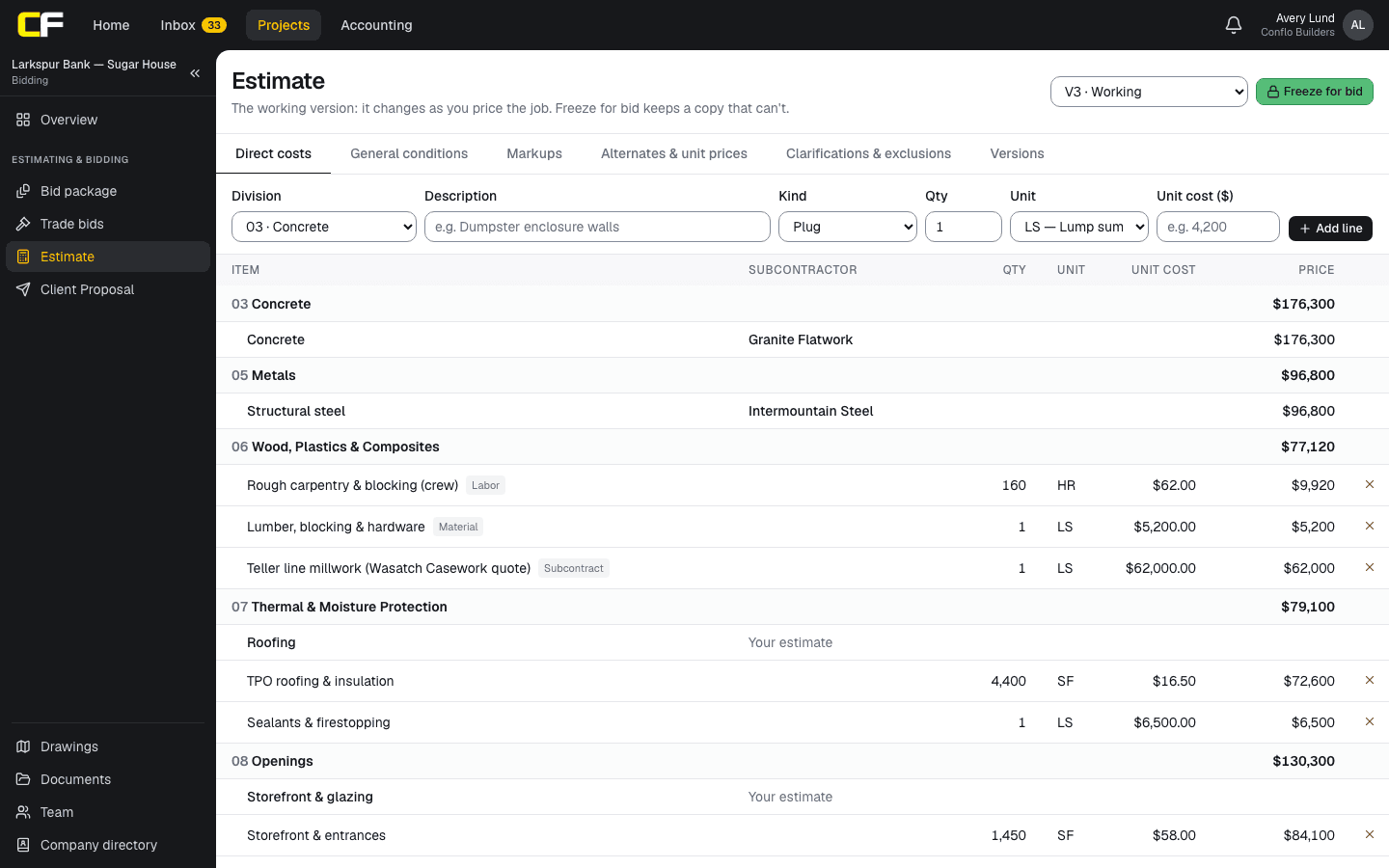
In Conflo's Estimate, alternates have their own tab. Each one is numbered, marked Add or Deduct, and priced with its own lines, like the base estimate, with a With markups setting. With markups on, an alternate is priced as the price of the job with it minus the price without it, so the base bid plus the alternate is exactly the price of the job with the alternate taken. Unit prices sit beside them.
The Client Proposal can offer the alternates and unit prices of a version frozen for bid, and the client's answer can accept only the alternates that proposal offered.
The bottom line
Price an alternate as carefully as the base bid: every trade it touches, your own work and time, and the same markups in the same order, given back in full on a deduct.
On public work the owner may add your alternates to your base bid to find the low bidder. The alternate you priced in the last ten minutes can be the one that decides it.
Sources
- VAAR 852.236-92, Notice to Bidders—Additive or Deductive Bid Line Items (APR 2019) — Acquisition.gov, U.S. General Services Administration. Read October 22, 2026.
- DIAR 1452.236-71, Additive or Deductive Items (JUL 1996) — Acquisition.gov, U.S. General Services Administration. Read October 22, 2026.
Questions
What is the difference between an add alternate and a deduct alternate?
An add alternate is work added to the base bid if the owner accepts it; its price raises the contract. A deduct alternate is work removed from the base bid; its price lowers the contract.
Do you put markup on a bid alternate?
Yes, the same markups as the base bid, unless the bid documents say otherwise. On a deduct, take the markup off too, since the work it was charged on is gone.
Can the owner accept an alternate after award?
Only if the bid documents or contract allow it, usually within a stated number of days. State how long your alternate prices hold.
Do alternates affect who is the low bidder?
They can. Many public owners compare the base bid plus the alternates they can afford, in a stated order of priority, so a bidder with a lower base bid can still lose.
Related
Bidding
How Do You Build an Estimate From Sub Bids?
Build a GC estimate from sub bids: plug each division, carry the leveled bid in place of the plug, add your own work and general conditions, then markups.
· 7 min read
Bidding
How Much Overhead and Profit Should a GC Carry?
Work out a GC's overhead and profit from its own books: home-office overhead over annual volume, plus target profit, turned into the markup a bid needs.
· 6 min read
Bidding
How Do You Send an Invitation to Bid to Subs?
What an invitation to bid to subs includes, how to send it, and how to run questions and addenda so every bid prices the same scope, with an example.
· 7 min read
Bidding
How Do You Level Subcontractor Bids?
Level subcontractor bids by pricing every scope gap, exclusion and missing addendum so each bid covers the same work, then compare the leveled totals.
· 9 min read
Role hub
The General Contractor's Guide: Bid to Closeout
What a general contractor is responsible for at every phase of a commercial job, from bidding and buyout to RFIs, change orders, pay apps and closeout.
· 8 min read